Ibrutinib
JFDA label: Imbruvica 140mg
Mechanism of Action
Inhibitor of Tyrosine-protein kinase BTK — Tyrosine-protein kinase BTK inhibitor
| Target | Action | Gene / class |
|---|---|---|
| Tyrosine-protein kinase BTK efficacy | INHIBITOR | BTK |
Indications
Approved
- Chronic graft-versus-host disease (refractory)
- Chronic lymphocytic leukemia/small lymphocytic lymphoma
- Mantle cell lymphoma, previously treated
- Marginal zone lymphoma, relapsed/refractory
- Waldenström macroglobulinemia
Class profile
| mechanismClass | BTK kinase inhibitor (TKI) |
|---|---|
| targetMolecule | BTK (Bruton tyrosine kinase) |
| targetPathway | B-cell receptor signaling (BCR) |
| generation | 1st generation BTK inhibitor (irreversible) |
| primaryTumors | CLL,MCL,WM,Marginal zone lymphoma,GVHD |
| resistanceMechanisms | BTK C481S mutation (covalent site; 75-80% of ibrutinib resistance),PLCG2 activating mutations,Downstream MAPK/PI3K bypass |
| source | NCCN/OncoKB/Goodman&Gilman13ed |
Contraindications
Source: Lexicomp
- Known hypersensitivity to ibrutinib or any component of the formulation Absolute
- There are no contraindications listed in the manufacturer's US labeling Absolute
Adverse Reactions
Cardiac disorders (4)
Very Common hypertension · Peripheral edema
Common Atrial fibrillation · atrial flutter
Nervous system disorders (5)
Very Common anxiety · chills · dizziness · Fatigue · headache
Renal and urinary disorders (2)
Very Common Urinary tract infection
Common Increased serum creatinine
Blood and lymphatic system disorders (7)
Very Common bruise · decreased hemoglobin · hemorrhage · malignant neoplasm · neutropenia · petechia · Thrombocytopenia
Metabolism and nutrition disorders (4)
Very Common dehydration · Hyperuricemia · hypoalbuminemia · hypokalemia
Gastrointestinal disorders (10)
Very Common abdominal pain · constipation · decreased appetite · Diarrhea · dyspepsia · gastroesophageal reflux disease · nausea · stomatitis · upper abdominal pain · vomiting
Skin and subcutaneous tissue disorders (3)
Very Common pruritus · skin infection · Skin rash
Musculoskeletal and connective tissue disorders (5)
Very Common arthralgia · arthropathy · muscle spasm · Musculoskeletal pain · weakness
Eye disorders (4)
Very Common blurred vision · decreased visual acuity · Dry eye syndrome · increased lacrimation
Infections and infestations (2)
Very Common Infection
Common Sepsis
General disorders and administration site conditions (2)
Very Common falling · Fever
Respiratory, thoracic and mediastinal disorders (8)
Very Common bronchitis · cough · dyspnea · epistaxis · oropharyngeal pain · pneumonia · sinusitis · Upper respiratory tract infection
Dosing
Source: Lexicomp
Warnings & Precautions
Source: Lexicomp
Cardiovascular effects
Serious (and some fatal) cardiac arrhythmias have occurred with therapy, including grade 3 or greater atrial fibrillation and flutter and grade 3 or greater ventricular tachyarrhythmias. Cardiac events have occurred particularly in patients with cardiac risk factors, hypertension, infections (acute), or with a history of arrhythmias. Monitor periodically for clinical symptoms of cardiac arrhythmias (eg, palpitations, light-headedness, syncope, chest pain); an ECG should be performed if symptoms or new-onset dyspnea develop. Manage arrhythmias appropriately; for persistent events, evaluate the risk-benefit of ibrutinib treatment and dose modification.
CNS effects
May cause dizziness, fatigue, and/or weakness, which may impair physical or mental abilities; patients must be cautioned about performing tasks that require mental alertness (eg, operating machinery, driving).
GI toxicity
Diarrhea has been commonly observed; maintain adequate hydration.
Hematologic effects
Grade 3 and 4 neutropenia, thrombocytopenia, and anemia occurred commonly during clinical studies in patients who received single-agent ibrutinib for B-cell malignancies. Monitor blood counts monthly or as clinically necessary. Lymphocytosis (≥50% increase from baseline) may occur upon therapy initiation, generally within the first few weeks of therapy. The increase in lymphocytes is temporary, and resolves by a median of 8 weeks (mantle cell lymphoma) or 14 weeks (chronic lymphocytic leukemia). Some patients who developed lymphocytosis (lymphocytes >400,000/mcL) have developed intracranial hemorrhage, lethargy, headache, and gait instability (some cases may have been associated with disease progression). Monitor for leukostasis, particularly in patients experiencing a rapid increase in lymphocytes to >400,000/mcL.
Hemorrhage
Grade 3 or higher bleeding events (intracranial hemorrhage [including subdural hematoma], GI bleeding, hematuria, and postprocedural bleeding) have occurred; some events were fatal. Bleeding events of any grade, including bruising and petechiae have occurred in approximately half of patients receiving ibrutinib. Monitor for signs of bleeding. Patients receiving concurrent antiplatelet or anticoagulant treatment may have an increased risk for bleeding. Evaluate the risk-benefit of withholding ibrutinib for 3 to 7 days prior to and after surgery, depending on the procedure type and risk of bleeding.
Hypertension
Hypertension has been reported with ibrutinib therapy. The median onset of hypertension was 4.6 months (range: 0.03 to 22 months). Monitor for new onset hypertension or hypertension that is not adequately controlled after treatment initiation. May require antihypertensive therapy or adjustment of existing antihypertensive regimen.
Infections
Serious infections (some fatal) have been observed, including bacterial, viral, and fungal infections. Cases of Pneumocystis jirovecii pneumonia (PCP) have also been reported (Ahn 2016). Monitor and evaluate for fever and other signs/symptoms of infection and manage appropriately. Consider prophylaxis (according to standard of care) for patients at increased risk for opportunistic infections.
Progressive multifocal encephalopathy
Progressive multifocal encephalopathy (PML) has been observed; evaluate for symptoms and manage appropriately.
Renal toxicity
Renal failure has been reported with use; some cases were fatal. Clinical trials report serum creatinine increases of up to 3 times ULN; monitor renal function periodically and maintain hydration.
Second primary malignancies
Patients treated with ibrutinib have developed second primary malignancies, including skin cancers and other carcinomas. Evaluate for sign/symptoms of malignancy during treatment.
Tumor lysis syndrome
Tumor lysis syndrome has been reported (rare); increased uric acid levels have been observed, including grade 4 elevations. Assess risk for tumor lysis syndrome (eg, high tumor burden); monitor closely in patients at risk and manage appropriately. Disease related concerns:
Hepatic impairment
Ibrutinib is hepatically metabolized, and exposure is increased in patients with hepatic dysfunction. Dosage adjustment is recommended in patients with mild or moderate (Child-Pugh class A or B) impairment; avoid use in patients with severe (Child-Pugh class C) impairment. Monitor closely for toxicity.
Renal impairment
While ibrutinib is minimally excreted by the kidney and exposure is not affected in patients with mild to moderate impairment, renal failure has been observed in studies. Use with caution in patients with pre-existing renal impairment; has not been studied in those with severe impairment or in patients on dialysis. Concurrent drug therapy issues:
Drug-drug/drug-food interactions
Potentially significant interactions may exist, requiring dose or frequency adjustment, additional monitoring, and/or selection of alternative therapy. Consult drug interactions database for more detailed information. Special populations:
Waldenström macroglobulinemia
Hyperviscosity may require plasmapheresis prior to or during ibrutinib treatment in patients with Waldenström macroglobulinemia; adjustment of ibrutinib dose due to plasmapheresis is not necessary. Other warnings/precautions:
Adherence
A retrospective analysis of a phase 3 efficacy trial in previously treated patients with chronic lymphocytic leukemia/small lymphocytic lymphoma evaluated the effect of dose intensity on progression-free survival (PFS) and overall response rate (ORR). A higher dose intensity was associated with longer median PFS and a higher ORR; optimal outcomes were achieved in patients with sustained adherence to a 420 mg/day dosing schedule (Barr 2017).
Pregnancy & Lactation
Pregnancy
Based on animal reproduction studies, ibrutinib may cause fetal harm if administered during pregnancy. For women of reproductive potential, verify pregnancy status prior to treatment initiation. Women of reproductive potential should avoid pregnancy during therapy and for up to 1 month after treatment cessation; males should avoid fathering a child during treatment and for 1 month after the last dose.
Lactation
It is not known if ibrutinib is present in breast milk. According to the manufacturer, the decision to breastfeed during therapy should take into account the risk of exposure to the breastfeeding infant and the benefits of treatment to the mother.
Monitoring
| Efficacy | Tumour response (RECIST criteria, tumour markers, imaging); progression-free survival; performance status (ECOG/Karnofsky) |
|---|---|
| Toxicity | CBC with differential (nadir timing depends on agent); LFTs; renal function; ECG (QT for relevant agents); echocardiogram for cardiotoxic agents (anthracyclines, trastuzumab); cumulative dose tracking for dose-limited toxicities |
| Clinical pearl | Treatment response is assessed after 2–3 cycles. Grade 3–4 toxicities typically require dose reduction or interruption per protocol-defined criteria. |
| Counseling | Attend all scheduled blood tests and imaging appointments. Report fever > 38°C (risk of neutropaenic sepsis — medical emergency), unusual bleeding, or new pain immediately. |
Chemistry & Properties
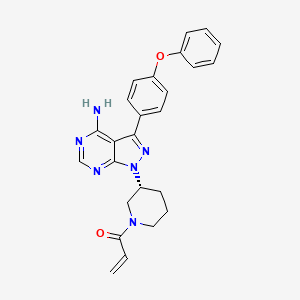
| Formula | C25H24N6O2 |
|---|---|
| Molecular weight | 440.51 g/mol |
| IUPAC name | 1-[(3R)-3-[4-amino-3-(4-phenoxyphenyl)pyrazolo[3,4-d]pyrimidin-1-yl]piperidin-1-yl]prop-2-en-1-one |
| CAS | 936563-96-1 |
| PubChem CID | 24821094 |
| InChIKey | XYFPWWZEPKGCCK-GOSISDBHSA-N |
| logP | 4.22 (XLogP 3.6) |
| Polar surface area | 99.16 Ų |
| H-bond acceptors / donors | 7 / 1 |
| Drug-likeness (QED) | 0.47 |
| Lipinski violations | 0 |
SMILES
C=CC(=O)N1CCC[C@@H](n2nc(-c3ccc(Oc4ccccc4)cc3)c3c(N)ncnc32)C1Biology & Pharmacokinetics
Pharmacokinetics predicted
| Bioavailability | 10.0% |
|---|---|
| Half-life | 0.732 h |
| Volume of distribution | 8.403 L/kg |
| Protein binding | 96.5% |
| BBB penetrant | No |
Enzyme interactions
| Enzyme | Role | Detail |
|---|---|---|
| CYP1A2 | Inhibitor | — |
| CYP2B6 | Inhibitor | IC₅₀ 11.100000000000003 µM |
| CYP2C19 | Inhibitor | IC₅₀ 25.228951623085738 µM |
| CYP2C8 | Inhibitor | IC₅₀ 7.8999999999999995 µM |
| CYP2C9 | Inhibitor | IC₅₀ 9.075516514226617 µM |
| CYP3A4 | Inhibitor | IC₅₀ 21.184900282984554 µM |
Receptor binding (top 16)
| Target | Action | Affinity |
|---|---|---|
| BLK proto-oncogene, Src family tyrosine kinase (BLK) | Inhibitor | pIC50 9.3 |
| Bruton tyrosine kinase (BTK) | Inhibitor | pIC50 9.3 |
| BMX non-receptor tyrosine kinase (BMX) | Inhibitor | pIC50 9.1 |
| TXK tyrosine kinase (TXK) | Inhibitor | pIC50 8.7 |
| erb-b2 receptor tyrosine kinase 4 (ERBB4) | Inhibitor | pIC50 8.5 |
| YES proto-oncogene 1, Src family tyrosine kinase (YES1) | Inhibitor | pIC50 8.4 |
| IL2 inducible T cell kinase (ITK) | Inhibitor | pIC50 8.3 |
| epidermal growth factor receptor (EGFR) | Inhibitor | pIC50 8.3 |
| LCK proto-oncogene, Src family tyrosine kinase (LCK) | Inhibitor | pIC50 8.2 |
| erb-b2 receptor tyrosine kinase 2 (ERBB2) | Inhibitor | pIC50 8.2 |
| tec protein tyrosine kinase (TEC) | Inhibitor | pIC50 8.1 |
| SRC proto-oncogene, non-receptor tyrosine kinase (SRC) | Inhibitor | pIC50 7.7 |
| LYN proto-oncogene, Src family tyrosine kinase (LYN) | Inhibitor | pIC50 7.7 |
| FYN proto-oncogene, Src family tyrosine kinase (FYN) | Inhibitor | pIC50 7.5 |
| HCK proto-oncogene, Src family tyrosine kinase (HCK) | Inhibitor | pIC50 7.5 |
Transporters
BCRP (Inhibitor)BSEP (Inhibitor)MDR1 (Inhibitor)MRP1 (Inhibitor)OATP1B1 (Inhibitor)OATP1B3 (Inhibitor)OATP2B1 (Inhibitor)P-gp (Inhibitor)MDR1 (Substrate)P-gp (Substrate)Transporter(unspecified) (Substrate)
Drug–drug interactions (100+, DDInter)
| Interacting drug | Severity | Management |
|---|---|---|
| Abciximab | major | |
| Acalabrutinib | major | |
| Acetylsalicylic acid | major | |
| Adalimumab | major | |
| Alteplase | major | |
| Amprenavir | major | |
| Anagrelide | major | |
| Anisindione | major | |
| Anistreplase | major | |
| Antithrombin III human | major | |
| Apalutamide | major | |
| Apixaban | major | |
| Aprepitant | major | |
| Ardeparin | major | |
| Argatroban | major | |
| Atazanavir | major | |
| Avapritinib | major | |
| Bacillus calmette-guerin substrain tice live antigen | major | |
| Baricitinib | major | |
| Berotralstat | major | |
| Betrixaban | major | |
| Binimetinib | major | |
| Bivalirudin | major | |
| Boceprevir | major | |
| Bromfenac | major | |
| Cabozantinib | major | |
| Cangrelor | major | |
| Caplacizumab | major | |
| Carbamazepine | major | |
| Ceritinib | major | |
| Certolizumab pegol | major | |
| Cilostazol | major | |
| Ciprofloxacin | major | |
| Cladribine | major | |
| Clarithromycin | major | |
| Clopidogrel | major | |
| Clozapine | major | |
| Cobicistat | major | |
| Conivaptan | major | |
| Crizotinib | major |
Showing 40 of 100+.
Registered Products (3)
| Brand | Form / strength | Pack | Agent | Citizen (JOD) |
|---|---|---|---|---|
| Dullarma | Capsule 140 mg | 120 cap | Hikma Pharmaceuticals Co.Ltd/Jordan | — |
| Imbruvica | Tablet 140 mg | 120 tab pack varies | Adatco Drug Store | — |
| Imbruvica | Tablet 140 mg | 90 tab pack varies | Adatco Drug Store | — |