Ivabradine
JFDA label: Procoralan
Mechanism of Action
Blocker of Potassium/sodium hyperpolarization-activated cyclic nucleotide-gated channel 4 — Potassium/sodium hyperpolarization-activated cyclic nucleotide-gated channel 4 blocker
| Target | Action | Gene / class |
|---|---|---|
| Potassium/sodium hyperpolarization-activated cyclic nucleotide-gated channel 4 efficacy | BLOCKER | HCN4 |
Indications
Approved
- Heart failure
Off-label
- Inappropriate sinus tachycardia
- Stable angina
Contraindications
Source: Lexicomp
- Acute decompensated heart failure Absolute
- Additional contraindications (not in US labeling): Hypersensitivity to ivabradine or any component of the formulation Absolute
- blood pressure Absolute
- resting heart rate Absolute
Adverse Reactions
Cardiac disorders (3)
Common atrial fibrillation · Bradycardia · hypertension
Nervous system disorders (1)
Common Phosphene
Other (2)
Not Known Cardiovascular: Heart block · sinoatrial arrest
Dosing
Source: Lexicomp
Warnings & Precautions
Source: Lexicomp
Atrial fibrillation
Use increases the risk of atrial fibrillation; monitor cardiac rhythm. Discontinue if atrial fibrillation develops.
Bradycardia and conduction disturbances
Bradycardia, sinus arrest, and heart block may occur; monitor heart rate prior to initiation and with any dosage adjustment. Bradycardia may increase the risk of QT prolongation, which may lead to severe ventricular arrhythmias, including torsade de pointes, especially in patients with risk factors such as use of QTc prolonging drugs. Risk factors for bradycardia include sinus node dysfunction, conduction defects (eg, first- or second-degree AV block, bundle branch block), ventricular dyssynchrony, and use of other negative chronotropes (eg, digoxin, diltiazem, verapamil, amiodarone). Avoid concurrent use with verapamil and diltiazem. Avoid use in patients with second-degree AV block (unless a functioning demand pacemaker is present). Use is contraindicated in patients with sick sinus syndrome, sinoatrial block, third-degree AV block (unless a functioning demand pacemaker is present), or pacemaker dependence. Decrease dose or discontinue use if heart rate • Visual function: Phosphenes (described as transient enhanced brightness in a limited area of the visual field, halos, image decomposition, colored bright lights, or multiple images) may occur with use. Onset is generally within the first 2 months of therapy and is reported to be of mild to moderate intensity; most cases resolve during or after treatment discontinuation. Concurrent drug therapy issues:
Drug-drug interactions
Potentially significant interactions may exist, requiring dose or frequency adjustment, additional monitoring, and/or selection of alternative therapy. Consult drug interactions database for more detailed information.
Pregnancy & Lactation
Pregnancy
Adverse events have been observed in animal reproduction studies, and fetal harm may occur if ivabradine is administered to pregnant women. Effective contraception is recommended in women of reproductive potential. If treatment is needed during pregnancy, closely monitor for destabilization of heart failure that could potentially result from heart rate slowing caused by ivabradine, especially during the first trimester. Pregnant women with chronic heart failure should also be monitored for preterm birth.
Lactation
It is not known if ivabradine is excreted in breast milk. Due to the potential risk from exposure in the nursing infant, breast-feeding is not recommended by the manufacturer.
Monitoring
| Clinical pearl | Heart rate (prior to initiation, prior to increasing dose, or after decreasing dose); monitor heart rate more closely if receiving other negative chronotropes (eg, amiodarone, beta-blockers, digoxin); blood pressure; regularly monitor cardiac rhythm (assessing for atrial fibrillation) |
|---|
Chemistry & Properties
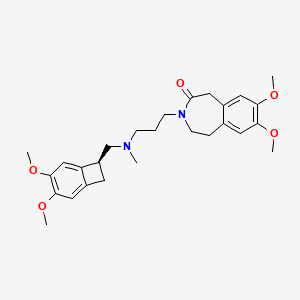
| Formula | C27H36N2O5 |
|---|---|
| Molecular weight | 468.59 g/mol |
| IUPAC name | 3-[3-[[(7S)-3,4-dimethoxy-7-bicyclo[4.2.0]octa-1,3,5-trienyl]methyl-methylamino]propyl]-7,8-dimethoxy-2,5-dihydro-1H-3-benzazepin-4-one |
| CAS | 155974-00-8 |
| PubChem CID | 132999 |
| InChIKey | ACRHBAYQBXXRTO-OAQYLSRUSA-N |
| logP | 3.31 (XLogP 2.4) |
| Polar surface area | 60.47 Ų |
| H-bond acceptors / donors | 6 / 0 |
| Drug-likeness (QED) | 0.53 |
| Lipinski violations | 0 |
SMILES
COc1cc2c(cc1OC)CC(=O)N(CCCN(C)C[C@H]1Cc3cc(OC)c(OC)cc31)CC2Biology & Pharmacokinetics
Pharmacokinetics predicted
| Bioavailability | 10.0% |
|---|---|
| Half-life | 2.152 h |
| Volume of distribution | 1.539 L/kg |
| Protein binding | 62.2% |
| BBB penetrant | Yes |
Enzyme interactions
| Enzyme | Role | Detail |
|---|---|---|
| CYP1A2 | Substrate | — |
| CYP2C19 | Substrate | — |
| CYP2D6 | Substrate | — |
| CYP3A4 | Inhibitor | — |
| CYP3A4 | Substrate | — |
Receptor binding (top 3)
| Target | Action | Affinity |
|---|---|---|
| HCN1 (HCN1) | Channel blocker | pIC50 5.7 |
| HCN3 (HCN3) | Channel blocker | pIC50 5.7 |
| HCN4 (HCN4) | Channel blocker | pIC50 5.7 |
Transporters
BCRP (Inhibitor)BSEP (Inhibitor)MRP1 (Inhibitor)OATP1B1 (Inhibitor)OATP1B3 (Inhibitor)OCT2 (Inhibitor)P-gp (Inhibitor)MDR1 (Substrate)OATP1B1 (Substrate)OATP1B3 (Substrate)P-gp (Substrate)Transporter(unspecified) (Substrate)
Drug–drug interactions (100+, DDInter)
| Interacting drug | Severity | Management |
|---|---|---|
| Abarelix | major | |
| Abiraterone | major | |
| Alimemazine | major | |
| Anagrelide | major | |
| Apalutamide | major | |
| Aprepitant | major | |
| Arsenic trioxide | major | |
| Astemizole | major | |
| Bicalutamide | major | |
| Bosutinib | major | |
| Cabozantinib | major | |
| Ceritinib | major | |
| Chloroquine | major | |
| Cilostazol | major | |
| Cisapride | major | |
| Clarithromycin | major | |
| Clotrimazole | major | |
| Cobicistat | major | |
| Crizotinib | major | |
| Dasatinib | major | |
| Daunorubicin | major | |
| Daunorubicin (liposomal) | major | |
| Degarelix | major | |
| Dolasetron | major | |
| Doxepin | major | |
| Doxepin (topical) | major | |
| Doxorubicin | major | |
| Doxorubicin (liposomal) | major | |
| Encorafenib | major | |
| Entrectinib | major | |
| Enzalutamide | major | |
| Epirubicin | major | |
| Eribulin | major | |
| Erythromycin | major | |
| Fedratinib | major | |
| Fluconazole | major | |
| Flutamide | major | |
| Gilteritinib | major | |
| Glasdegib | major | |
| Goserelin | major |
Showing 40 of 100+.
Registered Products (6)
| Brand | Form / strength | Pack | Agent | Citizen (JOD) |
|---|---|---|---|---|
| Ivanor | Tablet 5 mg | 30 tab | JORDAN RIVER PHARMA.IND(JORIVER)/JORDAN | 7.250 |
| Ivanor | Tablet 7.5 mg | 30 tab | JORDAN RIVER PHARMA.IND(JORIVER)/JORDAN | 7.250 |
| Procoralan | Tablet 7.5 mg | 56 tab | The Jordan Drugstore Co | 16.400 |
| Procoralan | Tablet 5 mg | 56 tab | The Jordan Drugstore Co | 16.400 |
| Tevader | Tablet 5 mg | 60 tab | UNITED PHARM.MFG.CO.LTD(UPM)/JORDAN | 16.570 |
| Tevader | Tablet 7.5 mg | 60 tab | UNITED PHARM.MFG.CO.LTD(UPM)/JORDAN | 16.570 |