Macitentan
JFDA label: Opsumit Film-Coated Tablets
- Pregnancy:
- REMS program:
Mechanism of Action
Antagonist of Endothelin receptor, ET-A/ET-B — Endothelin receptor, ET-A/ET-B antagonist
| Target | Action | Gene / class |
|---|---|---|
| Endothelin receptor, ET-A/ET-B efficacy | ANTAGONIST |
Indications
Approved
- Pulmonary arterial hypertension
Contraindications
Source: Lexicomp
- Additional contraindications (not in US labeling): Hypersensitivity to macitentan or any component of the formulation Absolute
- breast-feeding Absolute
Adverse Reactions
Nervous system disorders (1)
Very Common Headache
Hepatobiliary disorders (1)
Common Increased liver enzymes
Renal and urinary disorders (1)
Common Urinary tract infection
Blood and lymphatic system disorders (2)
Very Common Anemia
Common Decreased hemoglobin
Infections and infestations (1)
Common Influenza
Respiratory, thoracic and mediastinal disorders (3)
Very Common bronchitis · Nasopharyngitis · pharyngitis
Dosing
Source: Lexicomp
Warnings & Precautions
Source: Lexicomp
Fluid retention/peripheral edema
Development of peripheral edema due to treatment and/or disease state (pulmonary arterial hypertension) may occur. There have been postmarketing reports of fluid retention requiring treatment (eg, diuretics, fluid management, hospitalization) associated with other endothelin antagonists. Further evaluation may be necessary to determine cause and appropriate treatment or discontinuation of therapy. Use with caution in patients with severe chronic heart failure.
Hematologic effects
A reduction in hematocrit/hemoglobin has been observed and may occur early in therapy with subsequent stabilization. Decreases in hemoglobin rarely required transfusion. Measure hemoglobin prior to initiating therapy and repeat as clinically appropriate. Use is not recommended in patients with severe anemia.
Hepatic effects
Increases in serum liver aminotransferases, hepatotoxicity, and liver failure have been reported. Monitor transaminases prior to initiation of therapy and repeat as clinically appropriate. Discontinue treatment in patients who develop elevated transaminases either in combination with symptoms of hepatic injury (eg, anorexia, dark urine, fatigue, fever, itching, jaundice, nausea, right upper quadrant pain, vomiting) or elevated bilirubin (>2 x the upper limit of normal [ULN]). Upon normalization of hepatic enzymes, may consider reinitiation of therapy in patients not experiencing clinical signs of hepatotoxicity.
Spermatogenesis
Sperm count may be reduced in men during treatment. No changes in sperm function or hormone levels have been noted in animal studies. Advise male patients of potential effects on fertility. Disease-related concerns:
Pulmonary veno-occlusive disease (PVOD)
If signs of pulmonary edema occur, consider the possibility of PVOD; discontinue if PVOD is confirmed. Concurrent drug therapy issues:
Drug-drug interactions
Potentially significant interactions may exist, requiring dose or frequency adjustment, additional monitoring, and/or selection of alternative therapy. Consult drug interactions database for more detailed information. Special populations:
Pregnancy
Macitentan may cause fetal harm if given to pregnant women; do not administer to women who are pregnant. All females of reproductive potential should have a negative pregnancy test prior to beginning therapy and testing should continue monthly during treatment and one month after discontinuing therapy. Females of childbearing potential should not become pregnant during therapy or for 1 month following discontinuation of macitentan. Women may use one highly effective form of contraception (intrauterine device, contraceptive implant, or tubal sterilization) or a combination of methods (hormonal contraceptive with a barrier method or two barrier methods). A hormonal contraceptive or barrier method must be used in addition to a partner’s vasectomy, if that method is chosen. Females should be counseled on pregnancy prevention and planning and instructed to notify their prescriber immediately if a pregnancy should occur.
REMS program
Macitentan is available to females only through the restricted OPSUMIT Risk Evaluation and Mitigation Strategy (REMS) Program. All females regardless of their reproductive potential must be enrolled in the REMS program; prescribers and pharmacies must also be enrolled in the program. Females of reproductive potential must be able to comply with pregnancy testing and contraception requirements of the program. Call 1-866-228-3546 or visit http://www.opsumitrems.com for more information.
Pregnancy & Lactation
Pregnancy
Use is contraindicated in pregnant women. [US Boxed Warnings]: Macitentan may cause fetal harm if given to pregnant women; do not administer to women who are pregnant. Macitentan is available to females only through the restricted OPSUMIT Risk Evaluation and Mitigation Strategy (REMS) Program. All females of reproductive potential should have a negative pregnancy test prior to beginning therapy and testing should continue monthly during treatment and one month after discontinuing therapy. Females of childbearing potential should not become pregnant during therapy or for 1 month following discontinuation of macitentan by using acceptable methods of contraception. All females regardless of their reproductive potential must be enrolled in the REMS program; prescribers and pharmacies must also be enrolled in the program. Females of reproductive potential must be able to comply with pregnancy testing and contraception requirements of the program. Women may use one highly effective form of c
Lactation
It is not known if macitentan is excreted into breast milk. Due to the potential for adverse reactions in breast-feeding infants, the manufacturer recommends a decision be made to discontinue breast-feeding or to discontinue the drug. Canadian labeling contraindicates use in breast-feeding women.
Monitoring
| Clinical pearl | Monitor for significant peripheral edema and evaluate etiology if it occurs; measure liver enzymes prior to initiation and repeat as clinically appropriate (Canadian labeling recommends monthly monitoring of liver enzymes during the first year of therapy and then as clinically appropriate); monitor for clinical signs and symptoms of liver injury (eg, abdominal pain, anorexia, dark urine, fatigue, fever, itching, jaundice, nausea, vomiting); hemoglobin and hematocrit prior to initiation and repeat as clinically appropriate (Canadian labeling recommends to repeat hemoglobin after first month of therapy and then as clinically appropriate). A woman of childbearing potential must have a negative pregnancy test prior to the initiation of therapy, monthly during treatment, and 1 month after stopping treatment. |
|---|
Chemistry & Properties
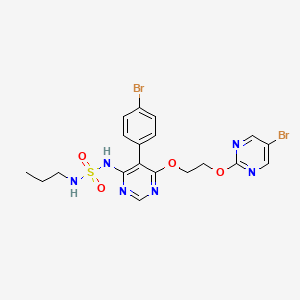
| Formula | C19H20Br2N6O4S |
|---|---|
| Molecular weight | 588.28 g/mol |
| IUPAC name | 5-(4-bromophenyl)-6-[2-(5-bromopyrimidin-2-yl)oxyethoxy]-N-(propylsulfamoyl)pyrimidin-4-amine |
| CAS | 441798-33-0 |
| PubChem CID | 16004692 |
| InChIKey | JGCMEBMXRHSZKX-UHFFFAOYSA-N |
| logP | 3.57 (XLogP 3.7) |
| Polar surface area | 128.22 Ų |
| H-bond acceptors / donors | 8 / 2 |
| Drug-likeness (QED) | 0.33 |
| Lipinski violations | 1 |
SMILES
CCCNS(=O)(=O)Nc1ncnc(OCCOc2ncc(Br)cn2)c1-c1ccc(Br)cc1Biology & Pharmacokinetics
Pharmacokinetics predicted
| Bioavailability | 10.0% |
|---|---|
| Half-life | 0.89 h |
| Volume of distribution | 0.43 L/kg |
| Protein binding | 98.1% |
| BBB penetrant | No |
Enzyme interactions
| Enzyme | Role | Detail |
|---|---|---|
| CYP2B6 | Inhibitor | — |
| CYP2C19 | Inhibitor | — |
| CYP2C8 | Inhibitor | — |
| CYP2C9 | Inhibitor | — |
| CYP2C9 | Substrate | — |
| CYP2D6 | Substrate | — |
| CYP3A4 | Inhibitor | — |
| CYP3A4 | Substrate | — |
Receptor binding (top 2)
| Target | Action | Affinity |
|---|---|---|
| ETA receptor (EDNRA) | Antagonist | pIC50 9.3 |
| ETB receptor (EDNRB) | Antagonist | pIC50 6.4 |
Transporters
BCRP (Inhibitor)BCRP (Inhibitor)BSEP (Inhibitor)BSEP (Inhibitor)MDR1 (Inhibitor)MRP1 (Inhibitor)NTCP (Inhibitor)OAT (Inhibitor)OATP1B1 (Inhibitor)OATP1B1 (Inhibitor)OATP1B3 (Inhibitor)OATP1B3 (Inhibitor)OATP2B1 (Inhibitor)P-gp (Inhibitor)BSEP (Substrate)MDR1 (Substrate)OAT (Substrate)OATP (Substrate)OATP1B1 (Substrate)OATP1B3 (Substrate)OATP2B1 (Substrate)P-gp (Substrate)
Drug–drug interactions (56, DDInter)
| Interacting drug | Severity | Management |
|---|---|---|
| Apalutamide | major | |
| Ceritinib | major | |
| Clarithromycin | major | |
| Cobicistat | major | |
| Enzalutamide | major | |
| Erythromycin | major | |
| Idelalisib | major | |
| Ketoconazole | major | |
| Leflunomide | major | |
| Lumacaftor | major | |
| Mitotane | major | |
| Teriflunomide | major | |
| Aminoglutethimide | moderate | |
| Aprepitant | moderate | |
| Asparaginase Escherichia coli | moderate | |
| Bexarotene | moderate | |
| Brentuximab vedotin | moderate | |
| Chloramphenicol | moderate | |
| Cimetidine | moderate | |
| Clofarabine | moderate | |
| Clotrimazole | moderate | |
| Crizotinib | moderate | |
| Dasatinib | moderate | |
| Deferasirox | moderate | |
| Dexamethasone | moderate | |
| Elagolix | moderate | |
| Fedratinib | moderate | |
| Fluconazole | moderate | |
| Fostamatinib | moderate | |
| Griseofulvin | moderate | |
| Imatinib | moderate | |
| Interferon beta-1a | moderate | |
| Interferon beta-1b | moderate | |
| Ivacaftor | moderate | |
| Ivosidenib | moderate | |
| Lapatinib | moderate | |
| Larotrectinib | moderate | |
| Lorlatinib | moderate | |
| Methotrexate | moderate | |
| Miconazole | moderate |
Showing 40 of 56.
Registered Products (2)
| Brand | Form / strength | Pack | Agent | Citizen (JOD) |
|---|---|---|---|---|
| Opsumit Film-Coated Tablets | Film-Coated Tablet 10 mg | 30 tab | Shawi & Rushedat Drug Store | — |
| Palivio | Tablet macitentan 10.00 mg | 30 tab | Hikma Pharmaceuticals | — |