Ribociclib
JFDA label: Kisqali
Mechanism of Action
Inhibitor of Cyclin-dependent kinase 4 — Cyclin-dependent kinase 4 inhibitor; Inhibitor of Cyclin-dependent kinase 6 — Cyclin-dependent kinase 6 inhibitor
| Target | Action | Gene / class |
|---|---|---|
| Cyclin-dependent kinase 4 efficacy | INHIBITOR | CDK4 |
| Cyclin-dependent kinase 6 efficacy | INHIBITOR | CDK6 |
Indications
Approved
- Breast cancer, advanced or metastatic
Class profile
| mechanismClass | CDK4/6 kinase inhibitor |
|---|---|
| targetMolecule | CDK4 + CDK6 |
| targetPathway | Cell cycle G1/S checkpoint |
| generation | 2nd generation CDK4/6 inhibitor |
| primaryTumors | HR+ HER2- Breast |
| resistanceMechanisms | RB1 loss,PI3K pathway activation; QTc prolongation limits use with some CYP3A4 inhibitors |
| source | NCCN/OncoKB/Goodman&Gilman13ed |
Contraindications
Source: Lexicomp
- There are no contraindications listed in the manufacturer's labeling Absolute
Adverse Reactions
Cardiac disorders (3)
Very Common Peripheral edema
Common Prolonged Q-T interval on ECG · syncope
Nervous system disorders (3)
Very Common Fatigue · headache · insomnia
Hepatobiliary disorders (1)
Common Decreased serum bilirubin
Renal and urinary disorders (2)
Very Common Increased serum creatinine · Urinary tract infection
Blood and lymphatic system disorders (5)
Very Common anemia, increased serum AST, increased serum bilirubin · decreased platelet count · leukopenia · Neutropenia
Common Febrile neutropenia
Metabolism and nutrition disorders (1)
Very Common Decreased serum potassium
Gastrointestinal disorders (7)
Very Common abdominal pain · constipation · decreased appetite · diarrhea · Nausea · stomatitis · vomiting
Skin and subcutaneous tissue disorders (3)
Very Common Alopecia · pruritus · skin rash
Musculoskeletal and connective tissue disorders (1)
Very Common Back pain
General disorders and administration site conditions (1)
Very Common Fever
Respiratory, thoracic and mediastinal disorders (1)
Very Common Dyspnea
Dosing
Source: Lexicomp
Warnings & Precautions
Source: Lexicomp
Bone marrow suppression
Neutropenia commonly occurs, including grades 3 and 4 neutropenia. The median time to onset for grade 2 or higher neutropenia was 16 days. The median recovery for grade 3 or higher neutropenia was 15 days (resolution to normal levels or to less than grade 3 toxicity). Neutropenic fever has been observed. Monitor blood counts (baseline, every 2 weeks for the first 2 cycles, at the beginning of each subsequent 4 cycles and as clinically necessary). Neutropenia may require treatment interruption, dose reduction and/or discontinuation (depending on the severity). Anemia, thrombocytopenia, and lymphopenia have also been observed.
Hepatobiliary toxicity
ALT and/or AST elevations have been observed, including grade 3 or 4 events. The median time to onset for grade 3 or higher transaminase elevations was 57 days; the median time for grade 3 or higher elevations to resolve to grade 2 or lower was 24 days. Concurrent elevation of ALT or AST >3 times ULN and total bilirubin >2 times ULN (with normal alkaline phosphatase and in the absence of cholestasis) occurred (rare); all cases resolved following ribociclib discontinuation. Monitor liver function tests (baseline, every 2 weeks for the first 2 cycles, at the beginning of each subsequent 4 cycles and as clinically necessary). Depending on the severity, hepatobiliary toxicity may require treatment interruption, dose reduction and/or discontinuation.
QT prolongation
Ribociclib is associated with concentration-dependent QT prolongation, with an estimated mean increase in the QT interval exceeding 20 msec at the mean steady-state Cmax of a 600 mg once daily dose. QTcF interval prolongation >500 msec has been observed, as well as QTcF prolongations >60 msec from baseline. QT interval changes occurred within the initial 4 weeks of ribociclib therapy and were reversible with treatment interruption. Torsades de pointes has not been reported, although syncope occurred in a small percentage of patients. One sudden death was reported in a patient with grade 3 hypokalemia and grade 2 QT prolongation who was receiving ribociclib in combination with letrozole. Evaluate ECG prior to treatment initiation. Initiate treatment only in patients with QTcF Disease-related concerns:
Hepatic impairment
Reduced initial doses are recommended for moderate to severe impairment. Concurrent drug therapy issues:
Drug-drug interactions
Potentially significant interactions may exist, requiring dose or frequency adjustment, additional monitoring, and/or selection of alternative therapy. Consult drug interactions database for more detailed information.
Pregnancy & Lactation
Pregnancy
Adverse events were observed in animal reproduction studies. Based on the mechanism of action, ribociclib may be expected to cause fetal harm if used during pregnancy. Women of reproductive potential should have a pregnancy test prior to treatment and use effective contraception during treatment and for at least 3 weeks after the last dose. Although not approved for use in men, animal data suggests that ribociclib may affect male fertility.
Lactation
It is not known if ribociclib is present in breast milk. Due to the potential for adverse events in the breastfed infant, the manufacturer does not recommend breastfeeding during therapy or for at least 3 weeks after the last dose.
Monitoring
| Efficacy | Tumour response (RECIST criteria, tumour markers, imaging); progression-free survival; performance status (ECOG/Karnofsky) |
|---|---|
| Toxicity | CBC with differential (nadir timing depends on agent); LFTs; renal function; ECG (QT for relevant agents); echocardiogram for cardiotoxic agents (anthracyclines, trastuzumab); cumulative dose tracking for dose-limited toxicities |
| Clinical pearl | Treatment response is assessed after 2–3 cycles. Grade 3–4 toxicities typically require dose reduction or interruption per protocol-defined criteria. |
| Counseling | Attend all scheduled blood tests and imaging appointments. Report fever > 38°C (risk of neutropaenic sepsis — medical emergency), unusual bleeding, or new pain immediately. |
Chemistry & Properties
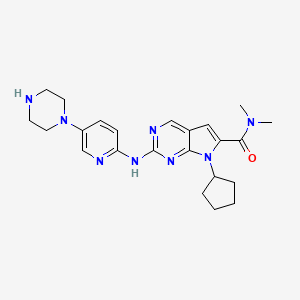
| Formula | C23H30N8O |
|---|---|
| Molecular weight | 434.55 g/mol |
| IUPAC name | 7-cyclopentyl-N,N-dimethyl-2-[(5-piperazin-1-yl-2-pyridinyl)amino]pyrrolo[2,3-d]pyrimidine-6-carboxamide |
| CAS | 1211441-98-3 |
| PubChem CID | 44631912 |
| InChIKey | RHXHGRAEPCAFML-UHFFFAOYSA-N |
| logP | 2.8 (XLogP 2.2) |
| Polar surface area | 91.21 Ų |
| H-bond acceptors / donors | 8 / 2 |
| Drug-likeness (QED) | 0.64 |
| Lipinski violations | 0 |
SMILES
CN(C)C(=O)c1cc2cnc(Nc3ccc(N4CCNCC4)cn3)nc2n1C1CCCC1Biology & Pharmacokinetics
Pharmacokinetics predicted
| Bioavailability | 70.0% |
|---|---|
| Half-life | 0.573 h |
| Volume of distribution | 4.583 L/kg |
| Protein binding | 65.6% |
| BBB penetrant | No |
Enzyme interactions
| Enzyme | Role | Detail |
|---|---|---|
| CYP1A2 | Inhibitor | — |
| CYP3A4 | Substrate | — |
Receptor binding (top 1)
| Target | Action | Affinity |
|---|---|---|
| cyclin dependent kinase 4 (CDK4) | Inhibitor | pIC50 8.0 |
Transporters
BCRP (Inhibitor)BSEP (Inhibitor)BSEP (Inhibitor)MRP1 (Inhibitor)OATP1B1 (Inhibitor)OATP1B3 (Inhibitor)P-gp (Inhibitor)P-gp (Substrate)
Drug–drug interactions (100+, DDInter)
| Interacting drug | Severity | Management |
|---|---|---|
| Abiraterone | major | |
| Acalabrutinib | major | |
| Adalimumab | major | |
| Adenosine | major | |
| Alfuzosin | major | |
| Alimemazine | major | |
| Amiodarone | major | |
| Amisulpride | major | |
| Amitriptyline | major | |
| Amoxapine | major | |
| Amprenavir | major | |
| Anagrelide | major | |
| Apalutamide | major | |
| Arformoterol | major | |
| Arsenic trioxide | major | |
| Astemizole | major | |
| Atazanavir | major | |
| Atomoxetine | major | |
| Avanafil | major | |
| Avapritinib | major | |
| Azithromycin | major | |
| Bacillus calmette-guerin substrain tice live antigen | major | |
| Baricitinib | major | |
| Bedaquiline | major | |
| Benzhydrocodone | major | |
| Bepridil | major | |
| Bicalutamide | major | |
| Boceprevir | major | |
| Bosutinib | major | |
| Brexpiprazole | major | |
| Brigatinib | major | |
| Butorphanol | major | |
| Cabozantinib | major | |
| Carbamazepine | major | |
| Ceritinib | major | |
| Certolizumab pegol | major | |
| Chloroquine | major | |
| Chlorpromazine | major | |
| Cilostazol | major | |
| Ciprofloxacin | major |
Showing 40 of 100+.
Registered Products (1)
| Brand | Form / strength | Pack | Agent | Citizen (JOD) |
|---|---|---|---|---|
| Kisqali | Tablet 200 mg | 63 tab | The Jordan Drugstore Co | — |