Sodium Bicarbonate
JFDA label: Eno-Fruit Salt Regular pd
Mechanism of Action
Dissociates to provide bicarbonate ion which neutralizes hydrogen ion concentration and raises blood and urinary pH Neutralizing additive (dental use): Increases pH of lidocaine and epinephrine solution to improve tolerability and increase tissue uptake
Indications
Approved
- Neutralizing additive (dental use)
Off-label
- Contrast-induced nephropathy (CIN) (prevention)
Contraindications
Source: Lexicomp
- Alkalosis, hypernatremia, severe pulmonary edema, hypocalcemia, unknown abdominal pain Neutralizing additive (dental use): Not for use as a systemic alkalizer Absolute
Adverse Reactions
Cardiac disorders (2)
Not Known Cardiac failure (exacerbation) · edema
Nervous system disorders (1)
Not Known Cerebral hemorrhage
Metabolism and nutrition disorders (6)
Not Known Acidosis (intracranial) · hypernatremia · hypocalcemia · hypokalemia · metabolic alkalosis · milk-alkali syndrome (especially with renal dysfunction)
Gastrointestinal disorders (3)
Not Known Abdominal distention · eructation · flatulence (oral administration)
Musculoskeletal and connective tissue disorders (1)
Not Known Tetany
Respiratory, thoracic and mediastinal disorders (1)
Not Known Pulmonary edema
Dosing
Source: Lexicomp
Warnings & Precautions
Source: Lexicomp
Extravasation
Vesicant (at concentrations ≥8.4%); ensure proper catheter or needle position prior to and during infusion. Avoid extravasation (tissue necrosis may occur due to hypertonicity. Disease-related concerns:
Cirrhosis
Use with caution in patients with cirrhosis.
Edema
Use with caution in patients with edema.
Heart failure
Use with caution in patients with heart failure.
Peptic ulcer disease
Not to be used in treatment of peptic ulcer disease.
Renal impairment
Use with caution in patients with renal impairment; may cause sodium retention. Special populations:
Elderly
Not the antacid of choice for the elderly because of sodium content and potential for systemic alkalosis.
Pediatric
Rapid administration in neonates, infants, and children Dosage form specific issues:
Injection
Use of IV NaHCO3 should be reserved for documented metabolic acidosis and for hyperkalemia-induced cardiac arrest. Routine use in cardiac arrest is not recommended.
Pregnancy & Lactation
Pregnancy
Animal reproduction studies have not been conducted. Medications used for the treatment of cardiac arrest in pregnancy are the same as in the non-pregnant woman. Doses and indications should follow current Advanced Cardiovascular Life Support guidelines. Appropriate medications should not be withheld due to concerns of fetal teratogenicity (Campbell 2009; Jeejeebhoy [AHA] 2015). Antacids containing sodium bicarbonate should not be used during pregnancy due to their potential to cause metabolic alkalosis and fluid overload (Mahadevan 2007).
Lactation
Sodium is found in breast milk (IOM 2004).
Chemistry & Properties
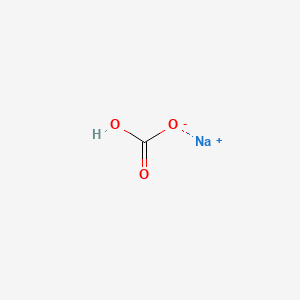
| Formula | CHNaO3 |
|---|---|
| Molecular weight | 84.01 g/mol |
| IUPAC name | sodium hydrogen carbonate |
| CAS | 144-55-8 |
| PubChem CID | 516892 |
| InChIKey | UIIMBOGNXHQVGW-UHFFFAOYSA-M |
SMILES
O=C([O-])O.[Na+]Biology & Pharmacokinetics
Pharmacokinetics predicted
| Bioavailability | 10.0% |
|---|---|
| Half-life | 3.643 h |
| Volume of distribution | 0.31 L/kg |
| Protein binding | 17.4% |
| BBB penetrant | No |
Enzyme interactions
| Enzyme | Role | Detail |
|---|---|---|
| CYP2C9 | Substrate | — |
Transporters
BCRP (Inhibitor)BSEP (Inhibitor)MRP1 (Inhibitor)OATP1B1 (Inhibitor)OATP1B3 (Inhibitor)P-gp (Inhibitor)P-gp (Substrate)
Drug–drug interactions (100+, DDInter)
| Interacting drug | Severity | Management |
|---|---|---|
| Dolutegravir | major | |
| Selpercatinib | major | |
| Acalabrutinib | moderate | |
| Acetohexamide | moderate | |
| Acetylsalicylic acid | moderate | |
| Amphetamine | moderate | |
| Amprenavir | moderate | |
| Atazanavir | moderate | |
| Atropine | moderate | |
| Bacampicillin | moderate | |
| Benzphetamine | moderate | |
| Bisacodyl | moderate | |
| Bosutinib | moderate | |
| Cabotegravir | moderate | |
| Cefditoren | moderate | |
| Cefpodoxime | moderate | |
| Cefuroxime | moderate | |
| Ceritinib | moderate | |
| Chlorpropamide | moderate | |
| Choline salicylate | moderate | |
| Ciprofloxacin | moderate | |
| Dabrafenib | moderate | |
| Dasatinib | moderate | |
| Delavirdine | moderate | |
| Demeclocycline | moderate | |
| Dextroamphetamine | moderate | |
| Doxycycline | moderate | |
| Elvitegravir | moderate | |
| Ephedrine | moderate | |
| Ephedrine (nasal) | moderate | |
| Erlotinib | moderate | |
| Ferrous fumarate | moderate | |
| Ferrous gluconate | moderate | |
| Ferrous sulfate anhydrous | moderate | |
| Gatifloxacin | moderate | |
| Glipizide | moderate | |
| Glyburide | moderate | |
| Iron | moderate | |
| Iron protein succinylate | moderate | |
| Itraconazole | moderate |
Showing 40 of 100+.
Registered Products (28)
| Brand | Form / strength | Pack | Agent | Citizen (JOD) |
|---|---|---|---|---|
| Fawar Fruit | Sachet 2.80 g/5 g, 0.82 g/5 g, 1.33 g/5 g | 6 sachet | Modern Drug Store | 0.640 |
| Fawar Lemon | Sachet 2.80 g/5 g, 0.82 g/5 g, 1.33 g/5 g | 6 sachet | Modern Drug Store | 0.640 |
| Eno-Fruit Salt Lemon pd | Powder 2.29 g, 2.16 g, 0.5 g | 10 sachet | Sukhtian Group | 1.010 |
| Eno-Fruit Salt Orange pd | Powder 2.285 g, 2.155 g, 0.5 g | 10 sachet pack varies | Sukhtian Group | 1.010 |
| Eno-Fruit Salt Regular pd | Powder 2.32 g, 2.18 g, 0.5 g | 10 sachet | Sukhtian Group | 1.010 |
| Alka-UR | Tablet 1.76 g, 0.72 g, 0.89 g, 0.63 g | 10 tab | Reda Jardaneh Drug Store | 1.390 |
| Sodium Bicarbonate Tab | Tablet 500 mg | 30 tab pack varies | Hayat Pharmaceutical Industries CO.PLC/JORDAN | 1.620 |
| Vixon | Solution 267 mg/10 ml, 160 mg/10 ml, 500 mg/10 ml | 190 ml | Dar Al Dawa Development and Investment Co Ltd/Jordan | 1.620 |
| Algicid Suspension | Suspension 2.67 %, 1.6 %, 5 % | 200 ml | PHILADELPHIA PHAEMACEUTICALS.COMP/JORDAN | 1.700 |
| Eno Fruit Salt Regular | Cream 2.319 g/5 g, 2.181 g/5 g, 0.5 g/5 g | 150 g tube | Sukhtian Group | 1.890 |
| Eno-Fruit Salt Lemon pd | Powder 2.29 g/5 g, 2.16 g/5 g, 0.5 g/5 g | 150 g | Sukhtian Group | 1.890 |
| Eno-Fruit Salt Orange pd | Powder 2.285 g, 2.155 g, 0.5 g | 150 g pack varies | Sukhtian Group | 1.890 |
| Sodium Bicarbonate | Tablet 500 mg | 100 tab pack varies | Hikma Pharmaceuticals Co.Ltd/Jordan | 2.240 |
| Gaviscon Peppermint Liquid Relief | Suspension 133.5 mg/5 ml, 80 mg/5 ml, 250 mg/5 ml | 200 ml | Nairoukh Drug Store | 2.340 |
| Atlast Liquid | Solution 2.67 g/100 ml, 1.60 g/100 ml, 5.00 g/100 ml | 200 ml | JERASH PHARMACEUTICALS LTD.CO/JORDAN | 2.380 |
| Gaviscon Aniseed | Solution 267 mg/10 ml, 160 mg/10 ml, 500 mg/10 ml | 200 ml | Nairoukh Drug Store | 2.800 |
| Oprazole Plus | Capsule 20 mg, 1100 mg | 1 cap | Hikma Pharmaceuticals Co.Ltd/Jordan | 4.810 |
| Gaviscon Double Action Liquid Sachets, Oral Suspension | Suspension Sodium Bicarbonate 213 mg/10 ml, Calcium Carbonate 325 mg/10 ml, Sodium Alginate 500 mg/10 ml | (12 SAC) | Awtar Pharmaceutical Co | 5.300 |
| Gaviscon Double Action Mint Liquid suspension | Suspension Sodium Bicarbonate 213 mg/10 ml, Sodium Alginate 500 mg/10 ml, Calcium Carbonate 325 mg/10 ml | 300 ml | Nairoukh Drug Store | 5.340 |
| Movicol Sachets | Sachet 0.047 g, 0.178 g, 0.351 g, 13.125 g | 20 sachet | Khoury Drug Store | 5.500 |
| ProRise 40MG/1100MG , Hard gelatin Capsule | Capsule Omeprazole 40 mg, Sodium Bicarbonate 1100 mg | 14 cap pack varies | Professional Drug Store | 5.910 |
| ZEGACID 40 | Capsule 40 mg, 1100 mg | 30 cap | Sahar Drug Store | 6.690 |
| Omezyn Plus | Capsule 40 mg, 1100 mg | 14 cap pack varies | Noor Drug Store | 6.890 |
| Fortrans | Sachet 0.75 g, 1.680 g, 1.460 g, 64 g, 5.700 g | 4 sachet | Abu Sharef Medical Stores | 8.190 |
| ProRise 40MG/1100MG , Hard gelatin Capsule | Capsule Omeprazole 40 mg, Sodium Bicarbonate 1100 mg | 30 cap pack varies | Professional Drug Store | 12.060 |
| Omezyn Plus | Capsule 40 mg, 1100 mg | 28 cap pack varies | Noor Drug Store | 13.130 |
| Oprazole Plus | Capsule 40 mg, 1100 mg | 1 cap | Hikma Pharmaceuticals Co.Ltd/Jordan | 15.020 |
| Sodium Bicarbonate Tab | Tablet 500 mg | 600 tab pack varies | Hayat Pharmaceutical Industries CO.PLC/JORDAN | 25.440 |