Tolvaptan
JFDA label: Politav Tablets
- Treatment initiation and monitoring:
Mechanism of Action
Antagonist of Vasopressin V2 receptor — Vasopressin V2 receptor antagonist
| Target | Action | Gene / class |
|---|---|---|
| Vasopressin V2 receptor efficacy | ANTAGONIST | AVPR2 |
Indications
Approved
- Autosomal dominant polycystic kidney disease (ADPKD)
- Hypervolemic and euvolemic hyponatremia
- Jinarc [Canadian product]
- Samsca
Contraindications
Source: Lexicomp
- Samsca: Hypersensitivity (eg, anaphylactic shock, generalized rash) to tolvaptan or any component of the formulation Absolute
- breastfeeding Absolute
- clinically relevant hepatic impairment Absolute
- concurrent use with strong CYP3A inhibitors (eg, ketoconazole, itraconazole, ritonavir, indinavir, nelfinavir, saquinavir, nefazodone, telithromycin, clarithromycin) Jinarc [Canadian product]: Hypersensitivity to tolvaptan or any component of the formulation Absolute
- hypernatremia Absolute
- hypovolemia Absolute
- hypovolemic hyponatremia Absolute
- urgent need to raise serum sodium acutely Absolute
- use in patients unable to sense or appropriately respond to thirst Absolute
Adverse Reactions
Hepatobiliary disorders (1)
Common Hepatotoxicity
Renal and urinary disorders (1)
Very Common Polyuria
Metabolism and nutrition disorders (3)
Very Common Increased thirst
Common Hyperglycemia · hypernatremia, constipation, anorexia
Gastrointestinal disorders (2)
Very Common Nausea · xerostomia
Musculoskeletal and connective tissue disorders (1)
Common Weakness
General disorders and administration site conditions (1)
Common Fever
Dosing
Source: Lexicomp
Warnings & Precautions
Source: Lexicomp
CNS effects
Dizziness, asthenia, and/or syncope have been reported when used for ADPKD; advise patients to use caution when performing dangerous tasks (eg, driving, operating machinery).
Hepatotoxicity
Tolvaptan may increase the risk of serious hepatotoxicity, including fatal hepatotoxicity. Cases of hepatotoxicity have been reported in patients treated for ADPKD and have usually occurred after 3 months of therapy although some cases occurred prior to 3 months. Therefore, treatment with Samsca should be limited to 30 days. If hepatotoxicity is suspected, discontinue use. Avoid use in patients with liver disease (including cirrhosis) since the ability to recover from further liver injury may be impaired. In the treatment of ADPKD, use of Jinarc [Canadian product] is not limited to 30 days however close monitoring of hepatic function is recommended. Interrupt therapy for signs/symptoms of hepatotoxicity (eg, anorexia, dark urine, jaundice, itching, fatigue, nausea, right upper abdominal pain) and evaluate hepatic function promptly (ie, within 48 to 72 hours) then increase the frequency of hepatic function testing; upon resolution may consider cautious reinitiation of therapy.
Hyperuricemia/Gout
Hyperuricemia and gout have been observed; in the treatment of ADPKD, monitoring of serum uric acid is recommended (Jinarc Canadian product monograph, 2015).
Hypovolemia/dehydration
Patients should ingest fluids in response to thirst during therapy. Interrupt or discontinue therapy in patients who develop significant signs or symptoms of hypovolemia.
Serum sodium monitoring/initiating in hospital
Tolvaptan should be initiated and reinitiated in patients only in a hospital where serum sodium can be closely monitored. Too rapid correction of hyponatremia (ie, >12 mEq/L/24 hours) can cause osmotic demyelination resulting in dysarthria, mutism, dysphagia, lethargy, affective changes, spastic quadriparesis, seizures, coma, and death. In susceptible patients (including those with severe malnutrition, alcoholism, or advanced liver disease), slower rates of correction may be advisable. Patients with SIADH, very low baseline, or patients who are fluid restricted during the first 24 hours of therapy may be at greater risk of overly-rapid correction. Avoid fluid restriction during the initial 24 hours of therapy. Discontinue or interrupt therapy if sodium correction is too rapid and consider administration of hypotonic fluids. Disease-related concerns:
Hepatic impairment
Avoid use in patients with liver disease, including those with cirrhosis, since the ability to recover from further liver injury may be impaired. In addition, patients with cirrhosis have a higher risk of gastrointestinal bleeding.
Hyperkalemia
Reductions in extracellular fluid volumes may cause hyperkalemia. Patients using concomitant medications that may increase potassium levels or with a pretreatment serum potassium >5 mEq/L should be monitored after initiation of therapy.
Renal impairment
Use in patients with creatinine clearance Concurrent drug therapy issues:
Drug-drug interactions
Potentially significant interactions may exist, requiring dose or frequency adjustment, additional monitoring, and/or selection of alternative therapy. Consult drug interactions database for more detailed information. Other warnings/precautions:
Appropriate use
Monitor closely for rate of serum sodium increase and neurological status; rapid serum sodium correction (>12 mEq/L/24 hours) can lead to permanent neurological damage. Discontinue use if rate of serum sodium increase is undesirable; fluid restriction during the first 24 hours of sodium correction can increase the risk of overly-rapid correction and should generally be avoided; not intended for urgent correction of serum sodium to prevent or treat serious neurologic symptoms; it has not been demonstrated that raising serum sodium with tolvaptan provides a symptomatic benefit. . In the treatment of ADPKD, patients most likely to benefit from therapy are those with rapidly progressive disease or those who are developing progressive disease but lack extensive renal damage. Factors associated with rapid progression include large total renal cyst mass for a given age (measured by total kidney volume), chronic kidney disease stage 2 to 3, rapid deterioration of renal function, systemic hypertension or albuminuria.
Limitations of use
SIADH: Limitations to the use of tolvaptan in SIADH may exist due to concerns about safety, such as overly rapid correction of hyponatremia and potential for hepatotoxicity (Spasovski, 2014). Based on available evidence, European clinical practice guidelines recommend against the use of vasopressin receptor antagonists in the treatment of hyponatremia in patients with SIADH (Spasovski, 2014). Additional data may be necessary to define the appropriate clinical role of tolvaptan in this condition.
Pregnancy & Lactation
Pregnancy
Adverse events were observed in animal reproduction studies.
Lactation
It is not known if tolvaptan is excreted in breast milk. Due to the potential for serious adverse reactions in the breastfeeding infant, the manufacturer recommends to discontinue breastfeeding or to discontinue the drug, taking into account the importance of treatment to the mother.
Monitoring
| Clinical pearl | Serum sodium concentration, rate of serum sodium increase, serum potassium concentration (if >5 mEq/L prior to administration or receiving medications known to elevate serum potassium); volume status; hepatic function and/or signs of drug induced hepatotoxicity (eg, anorexia, fatigue, right upper abdominal discomfort, jaundice, dark urine, itching) as indicated. Additional monitoring recommendations: Jinarc [Canadian product]: Hepatic function testing prior to therapy initiation, monthly for the first 18 months, then every 3 months for 12 months, and then every 3 to 6 months during therapy. If signs/symptoms of hepatotoxicity, obtain ALT/AST, total bilirubin, alkaline phosphatase promptly (ie, within 48 to 72 hours) and increase frequency of testing until clinical/laboratory signs of resolution; urine osmolality or specific gravity (trough level prior to morning dose); serum uric acid (prior to initiation and as indicated during therapy. |
|---|
Chemistry & Properties
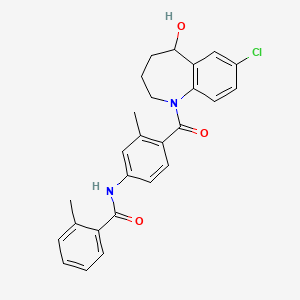
| Formula | C26H25ClN2O3 |
|---|---|
| Molecular weight | 448.95 g/mol |
| IUPAC name | N-[4-(7-chloro-5-hydroxy-2,3,4,5-tetrahydro-1-benzazepine-1-carbonyl)-3-methylphenyl]-2-methylbenzamide |
| CAS | 150683-30-0 |
| PubChem CID | 216237 |
| InChIKey | GYHCTFXIZSNGJT-UHFFFAOYSA-N |
| logP | 5.68 (XLogP 4.8) |
| Polar surface area | 69.64 Ų |
| H-bond acceptors / donors | 3 / 2 |
| Drug-likeness (QED) | 0.54 |
| Lipinski violations | 1 |
SMILES
Cc1ccccc1C(=O)Nc1ccc(C(=O)N2CCCC(O)c3cc(Cl)ccc32)c(C)c1Biology & Pharmacokinetics
Pharmacokinetics
| BBB penetrant | No |
|---|
Enzyme interactions
| Enzyme | Role | Detail |
|---|---|---|
| CYP1A2 | Substrate | — |
| CYP2B6 | Inhibitor | — |
| CYP2C19 | Inhibitor | — |
| CYP2C19 | Substrate | — |
| CYP2C8 | Inhibitor | — |
| CYP2C9 | Inhibitor | — |
| CYP3A4 | Inhibitor | — |
| CYP3A4 | Substrate | — |
Receptor binding (top 2)
| Target | Action | Affinity |
|---|---|---|
| V2 receptor (AVPR2) | Antagonist | pKi 9.4 |
| V1A receptor (AVPR1A) | Antagonist | pKi 7.9 |
Transporters
BCRP (Inhibitor)BSEP (Inhibitor)BSEP (Inhibitor)MATE1 (Inhibitor)MATE2 (Inhibitor)MDR1 (Inhibitor)MRP1 (Inhibitor)MRP2 (Inhibitor)MRP3 (Inhibitor)MRP4 (Inhibitor)NTCP (Inhibitor)OAT1 (Inhibitor)OAT3 (Inhibitor)OATP1B1 (Inhibitor)OATP1B1 (Inhibitor)OATP1B3 (Inhibitor)OATP1B3 (Inhibitor)OCT1 (Inhibitor)OCT2 (Inhibitor)P-gp (Inhibitor)MDR1 (Substrate)P-gp (Substrate)
Drug–drug interactions (100+, DDInter)
| Interacting drug | Severity | Management |
|---|---|---|
| Apalutamide | major | |
| Ceritinib | major | |
| Clarithromycin | major | |
| Cobicistat | major | |
| Enzalutamide | major | |
| Idelalisib | major | |
| Ketoconazole | major | |
| Leflunomide | major | |
| Lumacaftor | major | |
| Mitotane | major | |
| Teriflunomide | major | |
| Afatinib | moderate | |
| Alpelisib | moderate | |
| Aminoglutethimide | moderate | |
| Apixaban | moderate | |
| Aprepitant | moderate | |
| Artesunate | moderate | |
| Asparaginase Escherichia coli | moderate | |
| Betrixaban | moderate | |
| Bexarotene | moderate | |
| Binimetinib | moderate | |
| Bosutinib | moderate | |
| Brentuximab vedotin | moderate | |
| Brigatinib | moderate | |
| Cabozantinib | moderate | |
| Cladribine | moderate | |
| Clofarabine | moderate | |
| Cobimetinib | moderate | |
| Crizotinib | moderate | |
| Cyclosporine | moderate | |
| Dabrafenib | moderate | |
| Daunorubicin | moderate | |
| Daunorubicin (liposomal) | moderate | |
| Deferasirox | moderate | |
| Desmopressin | moderate | |
| Dexamethasone | moderate | |
| Docetaxel | moderate | |
| Doxorubicin | moderate | |
| Doxorubicin (liposomal) | moderate | |
| Edoxaban | moderate |
Showing 40 of 100+.
Registered Products (5)
| Brand | Form / strength | Pack | Agent | Citizen (JOD) |
|---|---|---|---|---|
| Politav Tablet | Tablet 45 mg, 15 mg | 56 tab | HIKMA PHARMACEUTICALS - JORDAN | — |
| Politav Tablet | Tablet 30 mg, 90 mg | 56 tab | HIKMA PHARMACEUTICALS - JORDAN | — |
| Politav Tablets | Tablet 30 mg, 60 mg | 56 tab | HIKMA PHARMACEUTICALS - JORDAN | — |
| Unotav Tablet | Tablet 15.00 mg | 10 tab | HIKMA PHARMACEUTICALS - JORDAN | — |
| Unotav Tablet | Tablet 30.00 mg | 10 tab | HIKMA PHARMACEUTICALS - JORDAN | — |