Upadacitinib
JFDA label: Rinvoq
- SERIOUS INFECTIONS, MORTALITY, MALIGNANCY, MAJOR ADVERSE CARDIOVASCULAR EVENTS, and THROMBOSIS SERIOUS INFECTIONS Patients treated with RINVOQ /RINVOQ LQ are at increased risk for developing serious i
Mechanism of Action
12.1 Mechanism of Action Upadacitinib is a Janus kinase (JAK) inhibitor. JAKs are intracellular enzymes which transmit signals arising from cytokine or growth factor-receptor interactions on the cellular membrane to influence cellular processes of hematopoiesis and immune cell function. Within the signaling pathway, JAKs phosphorylate and activate signal transducers and activators of transcription (STATs) which modulate intracellular activity including gene expression. Upadacitinib modulates the signaling pathway at the point of JAKs, preventing the phosphorylation and activation of STATs. JAK enzymes transmit cytokine signaling through their pairing (e.g., JAK1/JAK2, JAK1/JAK3, JAK1/TYK2, JAK2/JAK2, JAK2/TYK2). In a cell-free isolated enzyme assay, upadacitinib had greater inhibitory potency at JAK1 and JAK2 relative to JAK3 and TYK2. In human leukocyte cellular assays, upadacitinib inhibited cytokine-induced STAT phosphorylation mediated by JAK1 and JAK1/JAK3 more potently than JAK2/JAK2 mediated STAT phosphorylation. The relevance of inhibition of specific JAK enzymes to therapeutic effectiveness is not currently known.
Indications
Off-label
- Alopecia Areata
- Arthritis, Juvenile
- Arthritis, Psoriatic
- Arthritis, Rheumatoid
- Colitis, Ulcerative
- Crohn Disease
- Dermatitis, Atopic
- Giant Cell Arteritis
- Hidradenitis Suppurativa
- Lupus Erythematosus, Systemic
- Spondylitis, Ankylosing
- Takayasu Arteritis
- Vitiligo
Contraindications
Source: openFDA
- is contraindicated in patients with known hypersensitivity to upadacitinib or any of its excipients [see Warnings and Precautions ( 5.6 )] . Known hypersensitivity to upadacitinib or any of the excipients in RINVOQ/RINVOQ LQ. ( 4 , 5.6 ) Absolute
Dosing
Source: openFDA
Warnings & Precautions
Source: openFDA
Boxed Warning
SERIOUS INFECTIONS, MORTALITY, MALIGNANCY, MAJOR ADVERSE CARDIOVASCULAR EVENTS, and THROMBOSIS SERIOUS INFECTIONS Patients treated with RINVOQ /RINVOQ LQ are at increased risk for developing serious infections that may lead to hospitalization or death [see Warnings and Precautions ( 5.1 ), Adverse Reactions ( 6.1 )]. Most patients who developed these infections were taking concomitant immunosuppressants such as methotrexate or corticosteroids. If a serious infection develops, interrupt RINVOQ /RINVOQ LQ until the infection is controlled. Reported infections include: Active tuberculosis, which may present with pulmonary or extrapulmonary disease. Patients should be tested for latent tuberculosis before RINVOQ /RINVOQ LQ use and during therapy. Treatment for latent infection should be considered prior to RINVOQ /RINVOQ LQ use. Invasive fungal infections, including cryptococcosis and pneumocystosis. Bacterial, viral, including herpes zoster, and other infections due to opportunistic pathogens. The risks and benefits of treatment with RINVOQ /RINVOQ LQ should be carefully considered prior to initiating therapy in patients with chronic or recurrent infection. Patients should be closely monitored for the development of signs and symptoms of infection during and after treatment with RINVOQ /RINVOQ LQ , including the possible development of tuberculosis in patients who tested negative for latent tuberculosis infection prior to initiating therapy [see Warnings and Precautions ( 5.1 )]. MORTALITY In a large, randomized, postmarketing safety study in rheumatoid arthritis (RA) patients 50 years of age and older with at least one cardiovascular risk factor comparing another Janus kinase (JAK) inhibitor to tumor necrosis factor (TNF) blockers, a higher rate of all-cause mortality, including sudden cardiovascular death, was observed with the JAK inhibitor [see Warnings and Precautions ( 5.2 )] . MALIGNANCIES Lymphoma and other malignancies have been observed in patients treated with RINVOQ . In RA patients treated with another JAK inhibitor, a higher rate of malignancies (excluding non-melanoma skin cancer (NMSC)) was observed when compared with TNF blockers. Patients who are current or past smokers are at additional increased risk [see Warnings and Precautions ( 5.3 )] . MAJOR ADVERSE CARDIOVASCULAR EVENTS In RA patients 50 years of age and older with at least one cardiovascular risk factor treated with another JAK inhibitor, a higher rate of major adverse cardiovascula
Warnings & Precautions
Serious Infections : Avoid use in patients with active, serious infection, including localized infections. ( 5.1 ) Hypersensitivity : Serious hypersensitivity reactions (e.g., anaphylaxis) have been reported. Discontinue if a serious hypersensitivity reaction occurs. ( 5.6 ) Gastrointestinal (GI) Perforations : Monitor patients at risk for GI perforations and promptly evaluate patients with symptoms. ( 5.7 ) Laboratory Abnormalities : Monitoring recommended due to potential changes in lymphocytes, neutrophils, hemoglobin, liver enzymes and lipids. ( 5.8 ) Embryo-Fetal Toxicity : May cause fetal harm based on animal studies. Advise female patients of reproductive potential of the potential risk to a fetus and to use effective contraception. ( 5.9 , 8.1 , 8.3 ) Vaccinations : Avoid use with live vaccines. ( 5.10 ) Medication Residue in Stool : Observed in stool or ostomy output in patients with shortened GI transit times. Monitor patients clinically and consider alternative treatment if inadequate therapeutic response. ( 5.11 )
Serious Infections Serious and sometimes fatal infections have been re
Serious Infections Serious and sometimes fatal infections have been reported in patients receiving RINVOQ. The most frequent serious infections reported with RINVOQ included pneumonia and cellulitis [see Adverse Reactions ( 6.1 )] . Among opportunistic infections, tuberculosis, multidermatomal herpes zoster, oral/esophageal candidiasis, and cryptococcosis, were reported with RINVOQ. A higher rate of serious infections was observed with RINVOQ 30 mg compared to RINVOQ 15 mg. Avoid use of RINVOQ/RINVOQ LQ in patients with an active, serious infection, including localized infections. Consider the risks and benefits of treatment prior to initiating RINVOQ/RINVOQ LQ in patients: with chronic or recurrent infection who have been exposed to tuberculosis with a history of a serious or an opportunistic infection who have resided or traveled in areas of endemic tuberculosis or endemic mycoses; or with underlying conditions that may predispose them to infection. Closely monitor patients for the development of signs and symptoms of infection during and after treatment with RINVOQ/RINVOQ LQ. Interrupt RINVOQ/RINVOQ LQ if a patient develops a serious or opportunistic infection. A patient who develops a new infection during treatment with RINVOQ/RINVOQ LQ should undergo prompt and complete diagnostic testing appropriate for an immunocompromised patient; appropriate antimicrobial therapy should be initiated, the patient should be closely monitored, and RINVOQ/RINVOQ LQ should be interrupted if the patient is not responding to antimicrobial therapy. RINVOQ/RINVOQ LQ may be resumed once the infection is controlled. Tuberculosis Evaluate and test patients for latent and active tuberculosis (TB) infection prior to administration of RINVOQ/RINVOQ LQ. Patients with latent TB should be treated with standard antimycobacterial therapy before initiating RINVOQ/RINVOQ LQ. RINVOQ/RINVOQ LQ should not be given to patients with active TB. Consider anti-TB therapy prior to initiation of RINVOQ/RINVOQ LQ in patients with previously untreated latent TB or active TB in whom an adequate course of treatment cannot be confirmed, and for patients with a negative test for latent TB but who have risk factors for TB infection. Consultation with a physician with expertise in the treatment of TB is recommended to aid in the decision about whether initiating anti-TB therapy is appropriate for an individual patient. During RINVOQ/RINVOQ LQ use, monitor patients for the development of signs and sympto
Mortality In a large, randomized, postmarketing safety study of anothe
Mortality In a large, randomized, postmarketing safety study of another JAK inhibitor in RA patients 50 years of age and older with at least one cardiovascular risk factor, a higher rate of all-cause mortality, including sudden cardiovascular death, was observed in patients treated with the JAK inhibitor compared with TNF blockers. Consider the benefits and risks for the individual patient prior to initiating or continuing therapy with RINVOQ/RINVOQ LQ. 5. 3 Malignancy and Lymphoproliferative Disorders Malignancies, including lymphomas, were observed in clinical trials of RINVOQ [see Adverse Reactions ( 6.1 )] . In a large, randomized, postmarketing safety study of another JAK inhibitor in RA patients, a higher rate of malignancies (excluding NMSC) was observed in patients treated with the JAK inhibitor compared to those treated with TNF blockers. A higher rate of lymphomas was observed in patients treated with the JAK inhibitor compared to those treated with TNF blockers. A higher rate of lung cancers was observed in current or past smokers treated with the JAK inhibitor compared to those treated with TNF blockers. In this study, current or past smokers had an additional increased risk of overall malignancies. Consider the benefits and risks for the individual patient prior to initiating or continuing therapy with RINVOQ/RINVOQ LQ, particularly in patients with a known malignancy (other than a successfully treated NMSC), patients who develop a malignancy when on treatment, and patients who are current or past smokers. Non-Melanoma Skin Cancer NMSCs have been reported in patients treated with RINVOQ. Periodic skin examination is recommended for patients who are at increased risk for skin cancer. Exposure to sunlight and UV light should be limited by wearing protective clothing and using a broad-spectrum sunscreen.
Major Adverse Cardiovascular Events In a large, randomized, postmarket
Major Adverse Cardiovascular Events In a large, randomized, postmarketing safety study of another JAK inhibitor in RA patients 50 years of age and older with at least one cardiovascular risk factor, a higher rate of major adverse cardiovascular events (MACE) defined as cardiovascular death, non-fatal myocardial infarction (MI), and non-fatal stroke was observed with the JAK inhibitor compared to those treated with TNF blockers. Patients who are current or past smokers are at additional increased risk. Consider the benefits and risks for the individual patient prior to initiating or continuing therapy with RINVOQ/RINVOQ LQ, particularly in patients who are current or past smokers and patients with other cardiovascular risk factors. Patients should be informed about the symptoms of serious cardiovascular events and the steps to take if they occur. Discontinue RINVOQ/RINVOQ LQ in patients that have experienced a myocardial infarction or stroke. 5. 5 Thrombosis Thromboses, including deep venous thrombosis (DVT), pulmonary embolism (PE), and arterial thrombosis, have occurred in patients treated for inflammatory conditions with JAK inhibitors, including RINVOQ. Many of these adverse events were serious and some resulted in death [see Adverse Reactions ( 6.1 )] . In a large, randomized, postmarketing safety study of another JAK inhibitor in RA patients 50 years of age and older with at least one cardiovascular risk factor, higher rates of overall thrombosis, DVT, and PE were observed compared to those treated with TNF blockers. If symptoms of thrombosis occur, patients should discontinue RINVOQ/RINVOQ LQ and be evaluated promptly and treated appropriately. Avoid RINVOQ/RINVOQ LQ in patients that may be at increased risk of thrombosis. 5. 6 Hypersensitivity Reactions Serious hypersensitivity reactions such as anaphylaxis and angioedema were reported in patients receiving RINVOQ in clinical trials. If a clinically significant hypersensitivity reaction occurs, discontinue RINVOQ/RINVOQ LQ and institute appropriate therapy [see Adverse Reactions ( 6.1 )] . 5. 7 Gastrointestinal Perforations Gastrointestinal perforations have been reported in clinical trials with RINVOQ [see Adverse Reactions ( 6.1 ) ] . Monitor RINVOQ/RINVOQ LQ-treated patients who may be at risk for gastrointestinal perforation (e.g., patients with a history of diverticulitis and those taking concomitant medications including NSAIDs or corticosteroids). Evaluate promptly patients presenting with ne
Laboratory Abnormalities Neutropenia Treatment with RINVOQ was associa
Laboratory Abnormalities Neutropenia Treatment with RINVOQ was associated with an increased incidence of neutropenia (ANC less than 1000 cells/mm 3 ). Evaluate neutrophil counts at baseline and thereafter according to routine patient management. Avoid RINVOQ/RINVOQ LQ initiation and interrupt RINVOQ/RINVOQ LQ treatment in patients with a low neutrophil count (i.e., ANC less than 1000 cells/mm 3 ) [see Dosage and Administration ( 2.1 , 2.14 )] . Lymphopenia ALC less than 500 cells/mm 3 were reported in RINVOQ-treated patients in clinical trials. Evaluate lymphocyte counts at baseline and thereafter according to routine patient management. Avoid RINVOQ/RINVOQ LQ initiation or interrupt RINVOQ/RINVOQ LQ treatment in patients with a low lymphocyte count (i.e., less than 500 cells/mm 3 ) [see Dosage and Administration ( 2.1 , 2.14 )] . Anemia Decreases in hemoglobin levels to less than 8 g/dL were reported in RINVOQ-treated patients in clinical trials. Evaluate hemoglobin at baseline and thereafter according to routine patient management. Avoid RINVOQ/RINVOQ LQ initiation or interrupt RINVOQ/RINVOQ LQ treatment in patients with a low hemoglobin level (i.e., less than 8 g/dL) [see Dosage and Administration ( 2.1 , 2.14 )] . Lipids Treatment with RINVOQ was associated with increases in lipid parameters, including total cholesterol, low-density lipoprotein (LDL) cholesterol, and high-density lipoprotein (HDL) cholesterol [see Adverse Reactions ( 6.1 )] . Elevations in LDL cholesterol decreased to pre-treatment levels in response to statin therapy. The effect of these lipid parameter elevations on cardiovascular morbidity and mortality has not been determined. Assess lipid parameters approximately 12 weeks after initiation of treatment, and thereafter according to the clinical guidelines for hyperlipidemia. Manage patients according to clinical guidelines for the management of hyperlipidemia. Liver Enzyme Elevations Treatment with RINVOQ was associated with increased incidence of liver enzyme elevations compared to treatment with placebo. Evaluate liver enzymes at baseline and thereafter according to routine patient management. Prompt investigation of the cause of liver enzyme elevation is recommended to identify potential cases of drug-induced liver injury. If increases in ALT or AST are observed during routine patient management and drug-induced liver injury is suspected, RINVOQ/RINVOQ LQ should be interrupted until this diagnosis is excluded. 5. 9 Embryo-Fetal T
Medication Residue in Stool Reports of medication residue in stool or
Medication Residue in Stool Reports of medication residue in stool or ostomy output have occurred in patients taking RINVOQ. Most reports described anatomic (e.g., ileostomy, colostomy, intestinal resection) or functional gastrointestinal conditions with shortened gastrointestinal transit times. Instruct patients to contact their healthcare provider if medication residue is observed repeatedly. Monitor patients clinically and consider alternative treatment if there is an inadequate therapeutic response.
Pregnancy & Lactation
Lactation
Expert opinion considers breastfeeding to be unadvisable during tofacitinib use at this time.[ 1 - 4 ] The manufacturer recommends that breastfeeding be withheld for 6 days after the last dose.
Chemistry & Properties
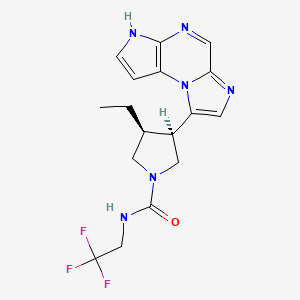
| Formula | C17H19F3N6O |
|---|---|
| Molecular weight | 380.37 g/mol |
| IUPAC name | (3S,4R)-3-ethyl-4-(1,5,7,10-tetrazatricyclo[7.3.0.02,6]dodeca-2(6),3,7,9,11-pentaen-12-yl)-N-(2,2,2-trifluoroethyl)pyrrolidine-1-carboxamide |
| CAS | 1310726-60-3 |
| PubChem CID | 58557659 |
| InChIKey | WYQFJHHDOKWSHR-MNOVXSKESA-N |
| logP | 2.91 (XLogP 2.7) |
| Polar surface area | 78.32 Ų |
| H-bond acceptors / donors | 4 / 2 |
| Drug-likeness (QED) | 0.73 |
| Lipinski violations | 0 |
SMILES
CC[C@@H]1CN(C(=O)NCC(F)(F)F)C[C@@H]1c1cnc2cnc3[nH]ccc3n12Biology & Pharmacokinetics
Pharmacokinetics predicted
| Bioavailability | 70.0% |
|---|---|
| Half-life | 1.442 h |
| Volume of distribution | 4.394 L/kg |
| Protein binding | 93.1% |
| BBB penetrant | Yes |
Enzyme interactions
| Enzyme | Role | Detail |
|---|---|---|
| CYP1A2 | Substrate | — |
| CYP2C8 | Inhibitor | — |
| CYP2C9 | Substrate | — |
| CYP3A4 | Substrate | — |
Receptor binding (top 4)
| Target | Action | Affinity |
|---|---|---|
| Janus kinase 1 (JAK1) | Inhibitor | pIC50 8.5 |
| Janus kinase 2 (JAK2) | Inhibitor | pIC50 6.9 |
| Janus kinase 3 (JAK3) | Inhibitor | pIC50 5.6 |
| tyrosine kinase 2 (TYK2) | Inhibitor | pIC50 5.3 |
Transporters
BCRP (Inhibitor)BCRP (Inhibitor)BSEP (Inhibitor)BSEP (Inhibitor)MATE1 (Inhibitor)MATE2 (Inhibitor)MRP1 (Inhibitor)OAT1 (Inhibitor)OAT3 (Inhibitor)OATP1B1 (Inhibitor)OATP1B1 (Inhibitor)OATP1B3 (Inhibitor)OATP1B3 (Inhibitor)OCT1 (Inhibitor)OCT2 (Inhibitor)P-gp (Inhibitor)Transporter(unspecified) (Inhibitor)BCRP (Substrate)MDR1 (Substrate)OATP1B (Substrate)OATP1B1 (Substrate)OATP1B3 (Substrate)OCT1 (Substrate)P-gp (Substrate)
Drug–drug interactions (100+, DDInter)
| Interacting drug | Severity | Management |
|---|---|---|
| Abatacept | major | |
| Abemaciclib | major | |
| Acalabrutinib | major | |
| Adalimumab | major | |
| Aflibercept | major | |
| Aldesleukin | major | |
| Alefacept | major | |
| Alemtuzumab | major | |
| Altretamine | major | |
| Amprenavir | major | |
| Anakinra | major | |
| Antilymphocyte immunoglobulin (horse) | major | |
| Antithymocyte immunoglobulin (rabbit) | major | |
| Apalutamide | major | |
| Asparaginase Escherichia coli | major | |
| Atazanavir | major | |
| Atezolizumab | major | |
| Avapritinib | major | |
| Axicabtagene ciloleucel | major | |
| Azacitidine | major | |
| Azathioprine | major | |
| Bacillus calmette-guerin substrain tice live antigen | major | |
| Baricitinib | major | |
| Basiliximab | major | |
| Beclomethasone dipropionate | major | |
| Belantamab mafodotin | major | |
| Belatacept | major | |
| Belimumab | major | |
| Belinostat | major | |
| Bendamustine | major | |
| Betamethasone | major | |
| Bexarotene | major | |
| Bleomycin | major | |
| Blinatumomab | major | |
| Boceprevir | major | |
| Bortezomib | major | |
| Bosutinib | major | |
| Brentuximab vedotin | major | |
| Brexucabtagene autoleucel | major | |
| Brigatinib | major |
Showing 40 of 100+.
Registered Products (1)
| Brand | Form / strength | Pack | Agent | Citizen (JOD) |
|---|---|---|---|---|
| Rinvoq | Tablet 15 mg | 30 tab | Abu Sheikha Drug Store | — |