Nifedipine
JFDA label: Myogard Retard 20 Tablets
Mechanism of Action
Blocker of Voltage-gated L-type calcium channel — Voltage-gated L-type calcium channel blocker
| Target | Action | Gene / class |
|---|---|---|
| Voltage-gated L-type calcium channel efficacy | BLOCKER |
Indications
Approved
- Chronic kidney disease (CKD) and hypertension
- Diabetes and hypertension
- Hypertension
Off-label
- Achalasia
- High altitude pulmonary edema (prevention and treatment)
- Hypertensive emergency in pregnancy
- Preterm labor
- Pulmonary hypertension
- Raynaud phenomenon
- Ureteral calculi (distal)
Contraindications
Source: Lexicomp · Curated
- Additional contraindications (not in US labeling): Severe hypotension Absolute
- Cardiogenic shock Absolute
- Hypersensitivity to nifedipine or any component of the formulation Note: Considered contraindicated in patients with ST-elevation myocardial infarction (STEMI) (ACCF/AHA [O'Gara 2013]) Absolute
- Kock pouch (ileostomy after proctocolectomy) Absolute
- SOGC [Magee 2014]). Extended release only: Hypersensitivity to other dihydropyridine calcium antagonists Absolute
- Yancy 2013) Absolute
- avoid use (Elkayam 1990 Absolute
- breast-feeding Absolute
- cardiovascular shock Absolute
- moderate or severe hepatic impairment Absolute
- pregnancy or women of childbearing potential. Note: SOGC and ACOG guidelines recommend nifedipine as a preferred agent for maternal hypertension (ACOG 2013 Absolute
- severe gastrointestinal obstructive disorders, concomitant use with rifampicin Absolute
Adverse Reactions
Cardiac disorders (6)
Very Common Flushing · peripheral edema
Common cardiac failure · Palpitations · Reflex tachycardia · transient hypotension
Vascular disorders (1)
Very Common Flushing
Nervous system disorders (12)
Very Common Dizziness · Headache · headache
Common chills · disturbed sleep · Dizziness · equilibrium disturbance · fatigue · jitteriness · Mood changes · nervousness · shakiness
Renal and urinary disorders (1)
Common Sexual difficulty
Gastrointestinal disorders (9)
Very Common Heartburn · nausea
Common abdominal cramps · Constipation · constipation · diarrhea · flatulence · Gingival hyperplasia · sore throat
Skin and subcutaneous tissue disorders (4)
Common Dermatitis · diaphoresis · pruritus · urticaria
Musculoskeletal and connective tissue disorders (3)
Common Muscle cramps · tremor · weakness
General disorders and administration site conditions (3)
Very Common Peripheral oedema
Common Fever · inflammation
Respiratory, thoracic and mediastinal disorders (5)
Common chest congestion · Cough · dyspnea · nasal congestion · wheezing
Dosing
Source: Lexicomp
Warnings & Precautions
Source: Lexicomp
Angina/MI
Increased angina and/or MI have occurred with initiation or dosage titration of dihydropyridine calcium channel blockers. Reflex tachycardia may occur resulting in angina and/or MI in patients with obstructive coronary disease, especially in the absence of concurrent beta-blockade. In patients with unstable angina/non-STEMI, the use of immediate-release nifedipine is not recommended except with concomitant beta-blockade (ACCF/AHA [Anderson 2013]).
Hypotension/syncope
Symptomatic hypotension with or without syncope can rarely occur; blood pressure must be lowered at a rate appropriate for the patient's clinical condition. The use of immediate release nifedipine (sublingually or orally) in hypertensive emergencies and urgencies is neither safe nor effective. Serious adverse events (eg, death, cerebrovascular ischemia, syncope, stroke, acute myocardial infarction, and fetal distress) have been reported. Immediate release nifedipine should not be used for acute blood pressure reduction. Guidelines are available when immediate release nifedipine is required for acute treatment in pregnant or postpartum women (ACOG 692 2017; Magee 2014).
Peripheral edema
The most common side effect is peripheral edema; occurs within 2 to 3 weeks of starting therapy. Disease-related concerns:
Aortic stenosis
Use with extreme caution in patients with severe aortic stenosis; may reduce coronary perfusion resulting in myocardial ischemia.
GI strictures
Alterations in GI anatomy (eg, severe GI narrowing, history of GI cancer, obstruction, bowel resection, gastric bypass, vertical banded gastroplasty) and underlying hypomotility disorders have led to bezoar formation with extended release forms.
Heart failure
The ACCF/AHA heart failure guidelines recommend to avoid use in patients with HF due to lack of benefit and/or worse outcomes with calcium channel blockers in general (Yancy 2013).
Hepatic impairment
Use with caution in patients with hepatic impairment. Clearance of nifedipine is reduced in cirrhotic patients leading to increased systemic exposure; monitor closely for adverse effects/toxicity and consider dose adjustments.
Hypertrophic cardiomyopathy (HCM) with outflow tract obstruction
Use with caution in patients with HCM and outflow tract obstruction since reduction in afterload may worsen symptoms associated with this condition. Concurrent drug therapy issues:
Drug-drug interactions
Potentially significant interactions may exist, requiring dose or frequency adjustment, additional monitoring, and/or selection of alternative therapy. Consult drug interactions database for more detailed information. Dosage form specific issues:
Extended release formulation
Consists of drug within a nondeformable matrix; following drug release/absorption, the matrix/shell is expelled in the stool. The use of nondeformable products in patients with known stricture/narrowing of the GI tract (eg, severe gastrointestinal narrowing, colon cancer, obstruction, bowel resection, gastric bypass, vertical banded gastroplasty) has been associated with symptoms of obstruction (pharmacobezoar).
Immediate release formulation
Immediate release formulations should not be used to manage primary hypertension, adequate studies to evaluate outcomes have not been conducted.
Lactose
Adalat CC tablets contain lactose; do not use with galactose intolerance, Lapp lactase deficiency, or glucose-galactose malabsorption syndromes. Other warnings/precautions:
Surgery
Use with caution before major surgery. Cardiopulmonary bypass, intraoperative blood loss or vasodilating anesthesia may result in severe hypotension and/or increased fluid requirements. Consider withdrawing nifedipine (>36 hours) before surgery if possible.
Withdrawal
Abrupt withdrawal may cause rebound angina in patients with CAD.
Pregnancy & Lactation
Pregnancy
Safe
Second-line after labetalol/methyldopa for chronic hypertension; first-line tocolytic (preterm labour). Avoid with magnesium sulphate (potentiates neuromuscular blockade)
Lactation
Nifedipine is present in breast milk. The relative infant dose (RID) of nifedipine is 0.27% to 3.2% when calculated using the highest breast milk concentration located and compared to an infant therapeutic dose of 0.25 to 3 mg/kg/day. In general, breastfeeding is considered acceptable when the RID is Milk concentrations reached a peak within 1 hour of maternal administration of immediate release capsules (Ehrenkrantz 1989; Penny 1989). The half-life of nifedipine in breast milk has been report
Monitoring
| Clinical pearl | Heart rate, blood pressure, signs and symptoms of CHF, peripheral edema |
|---|
Chemistry & Properties
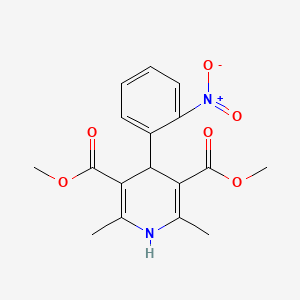
| Formula | C17H18N2O6 |
|---|---|
| Molecular weight | 346.34 g/mol |
| IUPAC name | dimethyl 2,6-dimethyl-4-(2-nitrophenyl)-1,4-dihydropyridine-3,5-dicarboxylate |
| CAS | 21829-25-4 |
| PubChem CID | 4485 |
| InChIKey | HYIMSNHJOBLJNT-UHFFFAOYSA-N |
| logP | 2.18 (XLogP 2.2) |
| Polar surface area | 107.77 Ų |
| H-bond acceptors / donors | 7 / 1 |
| Drug-likeness (QED) | 0.51 |
| Lipinski violations | 0 |
SMILES
COC(=O)C1=C(C)NC(C)=C(C(=O)OC)C1c1ccccc1[N+](=O)[O-]Biology & Pharmacokinetics
Pharmacokinetics predicted
| Bioavailability | 70.0% |
|---|---|
| Half-life | 0.687 h |
| Volume of distribution | 1.496 L/kg |
| Protein binding | 97.8% |
| BBB penetrant | No |
Enzyme interactions
| Enzyme | Role | Detail |
|---|---|---|
| CYP1A2 | Inhibitor | IC₅₀ 0.8306623862918078 µM |
| CYP1A2 | Substrate | — |
| CYP2C19 | Inhibitor | IC₅₀ 5.420000000000002 µM |
| CYP2C8 | Inhibitor | — |
| CYP2C9 | Inhibitor | IC₅₀ 4.080000000000001 µM |
| CYP2D6 | Substrate | — |
| CYP3A4 | Inhibitor | IC₅₀ 13.055161485691356 µM |
| CYP3A4 | Substrate | — |
Receptor binding (top 5)
| Target | Action | Affinity |
|---|---|---|
| Cav1.3 (CACNA1D) | Gating inhibitor | pIC50 7.7 |
| 5-HT2A (HTR2A) | Binding | pKi 6.5 |
| Cav1.4 (CACNA1F) | Gating inhibitor | pIC50 6.0 |
| glycine receptor β subunit (GLRB) | Antagonist | pIC50 5.9 |
| glycine receptor α1 subunit (GLRA1) | Antagonist | pIC50 5.5 |
Transporters
ASBT (Inhibitor)BCRP (Inhibitor)BCRP (Inhibitor)BSEP (Inhibitor)BSEP (Inhibitor)ENT1 (Inhibitor)ENT2 (Inhibitor)MDR1 (Inhibitor)MRP1 (Inhibitor)MRP1 (Inhibitor)MRP2 (Inhibitor)MRP3 (Inhibitor)MRP4 (Inhibitor)NTCP (Inhibitor)OATP1B1 (Inhibitor)OATP1B1 (Inhibitor)OATP1B3 (Inhibitor)OATP1B3 (Inhibitor)OATP2B1 (Inhibitor)OCT1 (Inhibitor)OCTN1 (Inhibitor)OCTN2 (Inhibitor)P-gp (Inhibitor)MDR1 (Substrate)P-gp (Substrate)
Drug–drug interactions (100+, DDInter)
| Interacting drug | Severity | Management |
|---|---|---|
| Apalutamide | major | |
| Ceritinib | major | |
| Cisapride | major | |
| Dolasetron | major | |
| Enzalutamide | major | |
| Lumacaftor | major | |
| Mitotane | major | |
| Siponimod | major | |
| Venetoclax | major | |
| Acalabrutinib | moderate | |
| Acetylsalicylic acid | moderate | |
| Adalimumab | moderate | |
| Aldesleukin | moderate | |
| Alefacept | moderate | |
| Alimemazine | moderate | |
| Amifostine | moderate | |
| Anagrelide | moderate | |
| Anakinra | moderate | |
| Apixaban | moderate | |
| Aprepitant | moderate | |
| Axitinib | moderate | |
| Betamethasone | moderate | |
| Betrixaban | moderate | |
| Bexarotene | moderate | |
| Binimetinib | moderate | |
| Bosutinib | moderate | |
| Brigatinib | moderate | |
| Brimonidine (ophthalmic) | moderate | |
| Brimonidine (topical) | moderate | |
| Budesonide | moderate | |
| Budesonide (nasal) | moderate | |
| Bupropion | moderate | |
| Cabazitaxel | moderate | |
| Calcium Phosphate | moderate | |
| Calcium acetate | moderate | |
| Calcium carbonate | moderate | |
| Calcium chloride | moderate | |
| Calcium citrate | moderate | |
| Calcium glubionate anhydrous | moderate | |
| Calcium glucoheptonate | moderate |
Showing 40 of 100+.
Registered Products (6)
| Brand | Form / strength | Pack | Agent | Citizen (JOD) |
|---|---|---|---|---|
| Epilat Retard 20 mg. Tab | Tablet 20 mg | 20 tab pack varies | Reda Jardaneh Drug Store | 2.000 |
| Myogard Retard 20 Tablets | Tablet 20 mg | 30 tab pack varies | UNITED PHARM.MFG.CO.LTD(UPM)/JORDAN | 4.440 |
| Adalat LA | Tablet 30 mg | 30 tab | Khoury Drug Store | 5.920 |
| Adalat LA | Tablet 60 mg | 30 tab | Khoury Drug Store | 12.930 |
| Epilat Retard 20 mg. Tab | Tablet 20 mg | 1000 tab pack varies | Reda Jardaneh Drug Store | 60.610 |
| Myogard Retard 20 Tablets | Tablet 20 mg | 1000 tab pack varies | UNITED PHARM.MFG.CO.LTD(UPM)/JORDAN | 125.800 |