Carteolol
JFDA label: Opti-tens LP 2% ED
Indications
Approved
- Cardiovascular Diseases — cardiovascular disease
- Glaucoma — glaucoma
Contraindications
Source: openFDA
- Carteolol is contraindicated in those individuals with bronchial asthma or with a history of bronchial asthma, or severe chronic obstructive pulmonary disease (see WARNINGS ); sinus bradycardia; second- and third-degree atrioventricular block; overt cardiac failure (see WARNINGS ); cardiogenic shock; or hypersensivity to any component of this product. Absolute
Adverse Reactions
Cardiac disorders (5)
Not Known Arrhythmia · Atrioventricular block · Bradycardia · Cardiac failure congestive · Palpitations
Vascular disorders (1)
Not Known Hypotension
Nervous system disorders (6)
Not Known Cerebral ischaemia · Cerebrovascular accident · Dizziness · Headache · Loss of consciousness · Syncope
Immune system disorders (1)
Not Known Hypersensitivity
Metabolism and nutrition disorders (2)
Not Known Diabetes mellitus · Hypoglycaemia
Gastrointestinal disorders (1)
Not Known Nausea
Skin and subcutaneous tissue disorders (1)
Not Known Rash generalised
Psychiatric disorders (3)
Not Known Depression · Insomnia · Photophobia
Eye disorders (7)
Not Known Conjunctivitis · Diplopia · Eye irritation · Eyelid ptosis · Lacrimation increased · Vision blurred · Visual impairment
Infections and infestations (1)
Not Known Sinusitis
General disorders and administration site conditions (8)
Not Known Asthenia · Conjunctival hyperaemia · Dysgeusia · Keratitis · Night blindness · Oedema · Shock · Vital dye staining cornea present
Respiratory, thoracic and mediastinal disorders (3)
Not Known Bronchospasm · Dyspnoea · Respiratory failure
Dosing
Source: openFDA
Warnings & Precautions
Source: openFDA
Warnings & Precautions
Carteolol has not been detected in plasma following ocular instillation. However, as with other topically applied ophthalmic preparations, Carteolol may be absorbed systemically. The same adverse reactions found with systemic administration of beta-adrenergic blocking agents may occur with topical administration. For example, severe respiratory reactions and cardiac reactions, including death due to bronchospasm in patients with asthma, and rarely death in association with cardiac failure, have been reported with topical application of beta-adrenergic blocking agents (see CONTRAINDICATIONS ). Cardiac Failure: Sympathetic stimulation may be essential for support of the circulation in individuals with diminished myocardial contractility, and its inhibition by beta-adrenergic receptor blockade may precipitate more severe failure. In Patients Without a History of Cardiac Failure: Continued depression of the myocardium with beta-blocking agents over a period of time can, in some cases, lead to cardiac failure. At the first sign or symptom of cardiac failure, Carteolol Hydrochloride should be discontinued. Non-Allergic Bronchospasm: In patients with non-allergic bronchospasm or with a history of non-allergic bronchospasm (e.g., chronic bronchitis, emphysema), Carteolol Hydrochloride Ophthalmic Solution should be administered with caution since it may block bronchodilation produced by endogenous and exogenous catecholamine stimulation of beta 2 receptors. Major Surgery: The necessity or desirability of withdrawal of beta-adrenergic blocking agents prior to major surgery is controversial. Beta-adrenergic receptor blockade impairs the ability of the heart to respond to beta-adrenergically mediated reflex stimuli. This may augment the risk of general anesthesia in surgical procedures. Some patients receiving beta-adrenergic receptor blocking agents have been subject to protracted severe hypotension during anesthesia. For these reasons, in patients undergoing elective surgery, gradual withdrawal of beta-adrenergic receptor blocking agents may be appropriate. If necessary during surgery, the effects of beta-adrenergic blocking agents may be reversed by sufficient doses of such agonists as isoproterenol, dopamine, dobutamine or levarterenol (see OVERDOSAGE ). Diabetes Mellitus: Beta-adrenergic blocking agents should be administered with caution in patients subject to spontaneous hypoglycemia or to diabetic patients (especially those with labile diabetes) who are receiv
Pregnancy & Lactation
Pregnancy
Lactation
No data are available for the use of carteolol during breastfeeding.
Chemistry & Properties
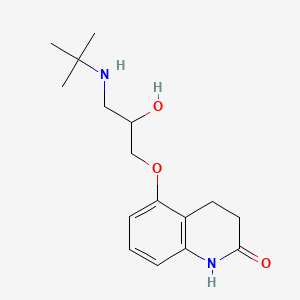
| Formula | C16H24N2O3 |
|---|---|
| Molecular weight | 292.38 g/mol |
| IUPAC name | 5-[3-(tert-butylamino)-2-hydroxypropoxy]-3,4-dihydro-1H-quinolin-2-one |
| CAS | 51781-06-7 |
| PubChem CID | 2583 |
| InChIKey | LWAFSWPYPHEXKX-UHFFFAOYSA-N |
| logP | 1.7 (XLogP 1.0) |
| Polar surface area | 70.59 Ų |
| H-bond acceptors / donors | 4 / 3 |
| Drug-likeness (QED) | 0.77 |
| Lipinski violations | 0 |
SMILES
CC(C)(C)NCC(O)COc1cccc2c1CCC(=O)N2Biology & Pharmacokinetics
Pharmacokinetics
| BBB penetrant | Yes (logBB -0.4) |
|---|
Enzyme interactions
| Enzyme | Role | Detail |
|---|---|---|
| CYP2C19 | Substrate | — |
| CYP2D6 | Substrate | — |
| CYP3A4 | Substrate | — |
Transporters
BCRP (Inhibitor)BSEP (Inhibitor)BSEP (Inhibitor)MRP1 (Inhibitor)OATP1B1 (Inhibitor)OATP1B3 (Inhibitor)P-gp (Inhibitor)P-gp (Substrate)
Drug–drug interactions (100+, DDInter)
| Interacting drug | Severity | Management |
|---|---|---|
| Aminophylline | major | |
| Ceritinib | major | |
| Dolasetron | major | |
| Dyphylline | major | |
| Epinephrine | major | |
| Fingolimod | major | |
| Formoterol | major | |
| Indacaterol | major | |
| Iobenguane (I-131) | major | |
| Olodaterol | major | |
| Orciprenaline | major | |
| Pirbuterol | major | |
| Salbutamol | major | |
| Salmeterol | major | |
| Siponimod | major | |
| Terbutaline | major | |
| Theophylline | major | |
| Vilanterol | major | |
| Aldesleukin | moderate | |
| Alectinib | moderate | |
| Amifostine | moderate | |
| Atropine | moderate | |
| Betamethasone | moderate | |
| Brigatinib | moderate | |
| Brimonidine (ophthalmic) | moderate | |
| Brimonidine (topical) | moderate | |
| Budesonide | moderate | |
| Bupropion | moderate | |
| Calcium Phosphate | moderate | |
| Calcium acetate | moderate | |
| Calcium carbonate | moderate | |
| Calcium citrate | moderate | |
| Calcium glubionate anhydrous | moderate | |
| Calcium gluconate | moderate | |
| Calcium lactate | moderate | |
| Canagliflozin | moderate | |
| Chlorpropamide | moderate | |
| Cimetidine | moderate | |
| Clidinium | moderate | |
| Corticotropin | moderate |
Showing 40 of 100+.
Registered Products (1)
| Brand | Form / strength | Pack | Agent | Citizen (JOD) |
|---|---|---|---|---|
| Opti-tens LP 2% ED | Injection 20 mg/ml | 3 ml | Dar Al Dawa Development and Investment Co Ltd/Jordan | 4.920 |