Drospirenone
JFDA label: Slinda 4 mg
- Estrogen plus progestin therapy:
- Estrogen-alone therapy:
Mechanism of Action
Antagonist of Mineralocorticoid receptor — Mineralocorticoid receptor antagonist; Agonist of Progesterone receptor — Progesterone receptor agonist
| Target | Action | Gene / class |
|---|---|---|
| Mineralocorticoid receptor efficacy | ANTAGONIST | NR3C2 |
| Progesterone receptor efficacy | AGONIST | PGR |
Indications
Approved
- Vasomotor symptoms associated with menopause
- Vulvar and vaginal atrophy associated with menopause
Contraindications
Source: Lexicomp
- Additional contraindications (not in US labeling): Progestin-dependent malignant neoplasia (current or history of) Absolute
- Anaphylactic reaction, angioedema, or hypersensitivity to drospirenone, estradiol, or any component of the formulation Absolute
- DVT or PE (current or history of) Absolute
- active or history of arterial thromboembolic disease (eg, stroke, MI) Absolute
- adrenal insufficiency Absolute
- benign or malignant liver tumors (current or history of) Absolute
- breastfeeding Absolute
- carcinoma of the breast (known, suspected, or history of) Absolute
- classic migraine Absolute
- endometrial hyperplasia Absolute
- estrogen-dependent tumor (known or suspected) Absolute
- hepatic impairment or disease Absolute
- known protein C, protein S, antithrombin deficiency or other known thrombophilic disorders Absolute
- partial or complete loss of vision due to ophthalmic vascular disease Absolute
- pregnancy (confirmed or suspected) Absolute
- renal impairment Absolute
- severe hypertriglyceridemia Absolute
- undiagnosed abnormal genital bleeding Absolute
Adverse Reactions
Nervous system disorders (2)
Common Emotional lability · migraine
Renal and urinary disorders (3)
Very Common genital bleeding · Mastalgia
Common Cervical polyp
Gastrointestinal disorders (2)
Common Abdominal pain · gastrointestinal pain
Dosing
Source: Lexicomp
Warnings & Precautions
Source: Lexicomp
Breast cancer
Based on data from the Women’s Health Initiative (WHI) studies, an increased risk of invasive breast cancer was observed in postmenopausal women using conjugated estrogens (CE) in combination with medroxyprogesterone acetate (MPA). This risk may be associated with duration of use and declines once combined therapy is discontinued (Chlebowski 2009). The risk of invasive breast cancer was decreased in postmenopausal women with a hysterectomy using CE only, regardless of weight. However, the risk was not significantly decreased in women at high risk for breast cancer (family history of breast cancer, personal history of benign breast disease) (Anderson, 2012). An increase in abnormal mammogram findings has also been reported with estrogen alone or in combination with progestin therapy. Estrogen use may also lead to severe hypercalcemia in patients with breast cancer and bone metastases; discontinue estrogen if hypercalcemia occurs. Use is contraindicated in patients with known or suspected breast cancer.
Dementia
Estrogens with or without progestin should not be used to prevent dementia. In the Women’s Health Initiative Memory Study (WHIMS), an increased incidence of probable dementia was observed in women ≥65 years of age taking CE alone or in combination with MPA.
Endometrial cancer
The use of unopposed estrogen in women with a uterus is associated with an increased risk of endometrial cancer. The addition of a progestin to estrogen therapy may decrease the risk of endometrial hyperplasia, a precursor to endometrial cancer. Adequate diagnostic measures, including endometrial sampling if indicated, should be performed to rule out malignancy in postmenopausal women with undiagnosed abnormal vaginal bleeding. Estrogens may exacerbate endometriosis. Malignant transformation of residual endometrial implants has been reported posthysterectomy with unopposed estrogen therapy. Consider adding a progestin in women with residual endometriosis posthysterectomy. There is no evidence that the use of natural estrogens results in a different endometrial risk profile than synthetic estrogens at equivalent estrogen doses. The risk of endometrial cancer is dose and duration dependent; risk appears to be greatest with use ≥5 years and may persist following discontinuation of therapy.
Endometriosis
Estrogens may exacerbate endometriosis. Malignant transformation of residual endometrial implants has been reported posthysterectomy with unopposed estrogen therapy. Consider adding a progestin in women with residual endometriosis posthysterectomy.
Hyperkalemia
Drospirenone has antimineralocorticoid activity that may lead to hyperkalemia. Use is contraindicated in patients with conditions which predispose to hyperkalemia (eg, renal insufficiency, hepatic dysfunction, or adrenal insufficiency); use caution with medications that may increase serum potassium.
Hyponatremia
Drospirenone may increase the possibility of hyponatremia in high risk patients.
Inherited thrombophilia
Women with inherited thrombophilias (eg, protein C or S deficiency) may have increased risk of venous thromboembolism (DeSancho, 2010; van Vlijmen 2011). Use is contraindicated in women with protein C, protein S, antithrombin deficiency, or other known thrombophilic disorders.
Lipid effects
Estrogen compounds are generally associated with lipid effects such as increased HDL-cholesterol and decreased LDL-cholesterol. Triglycerides may also be increased in women with preexisting hypertriglyceridemia; discontinue if pancreatitis occurs. Use with caution in patients with familial defects of lipoprotein metabolism.
Ovarian cancer
Postmenopausal estrogens with or without progestins may increase the risk of ovarian cancer; however, the absolute risk to an individual woman is small. Although results from various studies are not consistent, risk does not appear to be significantly associated with the duration, route, or dose of therapy. In one study, the risk decreased after 2 years following discontinuation of therapy (Mørch 2009).
Retinal vascular thrombosis
Estrogens may cause retinal vascular thrombosis; discontinue if migraine, loss of vision, proptosis, diplopia, or other visual disturbances occur; discontinue permanently if papilledema or retinal vascular lesions are observed on examination. Disease-related concerns:
Asthma
Use caution in patients with asthma; may exacerbate disease.
Carbohydrate intolerance
May impair glucose tolerance; use caution in women with diabetes.
Cardiovascular disease
Estrogens with or without progestin should not be used to prevent cardiovascular disease. Using data from the Women’s Health Initiative (WHI) studies, an increased risk of deep vein thrombosis (DVT) and stroke has been reported with CE and an increased risk of DVT, stroke, pulmonary emboli (PE) and myocardial infarction (MI) has been reported with CE with MPA in postmenopausal women 50 to 79 years of age. Additional risk factors include diabetes mellitus, hypercholesterolemia, hypertension, SLE, obesity, tobacco use, and/or history of venous thromboembolism (VTE). Risk factors should be managed appropriately; discontinue use immediately if adverse cardiovascular events occur or are suspected. Use is contraindicated in women with active DVT, or PE (or a history of these conditions) or in women with active or recent arterial thromboembolic disease (stroke and MI), or a history of these conditions
Chorea minor
Use caution with chorea minor; may exacerbate disease.
Diseases exacerbated by fluid retention
Use with caution in patients with diseases which may be exacerbated by fluid retention, including cardiac or renal dysfunction.
Epilepsy
Use caution with epilepsy; may exacerbate disease.
Gallbladder disease
Use of postmenopausal estrogen may be associated with an increased risk of gallbladder disease requiring surgery.
Hepatic dysfunction
Estrogens are poorly metabolized in patients with hepatic dysfunction. Use caution with a history of cholestatic jaundice associated with prior estrogen use or pregnancy. Discontinue if jaundice develops or if acute or chronic hepatic disturbances occur. Use is contraindicated with hepatic impairment or disease.
Hepatic hemangiomas
Use with caution in patients with hepatic hemangiomas; may exacerbate disease.
Hereditary angioedema
Exogenous estrogens may exacerbate angioedema symptoms in women with hereditary angioedema.
Hypoparathyroidism
Use caution in patients with hypoparathyroidism; estrogen-induced hypocalcemia may occur.
Migraine
Use caution with migraine; may exacerbate disease.
Otosclerosis
Use caution with otosclerosis; may exacerbate disease.
Porphyria
Use with caution in patients with porphyria; may exacerbate disease.
SLE
Use with caution in patients with SLE; may exacerbate disease. Concurrent drug therapy issues:
Drug-drug interactions
Potentially significant interactions may exist, requiring dose or frequency adjustment, additional monitoring, and/or selection of alternative therapy. Consult drug interactions database for more detailed information
Thyroid replacement therapy
Estrogens may increase thyroid-binding globulin (TBG) levels leading to increased circulating total thyroid hormone levels. Women on thyroid replacement therapy may require higher doses of thyroid hormone while receiving estrogens. Special populations:
Elderly
The benefit-risk of hormone therapy is most favorable if started in women who have no contraindications to therapy, are 60 years of age and may continue in women >65 years of age who have persistent vasomotor symptoms or quality of life issues after discussing the benefits and risks of treatment. Possible adjustments to safer lower-dose and/or route of administration should be evaluated at an annual exam which also considers a review of comorbidities (NAMS 2017)
Premenopausal women
Not for use prior to menopause.
Surgical patients
Whenever possible, estrogens should be discontinued at least 4-6 weeks prior to elective surgery associated with an increased risk of thromboembolism or during periods of prolonged immobilization. Other warnings/precautions:
Laboratory changes
The use of estrogens and/or progestins may change the results of some laboratory tests (eg, coagulation factors, lipids, glucose tolerance, binding proteins). Drospirenone can also cause an increase in plasma renin activity and plasma aldosterone. The dose, route, and the specific estrogen/progestin influences these changes. In addition, personal risk factors (eg, cardiovascular disease, smoking, diabetes, age) also contribute to adverse events; use of specific products may be contraindicated in women with certain risk factors.
Risks vs benefits
Estrogens with or without progestin should be used for the shortest duration possible at the lowest effective dose consistent with treatment goals and risks for the individual woman. Hormone therapy for menopausal symptoms is generally initiated in healthy symptomatic women within 10 years of menopause or Outcomes reported from clinical trials using CE with or without MPA should be assumed to be similar for other doses and other dosage forms of estrogens and progestins until comparable data becomes available. Women who are early in menopause, who are in good cardiovascular health, and who are at low risk for adverse cardiovascular events can be considered candidates for estrogen with or without progestin therapy for the relief of menopausal symptoms (ACOG 565 2013). Women at high risk of cardiovascular disease or intermediate to high risk of breast cancer should use nonhormonal therapy to treat vasomotor symptoms of menopause (Stuenkel 2015). Use of a transdermal product should be considered over an oral agent in women requiring systemic therapy who have moderate risk factors for coronary heart disease (ACOG 556 2013; Schenck-Gustafsson 2011; Stuenkel 2015). Nonoral routes of therapy are recommended for women at increased risk for venous thromboembolism (Stuenkel 2015).
Vulvar and vaginal atrophy use
Moderate-to-severe symptoms of vulvar and vaginal atrophy include vaginal dryness, dyspareunia, and atrophic vaginitis. [The combined conditions of vulvovaginal atrophy and urinary tract dysfunction is also referred to as genitourinary syndrome of menopause (GSM) (Portman 2014; Stuenkel 2015)]. When used solely for the treatment of vulvar and vaginal atrophy, topical vaginal products should be considered (NAMS 2017; NAMS 2013; Stuenkel 2015).
Pregnancy & Lactation
Pregnancy
Use is contraindicated in pregnant women.
Lactation
Drospirenone is present in breast milk. Following administration of an oral contraceptive agent containing drospirenone, ~0.02% of the dose was detected in breast milk, resulting in a maximum of ~3 mcg/day drospirenone to the infant. Estrogens may decrease the quality and quantity of breast milk.
Monitoring
| Clinical pearl | Routine physical examination that includes blood pressure and Papanicolaou smear, breast exam, mammogram. Monitor for signs of endometrial cancer. Adequate diagnostic measures, including endometrial sampling, if indicated, should be performed to rule out malignancy in all cases of undiagnosed abnormal vaginal bleeding. Monitor for loss of vision, sudden onset of proptosis, diplopia, migraine; signs and symptoms of thromboembolic disorders; glycemic control in patients with diabetes; lipid profiles in patients being treated for hyperlipidemias; thyroid function in patients on thyroid hormone replacement therapy. Serum potassium during the first month of therapy in patients at risk for hyperkalemia and who are on chronic strong CYP3A4 inhibitors Menopausal symptoms: Assess need for therapy periodically Note: Monitoring of FSH and serum estradiol is not useful when managing vasomotor symptoms associated with menopause or vulvar and vaginal atrophy. |
|---|
Chemistry & Properties
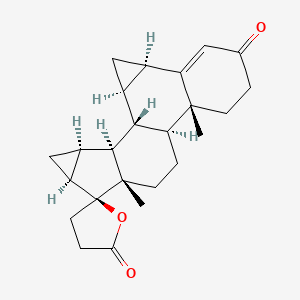
| Formula | C24H30O3 |
|---|---|
| Molecular weight | 366.5 g/mol |
| IUPAC name | (1R,2R,4R,10R,11S,14S,15S,16S,18S,19S)-10,14-dimethylspiro[hexacyclo[9.8.0.02,4.05,10.014,19.016,18]nonadec-5-ene-15,5'-oxolane]-2',7-dione |
| CAS | 67392-87-4 |
| PubChem CID | 68873 |
| InChIKey | METQSPRSQINEEU-HXCATZOESA-N |
| logP | 4.31 (XLogP 3.5) |
| Polar surface area | 43.37 Ų |
| H-bond acceptors / donors | 3 / 0 |
| Drug-likeness (QED) | 0.60 |
| Lipinski violations | 0 |
SMILES
C[C@]12CCC(=O)C=C1[C@@H]1C[C@@H]1[C@H]1[C@@H]3[C@@H]4C[C@@H]4[C@@]4(CCC(=O)O4)[C@@]3(C)CC[C@@H]12Biology & Pharmacokinetics
Pharmacokinetics predicted
| Bioavailability | 70.0% |
|---|---|
| Half-life | 0.903 h |
| Volume of distribution | 3.342 L/kg |
| Protein binding | 93.6% |
| BBB penetrant | No |
Enzyme interactions
| Enzyme | Role | Detail |
|---|---|---|
| CYP1A2 | Substrate | — |
| CYP2C19 | Substrate | — |
| CYP3A4 | Substrate | — |
Transporters
BCRP (Inhibitor)BSEP (Inhibitor)MRP1 (Inhibitor)MRP3 (Inhibitor)MRP4 (Inhibitor)OATP1B1 (Inhibitor)OATP1B3 (Inhibitor)OATP2B1 (Inhibitor)P-gp (Inhibitor)P-gp (Substrate)
Drug–drug interactions (100+, DDInter)
| Interacting drug | Severity | Management |
|---|---|---|
| Bexarotene | major | |
| Brigatinib | major | |
| Carfilzomib | major | |
| Ceritinib | major | |
| Clarithromycin | major | |
| Cobicistat | major | |
| Dabrafenib | major | |
| Encorafenib | major | |
| Griseofulvin | major | |
| Idelalisib | major | |
| Ketoconazole | major | |
| Lenalidomide | major | |
| Lumacaftor | major | |
| Mycophenolic acid | major | |
| Pomalidomide | major | |
| Sugammadex | major | |
| Thalidomide | major | |
| Tranexamic acid | major | |
| Acarbose | moderate | |
| Acetohexamide | moderate | |
| Acetylsalicylic acid | moderate | |
| Adalimumab | moderate | |
| Albiglutide | moderate | |
| Alefacept | moderate | |
| Alogliptin | moderate | |
| Aminoglutethimide | moderate | |
| Aminophylline | moderate | |
| Anakinra | moderate | |
| Apalutamide | moderate | |
| Aprepitant | moderate | |
| Artemether | moderate | |
| Asparaginase Escherichia coli | moderate | |
| Canagliflozin | moderate | |
| Canakinumab | moderate | |
| Celecoxib | moderate | |
| Certolizumab pegol | moderate | |
| Chlorpropamide | moderate | |
| Cladribine | moderate | |
| Clotrimazole | moderate | |
| Conestat alfa | moderate |
Showing 40 of 100+.
Registered Products (7)
| Brand | Form / strength | Pack | Agent | Citizen (JOD) |
|---|---|---|---|---|
| Zahra Tab | Tablet 0.03 mg, 3 mg | 21 tab | Noor Drug Store | 3.550 |
| Nesma | Film-Coated Tablet 0.03 mg, 3 mg | 21 F.C.T | Dar Al Dawa Development and Investment Co Ltd/Jordan | 3.690 |
| Diva | Tablet 0.03 mg, 3.0 mg | 7 tab | Nairoukh Drug Store | 3.860 |
| Yasmin Tab | Tablet 0.03 mg, 3 mg | 21 tab | The Jordan Drugstore Co | 5.070 |
| Drospera | Tablet 0.02 mg, 3.0 mg | 7 tab | Nairoukh Drug Store | 8.060 |
| Slinda | Film-Coated Tablet 4 mg | 28 F.C Tab | Nairoukh Drug Store | 9.300 |
| Yaz F.C Tab | Film-Coated Tablet 0.020 mg, 3.000 mg | 28 tab | The Jordan Drugstore Co | 9.320 |