Ethinylestradiol
JFDA label: Belara Tab
- Cigarette smoke and serious cardiovascular events:
Mechanism of Action
Agonist of Estrogen receptor — Estrogen receptor alpha agonist
| Target | Action | Gene / class |
|---|---|---|
| Estrogen receptor efficacy | AGONIST | ESR1 |
Indications
Approved
- Contraception
Off-label
- Abnormal uterine bleeding
- Dysmenorrhea
- Menstrual bleeding (menorrhagia)
- Pain associated with endometriosis
- Polycystic ovary syndrome (PCOS) in women with menstrual irregularities and hirsutism/acne
Contraindications
Source: Lexicomp
- Hypersensitivity to ethinyl estradiol, norgestrel, or any component of the formulation Absolute
- breast cancer or other estrogen- or progestin-dependent neoplasms (current or a history of), including endometrial cancer, hepatic tumors (benign or malignant) or hepatic disease, pregnancy, undiagnosed abnormal uterine bleeding, cholestatic jaundice of pregnancy, jaundice with prior combination hormonal contraceptive use Absolute
- concurrent use of hepatitis C drug combinations containing ombitasvir/paritaprevir/ritonavir (with or without dasabuvir). Use is also contraindicated in women at high risk of arterial or venous thrombotic diseases, for example, women with: Cerebrovascular disease, coronary artery disease, diabetes mellitus with vascular disease, DVT or PE (current or history of), hypercoagulopathies (inherited or acquired), hypertension (uncontrolled), headaches with focal neurological symptoms, migraine heada Absolute
Adverse Reactions
Cardiac disorders (11)
Not Known Arterial thromboembolism · Budd-Chiari syndrome · cerebral thrombosis · cerebrovascular accident · edema · hypertension · local thrombophlebitis · mesenteric thrombosis · myocardial infarction · pulmonary thromboembolism · retinal thrombosis
Nervous system disorders (6)
Not Known Cerebral hemorrhage · depression · dizziness · headache · migraine · nervousness
Hepatobiliary disorders (4)
Not Known Cholestatic jaundice · hepatic adenoma · hepatic neoplasm (benign) · jaundice
Renal and urinary disorders (13)
Not Known Breakthrough bleeding · breast hypertrophy · breast secretion · breast tenderness · change in cervical erosion · change in cervical secretions · cystitis-like syndrome · decreased lactation (postpartum) · Renal insufficiency · spotting · transient infertility (following discontinuation) · vaginitis · vulvovaginal candidiasis
Blood and lymphatic system disorders (9)
Not Known Decreased antithrombin III plasma level · hemolytic-uremic syndrome · hemorrhagic eruption · increased clotting factor IX · increased clotting factor VII · increased clotting factor VIII · increased clotting factor X · increased norepinephrine-induced platelet aggregation · prolonged prothrombin time
Metabolism and nutrition disorders (13)
Not Known Amenorrhea · change in libido · decreased glucose tolerance · decreased serum folate level · hirsutism · increased serum triglycerides · increased sex hormone binding globulin · increased thyroxine binding globulin · menstrual disease (flow changes) · porphyria · premenstrual syndrome · weight gain · weight loss
Gastrointestinal disorders (9)
Not Known Abdominal cramps · bloating · carbohydrate intolerance · change in appetite · cholestasis · colitis · gallbladder disease · nausea · vomiting
Skin and subcutaneous tissue disorders (6)
Not Known Acne vulgaris · allergic skin rash · chloasma (may persist) · erythema multiforme · erythema nodosum · loss of scalp hair
Eye disorders (4)
Not Known Cataract · change in corneal curvature (steepening) · contact lens intolerance · optic neuritis
Dosing
Source: Lexicomp
Warnings & Precautions
Source: Lexicomp
Breast cancer
In women at risk for breast cancer due to family history or susceptibility genes (BRCA1, BRCA2), the use of combination hormonal contraceptives has not been shown to modify the risk for breast cancer. However, breast cancer is a hormonal sensitive tumor and the prognosis for women with a current or recent history of breast cancer may be worse with combination hormonal contraceptive use (Curtis 2016b). Use is contraindicated in women with (or history of) breast cancer.
Cervical cancer
The use of combination hormonal contraceptives has been associated with a slight increased risk of cervical cancer; however, studies are not consistent and may be related to additional risk factors (Gierisch 2013). Theoretically, use may affect prognosis of existing disease. Women awaiting treatment for cervical cancer may use combination hormonal contraceptives (Curtis 2016b).
Chloasma
Combination hormonal contraceptives, as well as sun exposure and pregnancy, are triggers for chloasma. Women with a susceptibility to chloasma or additional risk factors should avoid exposure to sun or ultraviolet radiation during therapy (Handel, 2014).
Cholestasis
Risk of cholestasis may be increased with previous cholestasis of pregnancy or cholestasis with prior oral contraceptive use. Use is contraindicated with use with cholestatic jaundice or jaundice of pregnancy.
Lipid effects
Combination hormonal contraceptives may adversely affect lipid levels, including serum triglycerides. Women with hypertriglyceridemia or a family history of hypertriglyceridemia may be at increased risk of pancreatitis when using combination hormonal contraceptives. Consider alternative contraception for women with uncontrolled dyslipidemia.
Retinal vascular thrombosis
Discontinue if unexplained loss of vision, proptosis, diplopia, papilledema, or retinal vascular lesions occur and immediately evaluate for retinal vein thrombosis.
Thromboembolic disorders
Discontinue use of combination hormonal contraceptives if an arterial or venous thrombotic event occurs. Oral contraceptives may increase the risk of venous thromboembolism (risk is greatest during first year of use and less than the risk associated with pregnancy); some studies suggest this risk may be higher in preparations with third- or fourth-generation progestins and/or high dose ethinyl estradiol. Women with inherited thrombophilias (eg, protein C or S deficiency, factor V Leiden mutation, prothrombin mutation, antithrombin deficiency) may have increased risk of venous thromboembolism. Age >35 years, hypertension, obesity, and tobacco use also increase the risk of thrombotic events in women taking combination hormonal contraceptives (ASRM 2017; Curtis 2016b; DeSancho 2010; van Vlijmen 2011). Combination hormonal contraceptives may also increase the risk of arterial thrombosis (eg, MI, stroke) and should not be used in women with a history of stroke or ischemic heart disease (Curtis 2016b). Use of combination hormonal contraceptives is contraindicated in women with a high risk of arterial or venous thrombotic disease.
Vaginal bleeding
Breakthrough or intracyclic bleeding and spotting may occur, especially during the first 3 months of therapy. In addition, occasional missed periods may occur. Presentation of irregular, unresolving vaginal bleeding warrants further evaluation to rule out malignancy or pregnancy. Amenorrhea or oligomenorrhea may occur after discontinuing combination hormonal contraceptives, especially when such a condition was preexistent. Disease-related concerns:
Cardiovascular disease
Use with caution in patients with risk factors for cardiovascular disease ( eg, hypertension, low HDL, high LDL, high triglycerides, older age, diabetes, women who smoke); use of combination hormonal contraceptives may increase the risk of cardiovascular disease (Curtis 2016b). Use is contraindicated in women at high risk of arterial or venous thrombotic diseases.
Depression
Use with caution in patients with a history of depression; discontinue if serious depression recurs.
Diabetes
May impair glucose tolerance; use caution in women with diabetes or prediabetes. In general, use of combination oral contraceptives has limited effects on daily insulin needs and no long term effects on diabetes control in women with nonvascular disease. However, use in women with concomitant nephropathy, neuropathy, retinopathy, other vascular disease, or diabetes >20 years' duration should be evaluated for contraceptive use based on the severity of the condition (Curtis 2016b). Use is contraindicated in women with diabetes mellitus and vascular disease.
Diseases exacerbated by fluid retention
Use with caution in patients with diseases which may be exacerbated by fluid retention.
Endometrial or ovarian cancer
The risk of endometrial or ovarian cancer is decreased in women using combination hormonal contraceptives (Curtis 2016b; Walker 2015). Oral contraceptives may be used to reduce the risk of ovarian cancer including those women with BRCA1 and BRCA2 mutations (Walker 2015). Women awaiting treatment for endometrial or ovarian cancer may use combination hormonal contraceptives (Curtis 2016b).
Gallbladder disease
Combination hormonal contraceptives may cause a small increased risk of gallbladder disease or may worsen existing gallbladder disease (Curtis 2016b).
Hepatic adenomas or carcinomas
Use of combination hormonal contraceptives is associated with hepatic adenomas (rare); rupture may cause fatal intra-abdominal hemorrhage. Long-term use may be associated with an increased risk of hepatocellular carcinoma (rare). Use is contraindicated in women with preexisting hepatic tumors.
Hepatic impairment
Combination hormonal contraceptives may be poorly metabolized in women with hepatic impairment. Discontinue if jaundice develops during therapy or if liver function becomes abnormal. Use is contraindicated in women with hepatic disease. Use of combination hormonal contraceptives may be considered in women with mild (compensated) cirrhosis but should not be used in women with severe (decompensated) cirrhosis (Curtis 2016b).
Hepatitis
Initiation of combination hormonal contraceptives is not recommended in women with acute viral hepatitis or during a flare. Continuation of use in women with chronic hepatitis has not been shown to increase the rate or severity of cirrhotic fibrosis or hepatocellular carcinoma. Continuation of use in women who are carriers has not been shown to trigger liver failure or severe hepatic dysfunction (Curtis 2016b).
Hereditary angioedema
Estrogens may induce or exacerbate symptoms in women with hereditary angioedema (Geng, 2013; Zuraw, 2013).
Hypertension
The risk of hypertension may be increased with age, dose, and duration of use. Combination hormonal contraceptives should not be used in women with hypertension and vascular disease, or persistent blood pressure values ≥160 mm Hg systolic or ≥100 mm Hg diastolic. The risks of use may not outweigh the benefits of treatment in women with less severe hypertension (140 to 159 mm Hg systolic or 90 to 99 mm Hg diastolic) or those with hypertension that is adequately controlled (Curtis 2016a). Other risk factors for cardiovascular disease (eg, older age, smoking, diabetes) should be considered when prescribing contraceptives (Curtis 2016b).
Migraine
Evaluate new, recurrent, severe, or persistent headaches. Use of combination hormonal contraceptives may be considered in women who have migraines without aura (including menstrual migraines) (Curtis 2016b). Use in women with headaches with focal neurological symptoms, or migraine headaches with or without aura if >35 years is contraindicated.
Solid organ transplant
Although data is limited, serious medical complications have been reported in women with complicated organ transplants (eg, graft failure, rejection, cardiac allograft vasculopathy); use of combination hormonal contraceptives is not recommended in women with complicated organ transplants (Curtis 2016b).
Systemic lupus erythematosus
Women with systemic lupus erythematosus (SLE) are at an increased risk for heart disease, stroke, and VTE. Combination hormonal contraceptives should not be used in women with SLE who have positive (or unknown) antiphospholipid antibodies, due to an increased risk of arterial and venous thrombosis (Curtis 2016b). Concurrent drug therapy issues:
Drug-drug interactions
Potentially significant interactions may exist, requiring dose or frequency adjustment, additional monitoring, and/or selection of alternative therapy. Consult drug interactions database for more detailed information.
Thyroid replacement therapy
Estrogens may increase thyroid-binding globulin (TBG) levels leading to increased circulating total thyroid hormone levels. Women on thyroid replacement therapy may require higher doses of thyroid hormone while receiving estrogens. Special populations:
Obese
Available evidence suggests efficacy of combination hormonal contraceptives may be decreased in women with a BMI ≥30 kg/m2; however, reductions in effectiveness are considered minimal and information is conflicting. The risk of VTE may be increased in obese women using combination hormonal contraceptives. In general, the benefits of combination hormonal contraceptives may outweigh the risks in obese women who otherwise are eligible for this method (Curtis 2016b).
Pediatric
Not for use prior to menarche.
Postmenopausal women
Use is not indicated in postmenopausal women.
Smokers
Cigarette smoking increases the risk of serious cardiovascular events from combination oral contraceptives use. This risk increases with age and with heavy smoking (15 or more cigarettes per day) and is quite marked in women over 35 years. Women who use oral contraceptives should be strongly advised not to smoke.
Surgical patients
Whenever possible, should be discontinued at least 4 weeks prior to and for 2 weeks following elective surgery associated with an increased risk of thromboembolism or during periods of prolonged immobilization. Other warnings/precautions:
Appropriate use
When initiating a combination oral contraceptive, consider initiating with a monthly bleeding monophasic formulation containing ethinyl estradiol 30 to 35 mcg plus a progestin, and adjusting based on adverse events and patient preference (Ott 2014).
HIV infection protection
Combination hormonal contraceptives do not protect against HIV infection or other sexually transmitted diseases (Curtis 2016a; Curtis 2016b).
Laboratory changes
The use of estrogens and/or progestins may change the results of some laboratory tests (eg, coagulation factors, lipids, glucose tolerance, binding proteins).
Pregnancy & Lactation
Pregnancy
Use is contraindicated in pregnant women. Combination hormonal contraceptives are used to prevent pregnancy; treatment should be discontinued if pregnancy occurs. In general, the use of combination hormonal contraceptives, when inadvertently used early in pregnancy, have not been associated adverse fetal or maternal effects (Curtis 2016b). The manufacturer states that combination hormonal contraceptives should not be started until ≥4 to 6 weeks after delivery in women who choose not to breastfeed. Due to the increased risk of venous thromboembolism (VTE) postpartum, combination hormonal contraceptives should not be started in any woman 2, postpartum hemorrhage, smoking) (Curtis 2016b).
Lactation
Contraceptive steroids may be present in breast milk. Adverse health outcomes, or consistent effects on infant growth or illness due to exogenous estrogens have not been reported following maternal use of combination hormonal contraceptives in breastfeeding women (Curtis 2016b). Because estrogen containing contraceptives may reduce milk production, the manufacturer recommends use of other forms of contraception until the child is weaned. Due to the increased risk of venous thromboembolism (VTE
Monitoring
| Clinical pearl | Assessment of pregnancy status (prior to therapy); blood pressure (prior to therapy and yearly); weight (optional; BMI at baseline may be helpful to monitor changes during therapy); assess potential health status changes at routine visits (Curtis 2016a). If all doses have not been taken on schedule and one menstrual period is missed, the possibility of pregnancy should be considered. If two consecutive menstrual periods are missed, assess pregnancy status before a new dosing cycle is started. Monitor patient for vision changes; blood pressure; signs and symptoms of thromboembolic disorders; signs or symptoms of depression; glycemic control in patients with diabetes; lipid profiles in patients being treated for hyperlipidemias. Adequate diagnostic measures should be performed to rule out malignancy in all cases of undiagnosed abnormal vaginal bleeding. |
|---|
Chemistry & Properties
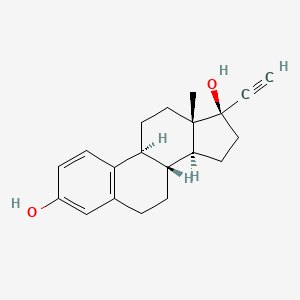
| Formula | C20H24O2 |
|---|---|
| Molecular weight | 296.41 g/mol |
| IUPAC name | (8R,9S,13S,14S,17R)-17-ethynyl-13-methyl-7,8,9,11,12,14,15,16-octahydro-6H-cyclopenta[a]phenanthrene-3,17-diol |
| CAS | 57-63-6 |
| PubChem CID | 5991 |
| InChIKey | BFPYWIDHMRZLRN-SLHNCBLASA-N |
| logP | 3.61 (XLogP 3.7) |
| Polar surface area | 40.46 Ų |
| H-bond acceptors / donors | 2 / 2 |
| Drug-likeness (QED) | 0.72 |
| Lipinski violations | 0 |
SMILES
C#C[C@]1(O)CC[C@H]2[C@@H]3CCc4cc(O)ccc4[C@H]3CC[C@@]21CBiology & Pharmacokinetics
Pharmacokinetics
| BBB penetrant | No |
|---|
Enzyme interactions
| Enzyme | Role | Detail |
|---|---|---|
| CYP1A2 | Substrate | — |
| CYP2B6 | Inhibitor | Ki 0.8485281374238575 µM |
| CYP2C19 | Inhibitor | — |
| CYP2C19 | Substrate | — |
| CYP2C8 | Inhibitor | — |
| CYP2C9 | Inhibitor | — |
| CYP3A4 | Inhibitor | Ki 18.000000000000014 µM |
| CYP3A4 | Substrate | — |
Receptor binding (top 2)
| Target | Action | Affinity |
|---|---|---|
| Estrogen receptor-α (ESR1) | Agonist | pIC50 8.7 |
| Estrogen receptor-β (ESR2) | Agonist | pIC50 8.1 |
Transporters
BCRP (Inhibitor)BSEP (Inhibitor)MATE2 (Inhibitor)MRP1 (Inhibitor)MRP2 (Inhibitor)MRP3 (Inhibitor)MRP4 (Inhibitor)OATP1B1 (Inhibitor)OATP1B3 (Inhibitor)OCT2 (Inhibitor)P-gp (Inhibitor)P-gp (Substrate)
Drug–drug interactions (100+, DDInter)
| Interacting drug | Severity | Management |
|---|---|---|
| Amprenavir | major | |
| Bexarotene | major | |
| Boceprevir | major | |
| Bosentan | major | |
| Brigatinib | major | |
| Carbamazepine | major | |
| Carfilzomib | major | |
| Dabrafenib | major | |
| Dantrolene | major | |
| Encorafenib | major | |
| Eslicarbazepine | major | |
| Felbamate | major | |
| Fosamprenavir | major | |
| Fosphenytoin | major | |
| Glecaprevir | major | |
| Griseofulvin | major | |
| Hemin | major | |
| Lenalidomide | major | |
| Lumacaftor | major | |
| Mycophenolate mofetil | major | |
| Mycophenolic acid | major | |
| Oxcarbazepine | major | |
| Paritaprevir | major | |
| Pexidartinib | major | |
| Phenobarbital | major | |
| Phenytoin | major | |
| Pomalidomide | major | |
| Primidone | major | |
| Rifabutin | major | |
| Rifampicin | major | |
| Rifapentine | major | |
| St. John's Wort | major | |
| Telaprevir | major | |
| Thalidomide | major | |
| Tizanidine | major | |
| Tranexamic acid | major | |
| Abametapir (topical) | moderate | |
| Acarbose | moderate | |
| Acetohexamide | moderate | |
| Adalimumab | moderate |
Showing 40 of 100+.
Registered Products (18)
| Brand | Form / strength | Pack | Agent | Citizen (JOD) |
|---|---|---|---|---|
| NORDIOL TABS | Tablet 50 mcg, 250 mcg | 21 tab | Arab Company for Medical & Agricultural Products | 1.290 |
| OVRAL TABS | Tablet 50 mcg, 500 mcg | 21 tab | Arab Company for Medical & Agricultural Products | 1.290 |
| Microgynon Tab | Tablet 0.03 mg, 0.15 mg | 21 tab | The Jordan Drugstore Co | 1.320 |
| Violet E | Tablet 0.03 mg, 0.15 mg | 21 tab | Dar Al Dawa Development and Investment Co Ltd/Jordan | 1.900 |
| MARVELON TABS | Tablet 0.030 mg, 0.15 mg | 21 tab | Sabbagh Drug Store | 2.720 |
| Cadila | Tablet 0.030 mg, 0.075 mg | 21 tab | Dar Al Dawa Development and Investment Co Ltd/Jordan | 3.400 |
| Zahra Tab | Tablet 0.03 mg, 3 mg | 21 tab | Noor Drug Store | 3.550 |
| Belara Tab | Tablet 0.03 mg, 2 mg | 1X21 pack varies | Nabulsi Drug Store | 3.650 |
| Nesma | Film-Coated Tablet 0.03 mg, 3 mg | 21 F.C.T | Dar Al Dawa Development and Investment Co Ltd/Jordan | 3.690 |
| Diva | Tablet 0.03 mg, 3.0 mg | 7 tab | Nairoukh Drug Store | 3.860 |
| DIANE 35 Tab | Tablet 2 mg, 0.035 mg | 21 tab | The Jordan Drugstore Co | 3.870 |
| Gracial Tabs | Tablet 0.04+0.03 mg, 0.025+0.125 mg | 1 X 22 | Sabbagh Drug Store | 4.190 |
| Yasmin Tab | Tablet 0.03 mg, 3 mg | 21 tab | The Jordan Drugstore Co | 5.070 |
| Ornibel | Implant 0.015 mg, 0.120 mg | 1 Ring | Nairoukh Drug Store | 6.740 |
| Drospera | Tablet 0.02 mg, 3.0 mg | 7 tab | Nairoukh Drug Store | 8.060 |
| Yaz F.C Tab | Film-Coated Tablet 0.020 mg, 3.000 mg | 28 tab | The Jordan Drugstore Co | 9.320 |
| Nuvaring Vaginal Ring | Vaginal 2.7 mg, 11.7 mg | 1 sachet | Sabbagh Drug Store | 9.480 |
| Belara Tab | Tablet 0.03 mg, 2 mg | 3X21 pack varies | Nabulsi Drug Store | 10.290 |