Glibenclamide
JFDA label: Glibemide Tablets
- Lactic acidosis:
Mechanism of Action
Blocker of Sulfonylurea receptor 1, Kir6.2 — Sulfonylurea receptor 1, Kir6.2 blocker
| Target | Action | Gene / class |
|---|---|---|
| Sulfonylurea receptor 1, Kir6.2 efficacy | BLOCKER |
Indications
Approved
- Diabetes mellitus, type 2
Class profile
| mechanismClass | Sulfonylurea (2nd generation, ATP-K+ channel blocker) |
|---|---|
| insulinSecretagogue | 1 |
| weightEffect | Gain |
| hypoglycemiaRisk | High |
| renalContraindicated | 0 |
| cardioProtective | 0 |
| renalProtective | 0 |
| source | ADA-EASD2023/Maruthur2016 |
Contraindications
Source: Lexicomp · Curated
- Hypersensitivity to metformin, glyburide, or any component of the formulation Absolute
- Severe renal impairment (accumulation of active metabolites → prolonged hypoglycaemia) Absolute
- Type 1 diabetes mellitus or diabetic ketoacidosis Absolute
- acute or chronic metabolic acidosis, including diabetic ketoacidosis, with or without coma Absolute
- concomitant administration of bosentan Documentation of allergenic cross-reactivity for sulfonylureas is limited. However, because of similarities in chemical structure and/or pharmacologic actions, the possibility of cross-sensitivity cannot be ruled out with certainty Absolute
- severe renal impairment (eGFR 2) Absolute
Adverse Reactions
Nervous system disorders (2)
Common dizziness · Headache
Hepatobiliary disorders (1)
Very Rare Elevated liver enzymes
Metabolism and nutrition disorders (3)
Very Common Hypoglycaemia · Hypoglycemia
Common Weight gain
Gastrointestinal disorders (6)
Very Common diarrhea · Gastrointestinal symptoms
Common abdominal pain · Nausea · Nausea · vomiting
Skin and subcutaneous tissue disorders (1)
Rare Skin rash
Respiratory, thoracic and mediastinal disorders (1)
Very Common Upper respiratory infection
Dosing
Source: Lexicomp
Warnings & Precautions
Source: Lexicomp
Cardiovascular mortality
Product labeling states oral hypoglycemic drugs may be associated with an increased cardiovascular mortality as compared to treatment with diet alone or diet plus insulin. Data to support this association are limited, and several studies, including a large prospective trial (UKPDS 1998) have not supported an association. Metformin does not appear to share this risk.
Hypoglycemia
All sulfonylurea drugs are capable of producing severe hypoglycemia. Hypoglycemia is more likely to occur when caloric intake is deficient, after severe or prolonged exercise, when ethanol is ingested, or when more than one glucose-lowering drug is used. It is also more likely in elderly patients, malnourished or debilitated patients, and in patients with impaired renal, hepatic, adrenal, and/or pituitary function; use with caution.
Lactic acidosis
Postmarketing cases of metformin-associated lactic acidosis have resulted in death, hypothermia, hypotension, and resistant bradyarrhythmias. The onset is often subtle, accompanied by nonspecific symptoms (eg, malaise, myalgias, respiratory distress, somnolence, abdominal pain); elevated blood lactate levels (>5 mmol/L); anion gap acidosis (without evidence of ketonuria or ketonemia); increased lactate:pyruvate ratio; metformin plasma levels generally >5 mcg/mL. Risk factors for lactic acidosis include patients with renal impairment, concomitant use of certain drugs (eg, carbonic anhydrase inhibitors such as topiramate), ≥65 years, having a radiologic study with contrast, surgery and other procedures, hypoxic states (eg, acute heart failure), excessive alcohol intake, and hepatic impairment. Discontinue immediately if lactic acidosis is suspected; prompt hemodialysis is recommended. Lactic acidosis should be suspected in any patient with diabetes receiving metformin with evidence of acidosis but without evidence of ketoacidosis. Discontinue metformin in patients with conditions associated with dehydration, sepsis, or hypoxemia. The risk of accumulation and lactic acidosis increases with the degree of impairment of renal function and the patient's age.
Sulfonamide (“sulfa”) allergy
The FDA-approved product labeling for many medications containing a sulfonamide chemical group includes a broad contraindication in patients with a prior allergic reaction to sulfonamides. There is a potential for cross-reactivity between members of a specific class (eg, two antibiotic sulfonamides). However, concerns for cross-reactivity have previously extended to all compounds containing the sulfonamide structure (SO2NH2). An expanded understanding of allergic mechanisms indicates cross-reactivity between antibiotic sulfonamides and nonantibiotic sulfonamides may not occur or at the very least this potential is extremely low (Brackett 2004; Johnson 2005; Slatore 2004; Tornero 2004). In particular, mechanisms of cross-reaction due to antibody production (anaphylaxis) are unlikely to occur with nonantibiotic sulfonamides. T-cell-mediated (type IV) reactions (eg, maculopapular rash) are less well understood and it is not possible to completely exclude this potential based on current insights. In cases where prior reactions were severe (Stevens-Johnson syndrome/TEN), some clinicians choose to avoid exposure to these classes.
Vitamin B12 concentrations
Long-term metformin use is associated with vitamin B12 deficiency; monitor vitamin B12 serum concentrations periodically with long-term therapy. Monitoring of B12 serum concentrations should be considered in all patients receiving metformin and in particular those with peripheral neuropathy or anemia (ADA 2018c). Disease-related concerns:
Glucose-6-phosphate dehydrogenase (G6PD) deficiency
Patients with G6PD deficiency may be at an increased risk of sulfonylurea-induced hemolytic anemia; however, cases have also been described in patients without G6PD deficiency during postmarketing surveillance. Use with caution and consider a nonsulfonylurea alternative in patients with G6PD deficiency.
Heart failure
Metformin may be used in patients with stable heart failure (HF); avoid use in unstable or hospitalized patients with HF (ADA 2018e). Risk of lactic acidosis may be increased secondary to hypoperfusion. In a scientific statement from the American Heart Association, metformin has been determined to be an agent that may exacerbate underlying myocardial dysfunction (magnitude: major) (AHA [Page 2016]). Use of metformin in patients with HF may be associated with reduced mortality and reduction in hospital readmission for HF (Crowley 2017; Eurich 2013).
Hepatic impairment
The metabolism and excretion of glyburide may be slowed in patients with hepatic impairment; if hypoglycemia should occur in such patients, it may be prolonged. The manufacturer recommends to generally avoid metformin use in patients with hepatic impairment due to potential for lactic acidosis. However, continued use of metformin in patients with diabetes with liver dysfunction, including cirrhosis, may be associated with a survival benefit in carefully selected patients (Brackett 2010; Crowley 2017; Zhang 2014).
Renal impairment
The metabolism and excretion of glyburide may be slowed in patients with renal impairment and its active metabolites may accumulate in advanced renal insufficiency (Snyder 2004). If hypoglycemia should occur, it may be prolonged. Use of glyburide is generally not recommended in chronic kidney disease (ADA [Tuttle 2014]]; Alsahli 2015; KDOQI [Nelson 2012]). Metformin is substantially excreted by the kidney and use is contraindicated in patients with eGFR 2. Use of concomitant medications that may affect renal function (ie, affect tubular secretion) may also affect metformin disposition. Metformin should be withheld in patients with dehydration and/or prerenal azotemia.
Stress-related states
It may be necessary to discontinue therapy and administer insulin if the patient is exposed to stress (fever, trauma, infection, surgery). Concurrent drug therapy issues:
Drug-drug interactions
Potentially significant interactions may exist, requiring dose or frequency adjustment, additional monitoring and/or selection of alternative therapy. Consult drug interactions database for more detailed information. Special populations:
Elderly
Use of glyburide is not recommended in elderly patients due to an increased risk of severe prolonged hypoglycemia (ADA 2018b; Beers Criteria [AGS 2015]). Use metformin with caution; risk of metformin-associated lactic acidosis increases with age. Other warnings/precautions:
Appropriate use
Not indicated for use in patients with type 1 diabetes mellitus or with diabetic ketoacidosis (DKA).
Ethanol use
Instruct patients to avoid excessive acute or chronic ethanol use; ethanol may potentiate metformin's effect on lactate metabolism.
Iodinated contrast
Temporarily discontinue metformin at the time of or before iodinated contrast imaging procedures in patients with an eGFR 30 to 60 mL/minute/1.73 m2; or with a history of hepatic disease, alcoholism, or heart failure; or in patients who will receive intra-arterial iodinated contrast. Reevaluate eGFR 48 hours after imaging procedure; restart if renal function is stable. Alternatively, the American College of Radiology (ACR) guidelines recommend that metformin may be used prior to or following administration of iodinated contrast media in patients with no evidence of acute kidney injury (AKI) and with an eGFR ≥30 mL/minute/1.73 m2; ACR guidelines recommend temporary discontinuation of metformin in patients with known AKI or severe chronic kidney disease ([stage IV or V [ie, eGFR 2]) or who are undergoing arterial catheter studies (ACR 2017).
Surgical procedures
Metformin should be withheld the day of surgery (all other oral hypoglycemic agents should be withheld the morning of surgery or procedure) (ADA 2018d). Resume only after normal intake returns and normal renal function is verified.
Pregnancy & Lactation
Pregnancy
Caution
Second-line after metformin and insulin for GDM in some guidelines. Avoid near delivery due to prolonged neonatal hypoglycaemia risk
Lactation
Metformin is present in breast milk; it is not known if glyburide is present in breast milk. Due to the potential for serious adverse reactions in the breastfed infant, the manufacturer recommends a decision be made to discontinue breastfeeding or to discontinue the drug, taking into account the importance of treatment to the mother. Refer to individual agents.
LactMed: monitor the infant.
Monitoring
| Efficacy | HbA1c every 3 months initially, then every 6–12 months when stable; fasting and post-prandial blood glucose; patient-reported hypoglycaemia episodes |
|---|---|
| Toxicity | Hypoglycaemia symptoms; eGFR for renally-cleared agents; weight; blood pressure |
| Clinical pearl | Individualise HbA1c targets based on patient age, comorbidities, and hypoglycaemia risk. Targets of < 7% are appropriate for most patients but < 8% may be safer in frail elderly. |
| Counseling | Monitor blood glucose regularly. Know how to recognise and treat hypoglycaemia. Keep carbohydrate snacks available. |
Chemistry & Properties
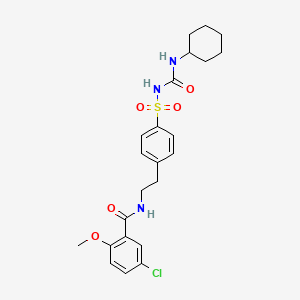
| Formula | C23H28ClN3O5S |
|---|---|
| Molecular weight | 494.01 g/mol |
| IUPAC name | 5-chloro-N-[2-[4-(cyclohexylcarbamoylsulfamoyl)phenyl]ethyl]-2-methoxybenzamide |
| CAS | 10238-21-8 |
| PubChem CID | 3488 |
| InChIKey | ZNNLBTZKUZBEKO-UHFFFAOYSA-N |
| logP | 3.64 (XLogP 4.8) |
| Polar surface area | 113.6 Ų |
| H-bond acceptors / donors | 5 / 3 |
| Drug-likeness (QED) | 0.52 |
| Lipinski violations | 0 |
SMILES
COc1ccc(Cl)cc1C(=O)NCCc1ccc(S(=O)(=O)NC(=O)NC2CCCCC2)cc1Biology & Pharmacokinetics
Pharmacokinetics
| BBB penetrant | Yes (logBB -0.9) |
|---|
Enzyme interactions
| Enzyme | Role | Detail |
|---|---|---|
| CYP2C19 | Substrate | — |
| CYP2C8 | Inhibitor | — |
| CYP2C9 | Inhibitor | IC₅₀ 1.6019999999999999 µM |
| CYP2C9 | Substrate | — |
| CYP3A4 | Inhibitor | — |
Transporters
BCRP (Inhibitor)BCRP (Inhibitor)BSEP (Inhibitor)BSEP (Inhibitor)MCT6 (Inhibitor)MDR1 (Inhibitor)MRP (Inhibitor)MRP1 (Inhibitor)MRP1 (Inhibitor)MRP2 (Inhibitor)MRP3 (Inhibitor)MRP4 (Inhibitor)MRP5 (Inhibitor)NTCP (Inhibitor)OAT (Inhibitor)OAT1 (Inhibitor)OAT2 (Inhibitor)OATP1B1 (Inhibitor)OATP1B1 (Inhibitor)OATP1B3 (Inhibitor)OATP1B3 (Inhibitor)OATP2B1 (Inhibitor)OCT1 (Inhibitor)OCT3 (Inhibitor)P-gp (Inhibitor)PEPT1 (Inhibitor)BCRP (Substrate)BSEP (Substrate)MDR1 (Substrate)MRP1 (Substrate)MRP2 (Substrate)MRP3 (Substrate)OAT (Substrate)OATP1B (Substrate)OATP1B3 (Substrate)OATP2B1 (Substrate)OCT1 (Substrate)P-gp (Substrate)
Drug–drug interactions (100+, DDInter)
| Interacting drug | Severity | Management |
|---|---|---|
| Aminolevulinic acid | major | |
| Bosentan | major | |
| Cinoxacin | major | |
| Ciprofloxacin | major | |
| Delafloxacin | major | |
| Enoxacin | major | |
| Fluconazole | major | |
| Gatifloxacin | major | |
| Gemifloxacin | major | |
| Grepafloxacin | major | |
| Levofloxacin | major | |
| Lomefloxacin | major | |
| Miconazole | major | |
| Moxifloxacin | major | |
| Nalidixic acid | major | |
| Norfloxacin | major | |
| Ofloxacin | major | |
| Sparfloxacin | major | |
| Trovafloxacin | major | |
| Voriconazole | major | |
| Abametapir (topical) | moderate | |
| Acebutolol | moderate | |
| Acetazolamide | moderate | |
| Acetylsalicylic acid | moderate | |
| Acitretin | moderate | |
| Activated charcoal | moderate | |
| Albiglutide | moderate | |
| Alimemazine | moderate | |
| Aloe Vera Leaf | moderate | |
| Alogliptin | moderate | |
| Alpelisib | moderate | |
| Aluminum hydroxide | moderate | |
| Aminolevulinic acid (topical) | moderate | |
| Amitriptyline | moderate | |
| Amoxapine | moderate | |
| Amprenavir | moderate | |
| Anisindione | moderate | |
| Apalutamide | moderate | |
| Aprepitant | moderate | |
| Aripiprazole | moderate |
Showing 40 of 100+.
Registered Products (23)
| Brand | Form / strength | Pack | Agent | Citizen (JOD) |
|---|---|---|---|---|
| Glibemide Tablets | Tablet 5 mg | 30 tab pack varies | UNITED PHARM.MFG.CO.LTD(UPM)/JORDAN | 1.560 |
| Glibil 5 Tablets | Tablet 5 mg | 30 tab pack varies | Hikma Pharmaceuticals Co.Ltd/Jordan | 1.560 |
| Glucana Tablets | Tablet 5 mg | 30 tab pack varies | MIDDLE EAST PHARMA&CHEMICAL IND/JORDAN | 1.560 |
| Glunil-5mg tablet | Tablet 5 mg | 30 tab pack varies | AL-RAM PHARMA.INDUS.CO.LTD/JORDAN | 1.560 |
| Bi-ACT 250mg /1.25mg | Tablet 1.25 mg, 250 mg | 28 tab pack varies | Al-Taqqadom Pharmaceutical Industries | 1.830 |
| Bi-ACT 250mg /1.25mg | Tablet 1.25 mg, 250 mg | 30 tab pack varies | Al-Taqqadom Pharmaceutical Industries | 1.970 |
| GLIBESYN TAB | Tablet 5 mg | 40 tab pack varies | Khoury Drug Store | 2.190 |
| Melix Tab | Tablet 5 mg | 30 tab pack varies | Reda Jardaneh Drug Store | 2.200 |
| BI-ACT 500mg/2.5mg | Tablet 2.5 mg, 500 mg | 28 tab pack varies | Al-Taqqadom Pharmaceutical Industries | 3.010 |
| BI-ACT 500mg/5mg | Tablet 5 mg, 500 mg | 28 tab pack varies | Al-Taqqadom Pharmaceutical Industries | 3.010 |
| BI-ACT 500mg/2.5mg | Tablet 2.5 mg, 500 mg | 30 tab pack varies | Al-Taqqadom Pharmaceutical Industries | 3.230 |
| BI-ACT 500mg/5mg | Tablet 5 mg, 500 mg | 30 tab pack varies | Al-Taqqadom Pharmaceutical Industries | 3.230 |
| Glucovance | Tablet 2.5 mg, 500 mg | 30 tab | Nabulsi Drug Store | 3.460 |
| Glucovance | Tablet 5 mg, 500 mg | 30 tab | Nabulsi Drug Store | 4.150 |
| Glibil 5 Tablets | Tablet 5 mg | 100 tab pack varies | Hikma Pharmaceuticals Co.Ltd/Jordan | 4.180 |
| Glunil-5mg tablet | Tablet 5 mg | 100 tab pack varies | AL-RAM PHARMA.INDUS.CO.LTD/JORDAN | 4.180 |
| Glucovance 1000/5 mg F.C Tab | Film-Coated Tablet 5 mg, 1000 mg | 30 tab | Nabulsi Drug Store | 4.380 |
| Melix Tab | Tablet 5 mg | 100 tab pack varies | Reda Jardaneh Drug Store | 6.420 |
| Glibil 5 Tablets | Tablet 5 mg | 1000 tab pack varies | Hikma Pharmaceuticals Co.Ltd/Jordan | 32.000 |
| Glibemide Tablets | Tablet 5 mg | 1000 tab pack varies | UNITED PHARM.MFG.CO.LTD(UPM)/JORDAN | 41.600 |
| Glucana Tablets | Tablet 5 mg | 1000 tab pack varies | MIDDLE EAST PHARMA&CHEMICAL IND/JORDAN | 41.600 |
| Glunil-5mg tablet | Tablet 5 mg | 1000 tab pack varies | AL-RAM PHARMA.INDUS.CO.LTD/JORDAN | 41.900 |
| GLIBESYN TAB | Tablet 5 mg | 1000 tab pack varies | Khoury Drug Store | 46.600 |