Nitrofurantoin
JFDA label: NITROBACT-100
Mechanism of Action
Inhibitor of DNA — DNA inhibitor
| Target | Action | Gene / class |
|---|---|---|
| DNA efficacy | INHIBITOR |
Indications
Approved
- Cystitis, acute uncomplicated
- Nitrofurantoin macrocrystals (Furadantin, Macrodantin)
- Nitrofurantoin monohydrate/macrocrystals (Macrobid)
Antimicrobial Spectrum
Expected / intrinsic spectrum (EUCAST breakpoints & labels) — not local resistance. Source: curated · openfda-label.
Bacteria
| Organism | Activity | MIC |
|---|---|---|
| Citrobacter amalonaticus | Active | — |
| Citrobacter diversus | Active | — |
| Citrobacter freundii | Active | — |
| Enterococcus faecalis | Susceptible | 32.0 mg/L |
| Escherichia coli | Susceptible | 32.0 mg/L |
| Klebsiella oxytoca | Active | — |
| Klebsiella ozaenae | Active | — |
| Staphylococcus aureus | Active | — |
| Staphylococcus epidermidis | Active | — |
| Staphylococcus saprophyticus | Susceptible | 32.0 mg/L |
| Streptococcus agalactiae | Active | — |
| Escherichia coli | Resistant | 64.0 mg/L |
| Klebsiella pneumoniae | Resistant | 64.0 mg/L |
Class profile
| gramStatus | Both |
|---|---|
| spectrumBreadth | Moderate |
| atypicalCoverage | No |
| isBactericidal | 1 |
| moaCategory | Multiple targets (nitro group reduction causes DNA/RNA/protein damage; urinary tract only) |
| pdIndex | Time-dependent |
| postAntibioticEffect | None |
| mrsaCoverage | 0 |
| resistanceMechanisms | Nitroreductase mutations (nfsA,nfsB),Efflux pumps |
Contraindications
Source: Lexicomp
- Anuria, oliguria, or significant impairment of renal function (creatinine clearance [CrCl] Note: The manufacturer’s contraindication in patients with CrCl Because of the possibility of hemolytic anemia caused by immature erythrocyte enzyme systems (glutathione instability), the drug is contraindicated in pregnant patients at term (38 to 42 weeks gestation), during labor and delivery, or when the onset of labor is imminent Absolute
- also contraindicated in neonates younger than 1 month of age Absolute
Adverse Reactions
Cardiac disorders (1)
Not Known ECG changes (nonspecific ST/T wave changes, bundle branch block)
Nervous system disorders (14)
Not Known Bulging fontanel (infants) · chills · confusion · depression · dizziness · drowsiness · headache · malaise · numbness · paresthesia · peripheral neuropathy · pseudotumor cerebri · psychotic reaction · vertigo
Hepatobiliary disorders (4)
Not Known Cholestatic jaundice · hepatic necrosis · hepatitis · increased serum transaminases
Renal and urinary disorders (1)
Not Known Urine discoloration (brown)
Blood and lymphatic system disorders (10)
Not Known Agranulocytosis · aplastic anemia · eosinophilia · glucose-6-phosphate dehydrogenase deficiency anemia · granulocytopenia · hemoglobin decreased · hemolytic anemia · leukopenia · megaloblastic anemia · thrombocytopenia
Immune system disorders (3)
Not Known Anaphylaxis · angioedema · hypersensitivity (including acute pulmonary hypersensitivity)
Metabolism and nutrition disorders (1)
Not Known Hyperphosphatemia
Gastrointestinal disorders (12)
Not Known Abdominal pain · anorexia · Clostridium difficile associated diarrhea · constipation · diarrhea · dyspepsia · flatulence · nausea · pancreatitis · pseudomembranous colitis · sialadenitis · vomiting
Skin and subcutaneous tissue disorders (7)
Not Known Alopecia · erythema multiforme · exfoliative dermatitis · pruritus · skin rash (eczematous, erythematous, maculopapular) · Stevens-Johnson syndrome · urticaria
Musculoskeletal and connective tissue disorders (4)
Not Known Arthralgia · lupus-like syndrome · myalgia · weakness
Eye disorders (3)
Not Known Amblyopia · nystagmus · optic neuritis
Infections and infestations (1)
Not Known Superinfection (eg, Pseudomonas or Candida)
General disorders and administration site conditions (1)
Not Known Fever
Respiratory, thoracic and mediastinal disorders (7)
Not Known Acute pulmonary reaction (symptoms include chills, chest pain, cough, dyspnea, fever, and eosinophilia) · cough · cyanosis · dyspnea · pneumonitis · pulmonary fibrosis (with long-term use) · pulmonary infiltration
Other (1)
Not Known Hepatotoxicity (idiosyncratic) (Chalasani, 2014)
Dosing
Source: Lexicomp
Warnings & Precautions
Source: Lexicomp
Hepatic reactions
Rare, but severe and sometimes fatal hepatic reactions (eg, cholestatic jaundice, hepatitis, hepatic necrosis) have been associated with use (onset may be insidious); discontinue immediately if hepatitis occurs. Monitor liver function tests periodically. Use is contraindicated in patients with a history of nitrofurantoin associated cholestatic jaundice or hepatic dysfunction.
Optic neuritis
Postmarketing cases of optic neuritis have been reported.
Peripheral neuropathy
Has been associated with peripheral neuropathy (rare); risk may be increased in patients with anemia, renal impairment (CrCl • Pulmonary toxicity: Acute, subacute, or chronic (usually after 6 months of therapy) pulmonary reactions (possibly fatal) have been observed; if these occur, discontinue therapy immediately. Monitor closely for malaise, dyspnea, cough, fever, radiologic evidence of diffuse interstitial pneumonitis or fibrosis.
Superinfection
Prolonged use may result in fungal or bacterial superinfection, including C. difficile-associated diarrhea (CDAD) and pseudomembranous colitis; CDAD has been observed >2 months postantibiotic treatment. Disease-related concerns:
Hemolytic anemia
Use caution in patients with G6PD deficiency; may be at increased risk for hemolytic anemia. Discontinue therapy if occurs.
Renal impairment
Urinary nitrofurantoin concentrations are variable in patients with impaired renal function. The manufacturer contraindicates use in CrCl Concurrent drug therapy issues:
Drug-drug interactions
Potentially significant interactions may exist, requiring dose or frequency adjustment, additional monitoring, and/or selection of alternative therapy. Consult drug interactions database for more detailed information.
Sedatives
Effects may be potentiated when used with other sedative drugs or ethanol. Special populations:
Elderly
Use in elderly patients, particularly females receiving long-term prophylaxis for recurrent UTIs, has also been associated with an increased risk of hepatic toxicity and peripheral neuropathy. Monitor closely for toxicities during use.
Pediatric
Use is contraindicated in children Other warnings/precautions:
Appropriate use
Pyelonephritis: Not indicated for the treatment of pyelonephritis or perinephric abscesses.
Pregnancy & Lactation
Pregnancy
Caution
Safe for treating UTI in T1 and T2. Avoid in T3 (particularly 38+ weeks). Not recommended as prophylaxis throughout T3
Lactation
Nitrofurantoin is excreted in breast milk. The relative infant dose (RID) of nitrofurantoin is 5% when calculated using the highest breast milk concentration located and compared to an infant therapeutic dose of 6 mg/kg/day. In general, breast-feeding is considered acceptable when the relative infant dose is The therapeutic use of nitrofurantoin is contraindicated in neonates (
Monitoring
| Efficacy | Culture and susceptibility testing; clinical resolution (temperature, WBC, CRP, procalcitonin) |
|---|---|
| Toxicity | Renal function (dose adjustment in renal impairment); hepatic function for hepatically cleared agents; signs of C. difficile infection (diarrhoea) |
| Clinical pearl | Culture results guide de-escalation to narrower-spectrum therapy. Review antibiotic appropriateness at 48–72 h (antimicrobial stewardship). |
| Counseling | Complete the full course. Report persistent diarrhoea, rash, or lack of improvement after 48–72 h. |
Chemistry & Properties
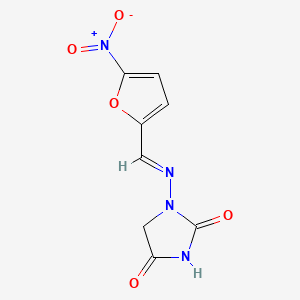
| Formula | C8H6N4O5 |
|---|---|
| Molecular weight | 238.16 g/mol |
| IUPAC name | 1-[(E)-(5-nitrofuran-2-yl)methylideneamino]imidazolidine-2,4-dione |
| CAS | 67-20-9 |
| PubChem CID | 6604200 |
| InChIKey | NXFQHRVNIOXGAQ-YCRREMRBSA-N |
| logP | 0.07 (XLogP -0.5) |
| Polar surface area | 118.05 Ų |
| H-bond acceptors / donors | 6 / 1 |
| Drug-likeness (QED) | 0.35 |
| Lipinski violations | 0 |
SMILES
O=C1CN(/N=C/c2ccc([N+](=O)[O-])o2)C(=O)N1Biology & Pharmacokinetics
Pharmacokinetics
| BBB penetrant | Yes |
|---|
Enzyme interactions
| Enzyme | Role | Detail |
|---|---|---|
| CYP1A2 | Inhibitor | — |
| CYP2B6 | Inhibitor | — |
| CYP2C8 | Inhibitor | — |
| CYP3A4 | Substrate | — |
Receptor binding (top 2)
| Target | Action | Affinity |
|---|---|---|
| mitochondrial pyruvate carrier 1 like (MPC1L) | Inhibitor | pIC50 5.5 |
| mitochondrial pyruvate carrier 2 (MPC2) | Inhibitor | pIC50 5.5 |
Transporters
BCRP (Inhibitor)BCRP (Inhibitor)BSEP (Inhibitor)BSEP (Inhibitor)MRP1 (Inhibitor)MRP2 (Inhibitor)MRP3 (Inhibitor)MRP4 (Inhibitor)OAT3 (Inhibitor)OATP1B1 (Inhibitor)OATP1B1 (Inhibitor)OATP1B3 (Inhibitor)OATP1B3 (Inhibitor)OATP2B1 (Inhibitor)P-gp (Inhibitor)BCRP (Substrate)MDR1 (Substrate)MRP2 (Substrate)P-gp (Substrate)
Drug–drug interactions (97, DDInter)
| Interacting drug | Severity | Management |
|---|---|---|
| Leflunomide | major | |
| Nitrous acid | major | |
| Teriflunomide | major | |
| Adalimumab | moderate | |
| Asparaginase Escherichia coli | moderate | |
| Balsalazide | moderate | |
| Benznidazole | moderate | |
| Benzocaine (topical) | moderate | |
| Bortezomib | moderate | |
| Brentuximab vedotin | moderate | |
| Cabazitaxel | moderate | |
| Carboplatin | moderate | |
| Carfilzomib | moderate | |
| Certolizumab pegol | moderate | |
| Chloramphenicol | moderate | |
| Chloroquine | moderate | |
| Cinchocaine (topical) | moderate | |
| Cisplatin | moderate | |
| Clofarabine | moderate | |
| Cocaine (nasal) | moderate | |
| Cocaine (topical) | moderate | |
| Crizotinib | moderate | |
| Dapsone | moderate | |
| Dapsone (topical) | moderate | |
| Dinutuximab | moderate | |
| Disulfiram | moderate | |
| Docetaxel | moderate | |
| Elotuzumab | moderate | |
| Epirubicin | moderate | |
| Eribulin | moderate | |
| Etanercept | moderate | |
| Ethinylestradiol | moderate | |
| Etoposide | moderate | |
| Fluconazole | moderate | |
| Fludarabine | moderate | |
| Golimumab | moderate | |
| Hydroxychloroquine | moderate | |
| Idelalisib | moderate | |
| Infliximab | moderate | |
| Interferon alfa-2a, Recombinant | moderate |
Showing 40 of 97.
Registered Products (1)
| Brand | Form / strength | Pack | Agent | Citizen (JOD) |
|---|---|---|---|---|
| NITROBACT-100 | Capsule 100 mg | 25 cap | Reda Jardaneh Drug Store | 3.300 |