Phenytoin
🧬 Cross-allergy: Aromatic anticonvulsants
JFDA label: Epanutin (PHENYTOIN)
- Cardiovascular risk associated with rapid infusion (injection):
Mechanism of Action
Blocker of Sodium channel alpha subunit — Sodium channel alpha subunit blocker
| Target | Action | Gene / class |
|---|---|---|
| Sodium channel alpha subunit efficacy | BLOCKER |
Indications
Approved
- Seizures (non-emergent use)
- Status epilepticus (injection only)
Off-label
- Prevention of early (within 1 week) posttraumatic seizures following traumatic brain injury
Contraindications
Source: Lexicomp · Curated
- Hypersensitivity to phenytoin, other hydantoins, or any component of the formulation Absolute
- Sinus bradycardia, sinoatrial block, or second- and third-degree AV block Absolute
- concurrent use of delavirdine Absolute
- history of prior acute hepatotoxicity attributable to phenytoin Injection: Additional contraindications: Sinus bradycardia, sinoatrial block, second- and third-degree heart block, Adams-Stokes syndrome Absolute
Adverse Reactions
Cardiac disorders (8)
Not Known Atrial conduction depression (IV administration) · bradycardia (IV administration) · cardiac arrhythmia (IV administration) · circulatory shock (IV administration) · hypotension (IV administration) · periarteritis nodosa · ventricular conduction depression (IV administration) · ventricular fibrillation (IV administration)
Nervous system disorders (15)
Not Known Ataxia · cerebral atrophy (elevated serum levels and/or long-term use) · cerebral dysfunction (elevated serum levels and/or long-term use) · confusion · dizziness · drowsiness · headache · insomnia · mood changes · nervousness · paresthesia · peripheral neuropathy (associated with chronic treatment) · slurred speech · twitching · vertigo
Hepatobiliary disorders (5)
Not Known Acute hepatic failure · hepatic injury · hepatitis · increased serum alkaline phosphatase · toxic hepatitis
Renal and urinary disorders (1)
Not Known Peyronie disease
Blood and lymphatic system disorders (13)
Not Known Agranulocytosis · granulocytopenia · Hodgkin lymphoma · immunoglobulin abnormality · leukopenia · lymphadenopathy · macrocytosis · malignant lymphoma · megaloblastic anemia · pancytopenia · pseudolymphoma · purpuric dermatitis · thrombocytopenia
Immune system disorders (2)
Not Known Anaphylaxis · DRESS syndrome
Metabolism and nutrition disorders (3)
Not Known Hyperglycemia · increased gamma-glutamyl transferase · vitamin D deficiency (associated with chronic treatment)
Gastrointestinal disorders (6)
Not Known Constipation · dysgeusia (metallic taste) · enlargement of facial features (lips) · gingival hyperplasia · nausea · vomiting
Skin and subcutaneous tissue disorders (9)
Not Known Bullous dermatitis · exfoliative dermatitis · hypertrichosis · morbilliform rash (most common) · scarlatiniform rash · skin or other tissue necrosis (IV administration) · skin rash · Stevens-Johnson syndrome · toxic epidermal necrolysis
Musculoskeletal and connective tissue disorders (4)
Not Known Coarsening of facial features · osteomalacia · systemic lupus erythematosus · tremor
Eye disorders (1)
Not Known Nystagmus
General disorders and administration site conditions (7)
Not Known Fever · Injection site reaction ("purple glove syndrome"; edema, discoloration, and pain distal to injection site) · local inflammation (IV administration) · local irritation (IV administration) · local tissue necrosis (IV administration) · localized tenderness (IV administration) · tissue sloughing (IV administration)
Dosing
Source: Lexicomp
Warnings & Precautions
Source: Lexicomp
Blood dyscrasias
A spectrum of hematologic effects have been reported (eg, agranulocytosis, leukopenia, granulocytopenia, thrombocytopenia, and pancytopenia with or without bone marrow suppression) and may be fatal; patients with a previous history of adverse hematologic reaction to any drug may be at increased risk. Early detection of hematologic change is important; advise patients of early signs and symptoms including fever, sore throat, mouth ulcers, infections, easy bruising, petechial or purpuric hemorrhage.
Bone effects
Chronic use of phenytoin has been associated with decreased bone mineral density (osteopenia, osteoporosis, and osteomalacia) and bone fractures. Chronic use may result in decreased vitamin D concentrations due to hepatic enzyme induction and may lead to vitamin D deficiency, hypocalcemia, and hypophosphatemia; monitor as appropriate and consider implementing vitamin D and calcium supplementation.
Cardiovascular events
Phenytoin must be administered slowly. Intravenous administration should not exceed 50 mg/minute in adult patients. In pediatric patients, intravenous administration rate should not exceed 1-3 mg/kg/minute or 50 mg/minute whichever is slower. Hypotension and severe cardiac arrhythmias (eg, heart block, ventricular tachycardia, ventricular fibrillation) may occur with rapid administration; adverse cardiac events have been reported at or below the recommended infusion rate. Cardiac monitoring is necessary during and after administration of intravenous phenytoin; reduction in rate of administration or discontinuation of infusion may be necessary. For nonemergency use, intravenous phenytoin should be administered more slowly; the use of oral phenytoin should be used whenever possible.
Dermatologic reactions
Severe reactions, including toxic epidermal necrolysis (TEN) and Stevens-Johnson syndrome (some fatal) have been reported; the onset of symptoms is usually within 28 days of treatment, but can occur later. Discontinue phenytoin if there are any signs of rash and evaluate for signs and symptoms of drug reaction with eosinophilia and systemic symptoms (DRESS). Data suggests a genetic susceptibility for serious skin reactions in patients of Asian descent (see "Special populations" below).
Extravasation
Vesicant (intravenous administration); ensure proper catheter or needle position prior to and during infusion. Avoid extravasation. IV formulation may cause soft tissue irritation and inflammation, and skin necrosis at IV site; avoid IV administration in small veins. The "purple glove syndrome" (ie, discoloration with edema and pain of distal limb) may occur following peripheral IV administration of phenytoin. This syndrome may or may not be associated with drug extravasation. Symptoms may resolve spontaneously; however, skin necrosis and limb ischemia may occur; interventions such as fasciotomies, skin grafts, and amputation (rare) may be required. To decrease the risk of this syndrome, inject phenytoin slowly and directly into a large vein through a large gauge needle or IV catheter; follow with NS flushes through the same needle or IV catheter.
Hepatotoxicity
Cases of acute hepatotoxicity, including infrequent cases of acute hepatic failure, have been reported. Other manifestations include jaundice, hepatomegaly, elevated serum transaminase levels, leukocytosis, and eosinophilia. The clinical course of acute phenytoin hepatotoxicity ranges from prompt recovery to fatal outcomes. Immediately discontinue phenytoin in patients who develop acute hepatotoxicity and do not readminister.
Hypersensitivity
Consider alternative therapy in patients who have experienced hypersensitivity to structurally similar drugs such as carboxamides (eg, carbamazepine), barbiturates, succinimides, and oxazolidinediones (eg, trimethadione).
Lymphadenopathy
May occur (local or generalized), including benign lymph node hyperplasia, pseudolymphoma, lymphoma, and Hodgkin disease; cause and effect relationship has not been established.
Multiorgan hypersensitivity reactions
Potentially serious, sometimes fatal multiorgan hypersensitivity reactions (also known as drug reaction with eosinophilia and systemic symptoms [DRESS]) have been reported with some antiepileptic drugs; including phenytoin; monitor for signs and symptoms of possible manifestations associated with lymphatic, hepatic, renal, and/or hematologic organ systems; gradual discontinuation and conversion to alternate therapy may be required.
Suicidal ideation
Pooled analysis of trials involving various antiepileptics (regardless of indication) showed an increased risk of suicidal thoughts/behavior (incidence rate: 0.43% treated patients compared to 0.24% of patients receiving placebo); risk observed as early as 1 week after initiation and continued through duration of trials (most trials ≤24 weeks). Monitor all patients for notable changes in behavior that might indicate suicidal thoughts or depression; notify healthcare provider immediately if symptoms occur. Disease-related concerns:
Cardiovascular disease
Use with caution in patients with underlying cardiac disease; IV use is contraindicated in patients with sinus bradycardia, sinoatrial block, or second and third degree heart block.
Diabetes
Use with caution in patients with diabetes mellitus; phenytoin may inhibit insulin release and increase serum glucose in patients with diabetes.
Hepatic impairment
Use with caution in patients with hepatic impairment; use free (unbound) serum concentrations to monitor.
Hypoalbuminemia
Use with caution in patients with any condition associated with low serum albumin levels, which will increase the free fraction of phenytoin in the serum and, therefore, the pharmacologic response. Use free (unbound) serum concentrations to monitor.
Hypothyroidism
Use with caution in patients with hypothyroidism; phenytoin may alter thyroid hormone serum concentrations (with chronic administration).
Porphyria
May cause exacerbation of porphyria; use with caution in patients with porphyria.
Renal impairment
Use with caution in patients with renal impairment; use free (unbound) serum concentrations to monitor. Concurrent drug therapy issues:
Drug-drug interactions
Potentially significant interactions may exist, requiring dose or frequency adjustment, additional monitoring, and/or selection of alternative therapy. Consult drug interactions database for more detailed information. Special populations:
Asian ancestry
Asian patients with the variant HLA-B*1502 may be at an increased risk of developing Stevens-Johnson syndrome and/or TEN. Note: Carbamazepine, another antiepileptic with a chemical structure similar to phenytoin, includes in the manufacturer labeling a recommendation to screen patients of Asian descent for the HLA-B*1502 allele prior to initiating therapy; this is not a current recommendation in the phenytoin manufacturer labeling. Patients with a positive result should avoid phenytoin.
Critically-ill patients
Use with caution in critically ill patients.
Debilitated patients
Use with caution in patients who are debilitated. Dosage form specific issues:
Benzyl alcohol and derivatives
Some dosage forms may contain sodium benzoate/benzoic acid; benzoic acid (benzoate) is a metabolite of benzyl alcohol; large amounts of benzyl alcohol (≥99 mg/kg/day) have been associated with a potentially fatal toxicity (“gasping syndrome”) in neonates; the “gasping syndrome” consists of metabolic acidosis, respiratory distress, gasping respirations, CNS dysfunction (including convulsions, intracranial hemorrhage), hypotension, and cardiovascular collapse (AAP ["Inactive" 1997]; CDC 1982); some data suggests that benzoate displaces bilirubin from protein binding sites (Ahlfors 2001); avoid or use dosage forms containing benzyl alcohol derivative with caution in neonates. See manufacturer's labeling.
Propylene glycol
Some dosage forms may contain propylene glycol; large amounts are potentially toxic and have been associated hyperosmolality, lactic acidosis, seizures and respiratory depression; use caution (AAP 1997; Zar 2007). Other warnings/precautions:
Appropriate use
Not indicated for the treatment of absence seizures or seizures due to hypoglycemia or other metabolic causes.
Sustained serum concentrations
Plasma concentrations of phenytoin sustained above the optimal range may produce confusional states referred to as delirium, psychosis, or encephalopathy, or rarely, irreversible cerebellar dysfunction and/or cerebellar atrophy. Measure plasma phenytoin concentrations at the first sign of acute toxicity; dosage reduction is indicated if phenytoin concentrations are excessive; if symptoms persist, discontinue administration.
Withdrawal
Anticonvulsants should not be discontinued abruptly because of the possibility of increasing seizure frequency; therapy should be withdrawn gradually to minimize the potential of increased seizure frequency, unless safety concerns require a more rapid withdrawal.
Pregnancy & Lactation
Pregnancy
Avoid
Use only if no safer alternative for epilepsy control. Folic acid supplementation. Neonatal vitamin K at birth. Monitor drug levels (protein binding changes in pregnancy)
Lactation
Phenytoin is excreted in breast milk. According to the manufacturer, the decision to breastfeed during therapy should consider the risk of infant exposure, the benefits of breastfeeding to the infant, and benefits of treatment to the mother.
Monitoring
| Efficacy | Serum phenytoin 10–20 mg/L (total) or 1–2 mg/L (free, in hypoalbuminaemia); seizure frequency |
|---|---|
| Toxicity | Ataxia, nystagmus, diplopia at > 20 mg/L; encephalopathy at > 40 mg/L; CBC for haematological toxicity; LFTs |
| Clinical pearl | Phenytoin follows non-linear (Michaelis-Menten) kinetics — small dose increases cause disproportionately large level increases near saturation. Always adjust in small increments. |
| Counseling | Take at the same time each day. Report dizziness, slurred speech, rash, or unusual bleeding. Regular dental care is important (gingival hyperplasia risk). |
Chemistry & Properties
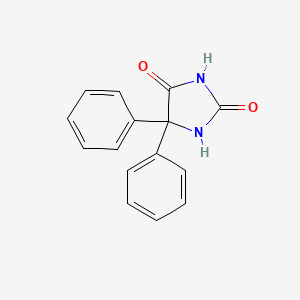
| Formula | C15H12N2O2 |
|---|---|
| Molecular weight | 252.27 g/mol |
| IUPAC name | 5,5-diphenylimidazolidine-2,4-dione |
| CAS | 57-41-0 |
| PubChem CID | 1775 |
| InChIKey | CXOFVDLJLONNDW-UHFFFAOYSA-N |
| logP | 1.77 (XLogP 2.5) |
| Polar surface area | 58.2 Ų |
| H-bond acceptors / donors | 2 / 2 |
| Drug-likeness (QED) | 0.80 |
| Lipinski violations | 0 |
SMILES
O=C1NC(=O)C(c2ccccc2)(c2ccccc2)N1Biology & Pharmacokinetics
Pharmacokinetics
| BBB penetrant | Yes (logBB -0.1) |
|---|
Enzyme interactions
| Enzyme | Role | Detail |
|---|---|---|
| CYP2B6 | Substrate | — |
| CYP2C19 | Substrate | — |
| CYP2C9 | Inhibitor | Ki 7.745966692414836 µM |
| CYP2C9 | Substrate | — |
| CYP3A4 | Substrate | — |
Transporters
BCRP (Inhibitor)BCRP (Inhibitor)BSEP (Inhibitor)MDR1 (Inhibitor)MRP1 (Inhibitor)MRP2 (Inhibitor)OATP1B1 (Inhibitor)OATP1B1 (Inhibitor)OATP1B3 (Inhibitor)OATP1B3 (Inhibitor)OATP2B1 (Inhibitor)OCT1 (Inhibitor)OCT3 (Inhibitor)OCTN2 (Inhibitor)P-gp (Inhibitor)BCRP (Substrate)MDR1 (Substrate)MRP2 (Substrate)P-gp (Substrate)
Drug–drug interactions (100+, DDInter)
| Interacting drug | Severity | Management |
|---|---|---|
| Abemaciclib | major | |
| Abiraterone | major | |
| Acalabrutinib | major | |
| Alpelisib | major | |
| Apixaban | major | |
| Apremilast | major | |
| Artemether | major | |
| Avatrombopag | major | |
| Axitinib | major | |
| Bortezomib | major | |
| Bosutinib | major | |
| Brigatinib | major | |
| Cabozantinib | major | |
| Ceritinib | major | |
| Cimetidine | major | |
| Cobicistat | major | |
| Cobimetinib | major | |
| Copanlisib | major | |
| Crizotinib | major | |
| Darolutamide | major | |
| Dasatinib | major | |
| Deflazacort | major | |
| Eliglustat | major | |
| Encorafenib | major | |
| Entrectinib | major | |
| Ethinylestradiol | major | |
| Everolimus | major | |
| Fedratinib | major | |
| Fluconazole | major | |
| Fostamatinib | major | |
| Gilteritinib | major | |
| Glasdegib | major | |
| Hydrocodone | major | |
| Ibrutinib | major | |
| Idelalisib | major | |
| Imatinib | major | |
| Irinotecan | major | |
| Irinotecan (liposomal) | major | |
| Ivacaftor | major | |
| Ivosidenib | major |
Showing 40 of 100+.
Registered Products (5)
| Brand | Form / strength | Pack | Agent | Citizen (JOD) |
|---|---|---|---|---|
| Epanutin (PHENYTOIN) | Tablet 100 mg | 100 tab | Sabbagh Drug Store | 6.000 |
| Fentex 250mg/5ml Solution For Injection | Injection 50 mg/1 ml | 1 vial pack varies | MS PHARMA/JORDAN | — |
| Fentex 250mg/5ml Solution For Injection | Injection 50 mg/1 ml | 5 vial pack varies | MS PHARMA/JORDAN | — |
| Fentex 250mg/5ml Solution For Injection | Injection 50 mg/1 ml | 10 vial pack varies | MS PHARMA/JORDAN | — |
| Phentolep Amp. | Ampoule 50 mg/ml | 5 amp | Hikma Pharmaceuticals Co.Ltd/Jordan | — |