Testosterone
JFDA label: Testoviron DEPOT Amp
- Secondary exposure (transdermal gel, transdermal solution):
- Pulmonary oil microembolism (testosterone undecanoate):
Mechanism of Action
Agonist of Androgen receptor — Androgen Receptor agonist
| Target | Action | Gene / class |
|---|---|---|
| Androgen receptor efficacy | AGONIST | AR |
Indications
Approved
- Breast cancer, metastatic
- Delayed puberty
- Hypogonadism, hypogonadotropic (congenital or acquired)
- Hypogonadism, primary (congenital or acquired)
Contraindications
Source: Lexicomp
- Breast cancer (males) Absolute
- breast-feeding women Depo-Testosterone: Additional contraindications: Hypersensitivity to testosterone cypionate, serious cardiac, hepatic, or renal disease Testosterone enanthate: Additional contraindications: Hypersensitivity to any component of the formulation Documentation of allergenic cross-reactivity for androgens is limited. However, because of similarities in chemical structure and/or pharmacologic actions, the possibility of cross-sensitivity cannot be ruled out with certainty Absolute
- pregnant women or women who may become pregnant Androderm, Androgel, Axiron, Fortesta, Natesto, Striant, Testim, Vogelxo: Additional contraindication: Breast-feeding women Andriol [Canadian product]: Additional contraindications: Hypersensitivity to any component of the formulation Absolute
- prostate cancer (known or suspected) Absolute
- use in women Aveed: Additional contraindications: Hypersensitivity to testosterone undecanoate, castor oil, benzyl benzoate Absolute
Adverse Reactions
Cardiac disorders (3)
Common Exacerbation of hypertension (buccal) · Hypertension · peripheral vascular disease, anosmia, altered sense of smell, headache, procedural pain, depression, nervousness, abnormality in thinking, crusted skin, excoriation, contact dermatitis, bulla, hyperli
Nervous system disorders (1)
Common Hostility (topical)
Hepatobiliary disorders (1)
Common Hepatic adenoma (intramuscular; long-term testosterone enanthate therapy)
Renal and urinary disorders (2)
Very Common benign prostatic hypertrophy · Prostate specific antigen increase
Blood and lymphatic system disorders (5)
Common anemia · application site irritation, myalgia, limb pain, weakness, abnormal bone growth, polyuria, rhinorrhea, epistaxis, nasal discomfort, bronchitis, upper respiratory tract infection, dry nose, nasal conge · Increased hematocrit · polycythemia · prostate carcinoma, application site vesicles, application site reaction, pain at injection site, application site induration: transdermal: 3%)
Gastrointestinal disorders (9)
Common Abdominal pain (buccal) · decreased appetite · diarrhea · dysgeusia, prostatic disease, hypogonadism, mastalgia, prostatitis, dysuria, abnormal hepatic function tests · gingival pain · Gingivitis · gum line erosion (buccal) · mouth irritation · nausea
Skin and subcutaneous tissue disorders (1)
Very Common Skin blister
General disorders and administration site conditions (1)
Very Common Application-site pruritus
Dosing
Source: Lexicomp
Warnings & Precautions
Source: Lexicomp
Breast cancer
Long term use (>10 years) of parenteral testosterone for male hypogonadism may increase the risk of breast cancer (Medras 2006).
Cardiovascular events
Available studies are inconclusive regarding the risk of developing major adverse cardiovascular events (MACE) such as nonfatal MI, stroke, or cardiovascular death following testosterone use. Some studies have suggested an increased risk of cardiovascular events among groups of men prescribed testosterone therapy (Basaria 2010; Finkle 2014; Vigen 2013), although the overall evidence does not demonstrate an increased or decreased cardiovascular risk (Endocrine Society [Bhasin 2010]; Corona 2014; Morgentaler 2015). According to the FDA, prescribe testosterone therapy only for men with low testosterone levels caused by certain medical conditions (eg, disorders of the testicles, pituitary gland, brain) and confirmed by laboratory tests (FDA Drug Safety Communication 2015). However, in a position statement issued by the American Association of Clinical Endocrinologists (AACE) and the American College of Endocrinology (ACE), they recommend that after a thorough diagnostic work-up, testosterone replacement should be guided by signs and symptoms and testosterone concentrations rather than the underlying cause (AACE/ACE [Goodman 2015]). The Endocrine Society suggests it may be prudent to avoid testosterone therapy in men who have experienced a cardiovascular event (eg, MI, stroke, acute coronary syndrome) in the past six months (The Endocrine Society 2014). Evaluate patients for cardiovascular risk factors prior to initiating therapy and monitor closely during therapy for cardiovascul
Dyslipidemia
May alter serum lipid profile; use caution with history of MI or coronary artery disease.
Gynecomastia
May cause gynecomastia, which may persist in patients treated for hypogonadism.
Hepatic effects
Prolonged use of high doses of androgens has been associated with serious hepatic effects (peliosis hepatis, hepatic neoplasms, cholestatic hepatitis, jaundice). Prolonged use of intramuscular testosterone enanthate has been associated with multiple hepatic adenomas. Discontinue therapy if signs or symptoms of hepatic dysfunction (such as jaundice) develop.
Hypercalcemia
May cause hypercalcemia in patients with prolonged immobilization or cancer.
Oligospermia
Large doses may suppress spermatogenesis; oligospermia may occur. Discontinue therapy if this occurs, if restarted, a lower dose should be used.
Polycythemia
May increase hematocrit requiring dose adjustment or discontinuation. Withhold initial treatment in patients with hematocrit >50%. Discontinue therapy if hematocrit exceeds 54%; may reinitiate at lower dose (Endocrine Society [Bhasin 2010]).
Priapism
Priapism or excessive sexual stimulation may occur; discontinue therapy if this occurs, if restarted, a lower dose should be used.
Prostate cancer
May increase the risk of prostate cancer. Withhold therapy pending urological evaluation in patients with palpable prostate nodule or induration, PSA >4 ng/mL, or PSA >3 ng/mL in men at high risk of prostate cancer (Endocrine Society [Bhasin 2010]).
Venous thromboembolism
Venous thromboembolic events, including deep vein thrombosis (DVT) and pulmonary embolism (PE), have been reported with testosterone products. Evaluate patients with symptoms of pain, edema, warmth, and erythema in the lower extremity for DVT and those with acute shortness of breath for PE. Discontinue therapy if a venous thromboembolism is suspected. Disease-related concerns:
Benign prostatic hyperplasia (BPH)
Androgens may worsen BPH; do not use in patients with severe lower urinary tract symptoms [(AUA)/International Prostate Symptom Score (IPSS) > 19] (Endocrine Society [Bhasin 2010]). Discontinue therapy if urethral obstruction develops in patients with BPH (use lower dose if restarted).
Diseases exacerbated by fluid retention
Use with caution in patients with diseases that may be exacerbated by fluid retention, including cardiac impairment; testosterone may cause fluid retention. Treatment of androgen deficiency syndromes is not recommended for men with uncontrolled or poorly controlled heart failure (Endocrine Society [Bhasin 2010]).
Hepatic impairment
Use with caution in patients with hepatic impairment; testosterone may cause fluid retention; testosterone cypionate is contraindicated in serious hepatic impairment.
Renal impairment
Use with caution in patients with renal impairment; testosterone may cause fluid retention; testosterone cypionate is contraindicated in serious renal impairment.
Sleep apnea
May potentiate sleep apnea in some male patients, especially those with risk factors (eg, obesity or chronic lung disease). Withhold initial treatment in patients with untreated obstructive sleep apnea (Endocrine Society [Bhasin 2010]). Concurrent drug therapy issues:
Drug-drug interactions
Potentially significant interactions may exist, requiring dose or frequency adjustment, additional monitoring, and/or selection of alternative therapy. Consult drug interactions database for more detailed information. Special populations:
Elderly
Geriatric patients may be at greater risk for prostatic hyperplasia, prostate cancer, fluid retention, and transaminase elevations.
Pediatric
May accelerate bone maturation (without producing compensatory gain in linear growth) and premature closure of the epiphyses in children; in prepubertal children perform radiographic examination of the hand and wrist every 6 months to determine the rate of bone maturation and to assess the effect of treatment on the epiphyseal centers. Use with caution in males with delayed puberty.
Women
During treatment for metastatic breast cancer, women should be monitored for signs of virilization; discontinue if mild virilization is present to prevent irreversible symptoms. Dosage form specific issues:
Benzyl alcohol and derivatives
Some dosage forms may contain benzyl alcohol; large amounts of benzyl alcohol (≥99 mg/kg/day) have been associated with a potentially fatal toxicity (“gasping syndrome”) in neonates; the “gasping syndrome” consists of metabolic acidosis, respiratory distress, gasping respirations, CNS dysfunction (including convulsions, intracranial hemorrhage), hypotension, and cardiovascular collapse (AAP ["Inactive" 1997]; CDC 1982); some data suggests that benzoate displaces bilirubin from protein binding sites (Ahlfors 2001); avoid or use dosage forms containing benzyl alcohol with caution in neonates. See manufacturer’s labeling.
Castor oil
Some products may contain castor oil.
Gel, intranasal
Use of the intranasal gel is not recommended in patients with sinus disease, mucosal inflammatory disorders (eg, Sjogren syndrome), or with a history of nasal disorders, nasal or sinus surgery, nasal fracture within the previous 6 months, or nasal fracture that caused a deviated anterior nasal septum. Safety and efficacy have not been established in males with a BMI >35 kg/m2.
Gel, topical
Topical testosterone products may have different doses, strengths, or application instructions that may result in different systemic exposure; these products are not interchangeable.
Injection
Testosterone cypionate should not be used interchangeably with testosterone propionate due to differences in duration of action.
Pulmonary oil microembolism
Testosterone undecanoate injection: [US Boxed Warning]: Serious pulmonary oil microembolism (POME) reactions and anaphylaxis have been reported with testosterone undecanoate injection. Reactions include anaphylaxis, chest pain, urge to cough, dizziness, dyspnea, throat tightening, and syncope; may be life threatening. Reactions may occur after any injection during the course of therapy, including the first dose. Patients must be monitored for 30 minutes after injection. Due to the risk of serious POME reactions, Aveed is only available through the Aveed REMS program. To minimize risk of adverse reactions, inject deeply into gluteal muscle. Rare reports of reactions involving urge to cough, coughing fits, and respiratory distress immediately after the injection of testosterone enanthate (an oil-based depot preparation) have also been reported.
Solution
Axiron is not interchangeable with other topical testosterone products. Use in males with BMI >35 kg/m2 has not been established.
Transdermal patch
May contain conducting metal (eg, aluminum); remove patch prior to MRI. Other warnings/precautions:
Abuse/misuse/diversion
Anabolic steroids may be abused, typically at doses higher than recommended and in combination with other anabolic androgenic steroids; abuse may be associated with serious cardiovascular and psychiatric adverse reactions. Inform patients of the serious adverse reactions associated with abuse of testosterone and anabolic androgenic steroids; if abuse is suspected, check serum testosterone levels (testosterone levels may be in the normal or subnormal range in men abusing synthetic testosterone derivatives). Consider the possibility of abuse in suspected patients who present with serious cardiovascular or psychiatric adverse events.
Dependence
Drug dependence in individuals using approved doses of testosterone for approved indications has not been documented; however dependence may occur when used outside of approved dosage/indications.
Secondary exposure
Testosterone may be transferred to another person following skin-to-skin contact with the application site. [US Boxed Warning]: Virilization in children has been reported following contact with unwashed or unclothed application sites of men using topical testosterone. Patients should strictly adhere to instructions for use in order to prevent secondary exposure. Children and women should avoid contact with application sites of men using topical products. Symptoms of virilization generally regress following removal of exposure; however, in some children, enlarged genitalia and bone age did not fully return to age appropriate normal. Signs of inappropriate virilization in women or children following secondary exposure to topical testosterone should be brought to the attention of a healthcare provider.
Pregnancy & Lactation
Pregnancy
Use is contraindicated in pregnant women or women who may become pregnant. Exposure to a fetus may cause virilization of varying degrees. Because of the potential for secondary exposure, all children and women should avoid skin-to-skin contact to areas where testosterone has been applied topically on another person. Some products contain benzyl alcohol, which can cross the placenta. Large doses of testosterone may suppress spermatogenesis. Treatment of hypogonadotropic hypogonadism is not recommended for men desiring fertility (Endocrine Society [Bhasin 2010]).
Lactation
Testosterone is excreted in breast milk. Most products are contraindicated while breast-feeding. Distribution of testosterone in breast milk was evaluated following use of the subcutaneous pellet in a nursing woman. Prior to therapy, milk concentrations of testosterone were 96 pg/mL. Following SubQ implantation of the 100 mg pellet, milk samples ranged from 88 pg/mL (day 2) to 100 pg/mL (day 7 [morning]). Reported maternal serum samples ranged from Because of the potential for secondary exposu
Monitoring
| Clinical pearl | Prior to treatment initiation: Confirm hypogonadism by measuring morning serum testosterone on at least 2 separate days. Liver function tests, lipid panel, hemoglobin and hematocrit (withhold initial treatment with hematocrit >50%) (Endocrine Society [Bhasin 2010]). PSA and prostate exam in men >40 years of age with baseline PSA >0.6 ng/mL. During treatment: Liver function tests, lipid panel, hemoglobin and hematocrit (at 3 to 6 months then annually); discontinue therapy if hematocrit exceeds 54% (Endocrine Society [Bhasin 2010]). Monitor urine and serum calcium and signs of virilization in women treated for breast cancer. Serum glucose (may be decreased by testosterone, monitor patients with diabetes). Evaluate males for response to treatment and adverse events 3 to 6 months after initiation and then annually; monitor for cardiovascular events closely during therapy. Monitor serum testosterone 3 to 6 months after initial dose titration (if applicable) then annually. Bone mineral density: Prepubertal children: Radiologic examination of wrist and hand every 6 months. Hypogonadal men with osteoporosis or low trauma fracture: Monitor after 1 to 2 years of therapy (Endocrine Society [Bhasin 2010]). PSA: In men >40 years of age with baseline PSA >0.6 ng/mL, PSA and prostate exam at 3 to 6 months, then as based on current guidelines. Withhold treatment pending urological evaluation in patients with palpable prostate nodule or induration or PSA >4 ng/mL or if PSA >3 ng/m |
|---|
Chemistry & Properties
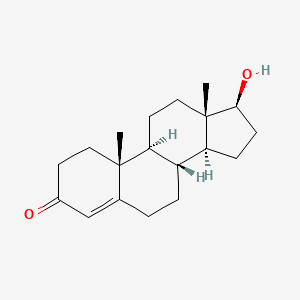
| Formula | C19H28O2 |
|---|---|
| Molecular weight | 288.43 g/mol |
| IUPAC name | (8R,9S,10R,13S,14S,17S)-17-hydroxy-10,13-dimethyl-1,2,6,7,8,9,11,12,14,15,16,17-dodecahydrocyclopenta[a]phenanthren-3-one |
| CAS | 58-22-0 |
| PubChem CID | 6013 |
| InChIKey | MUMGGOZAMZWBJJ-DYKIIFRCSA-N |
| logP | 3.88 (XLogP 3.3) |
| Polar surface area | 37.3 Ų |
| H-bond acceptors / donors | 2 / 1 |
| Drug-likeness (QED) | 0.73 |
| Lipinski violations | 0 |
SMILES
C[C@]12CC[C@H]3[C@@H](CCC4=CC(=O)CC[C@@]43C)[C@@H]1CC[C@@H]2OBiology & Pharmacokinetics
Pharmacokinetics predicted
| Bioavailability | 70.0% |
|---|---|
| Half-life | 1.255 h |
| Volume of distribution | 0.308 L/kg |
| Protein binding | 80.0% |
| BBB penetrant | Yes |
Enzyme interactions
| Enzyme | Role | Detail |
|---|---|---|
| CYP1A2 | Substrate | — |
| CYP2B6 | Inhibitor | — |
| CYP2C19 | Substrate | — |
| CYP2C9 | Substrate | — |
| CYP3A4 | Inhibitor | IC₅₀ 0.11223680975858222 µM |
| CYP3A4 | Substrate | — |
Transporters
BCRP (Inhibitor)BCRP (Inhibitor)BSEP (Inhibitor)BSEP (Inhibitor)MATE1 (Inhibitor)MATE2 (Inhibitor)MDR1 (Inhibitor)MRP1 (Inhibitor)MRP4 (Inhibitor)OAT2 (Inhibitor)OATP1B1 (Inhibitor)OATP1B1 (Inhibitor)OATP1B3 (Inhibitor)OATP1B3 (Inhibitor)OATP2B1 (Inhibitor)OCT2 (Inhibitor)P-gp (Inhibitor)BCRP (Substrate)MDR1 (Substrate)OATP1B1 (Substrate)OATP1B2 (Substrate)OATP1B3 (Substrate)OATP2B1 (Substrate)P-gp (Substrate)Transporter(unspecified) (Substrate)
Drug–drug interactions (87, DDInter)
| Interacting drug | Severity | Management |
|---|---|---|
| Carfilzomib | major | |
| Dicoumarol | major | |
| Leflunomide | major | |
| Pazopanib | major | |
| Teriflunomide | major | |
| Warfarin | major | |
| Acetohexamide | moderate | |
| Apalutamide | moderate | |
| Aprepitant | moderate | |
| Asparaginase Escherichia coli | moderate | |
| Betamethasone | moderate | |
| Binimetinib | moderate | |
| Brentuximab vedotin | moderate | |
| Brigatinib | moderate | |
| Budesonide | moderate | |
| Calcipotriol (topical) | moderate | |
| Calcitriol (topical) | moderate | |
| Chlorpropamide | moderate | |
| Clofarabine | moderate | |
| Conestat alfa | moderate | |
| Corticotropin | moderate | |
| Cyclosporine | moderate | |
| Dabrafenib | moderate | |
| Dasatinib | moderate | |
| Deferasirox | moderate | |
| Deflazacort | moderate | |
| Dexamethasone | moderate | |
| Enzalutamide | moderate | |
| Epirubicin | moderate | |
| Fedratinib | moderate | |
| Fluconazole | moderate | |
| Fludrocortisone | moderate | |
| Fostamatinib | moderate | |
| Glimepiride | moderate | |
| Glipizide | moderate | |
| Glyburide | moderate | |
| Human C1-esterase inhibitor | moderate | |
| Hydrocortisone | moderate | |
| Idelalisib | moderate | |
| Imatinib | moderate |
Showing 40 of 87.
Registered Products (6)
| Brand | Form / strength | Pack | Agent | Citizen (JOD) |
|---|---|---|---|---|
| Cypterone | Vial Testosterone Cypionate 200 mg/1 ml | 1 vial | Hikma Pharmaceuticals LLC | 3.840 |
| Testoviron DEPOT Amp | Ampoule 250 mg/ml | 1 amp | The Jordan Drugstore Co | 3.840 |
| SUSTANON Amps | Ampoule 30 mg/ml, 60 mg/ml, 100 mg/ml, 60 mg | 1 amp | Sabbagh Drug Store | 4.620 |
| ANDRIOL Testocaps | Tablet 40 mg | 30 tab | Sabbagh Drug Store | 9.140 |
| TESTAVAN 20 mg/g transdermal Gel | Gel 20.0 mg/1 g | 85.5 g tube | Petra Drug Store | 40.300 |
| Nebido | Vial 25 % | 1 vial | The Jordan Drugstore Co | 81.260 |