Remdesivir
Active form: Rdv-Tp.
JFDA label: Veklury
- Black Box Warning — ChEMBL drug_warning (Black Box Warning) | United States
Mechanism of Action
Inhibitor of RNA-directed RNA polymerase L — RNA-directed RNA polymerase L inhibitor; Inhibitor of Replicase polyprotein 1ab — Replicase polyprotein 1ab inhibitor
| Target | Action | Gene / class |
|---|---|---|
| RNA-directed RNA polymerase L efficacy | INHIBITOR | L |
| Replicase polyprotein 1ab efficacy | INHIBITOR | rep |
Indications
Approved
- COVID-19 — COVID-19
- Coronavirus Infections — coronavirus infectious disease
- Severe Acute Respiratory Syndrome — severe acute respiratory syndrome
- Virus Diseases — viral disease
Off-label
- Hemorrhagic Fever, Ebola
- Influenza, Human
- Pneumonia
- Respiratory Distress Syndrome
Antimicrobial Spectrum
Expected / intrinsic spectrum (EUCAST breakpoints & labels) — not local resistance. Source: openfda-label.
Viruses
| Organism | Activity | MIC |
|---|---|---|
| Respiratory Syncytial | Active | — |
| Rsv | Active | — |
Class profile
| targetVirus | SARS-CoV-2 / Ebola / RSV |
|---|---|
| viralClass | Various RNA viruses |
| targetStep | RNA-dependent RNA polymerase (RdRp, NUC prodrug, chain terminator) |
| resistanceBarrier | Moderate (F480L + V557L in nsp12 RdRp reduce susceptibility) |
| crossResistance | No cross-resistance with 3CL-pro inhibitors; activity against Coronaviridae family |
| source | DHHS/AASLD/manufacturer-PIL |
Contraindications
Source: openFDA
- is contraindicated in patients with a history of clinically significant hypersensitivity reactions to VEKLURY or any components of the product [see Warnings and Precautions (5.1) ]. VEKLURY is contraindicated in patients with a history of clinically significant hypersensitivity reactions to VEKLURY or any components of the product. ( 4 ) Absolute
Dosing
Source: openFDA
Warnings & Precautions
Source: openFDA
Warnings & Precautions
Hypersensitivity including infusion-related and anaphylactic reactions: Hypersensitivity reactions have been observed during and following administration of VEKLURY. Slower infusion rates, with a maximum infusion time of up to 120 minutes, can be considered to potentially prevent signs and symptoms of hypersensitivity. Monitor patients during infusion and observe patients for at least one hour after infusion is complete for signs and symptoms of hypersensitivity as clinically appropriate. If signs and symptoms of a clinically significant hypersensitivity reaction occur, immediately discontinue administration of VEKLURY and initiate appropriate treatment. ( 5.1 ) Increased risk of transaminase elevations: Transaminase elevations have been observed in healthy volunteers and have also been reported in patients with COVID-19 who received VEKLURY. Perform hepatic laboratory testing in all patients before starting VEKLURY and while receiving VEKLURY as clinically appropriate. Consider discontinuing VEKLURY if ALT levels increase to greater than 10 times the upper limit of normal. Discontinue VEKLURY if ALT elevation is accompanied by signs or symptoms of liver inflammation. ( 5.2 ) Risk of reduced antiviral activity when coadministered with chloroquine phosphate or hydroxychloroquine sulfate: Coadministration of VEKLURY and chloroquine phosphate or hydroxychloroquine sulfate is not recommended based on data from cell culture experiments demonstrating a potential antagonistic effect of chloroquine on the intracellular metabolic activation and antiviral activity of VEKLURY. ( 5.3 )
Hypersensitivity Including Infusion-related and Anaphylactic Reactions
Hypersensitivity Including Infusion-related and Anaphylactic Reactions Hypersensitivity reactions, including infusion-related and anaphylactic reactions, have been observed during and following administration of VEKLURY; most occurred within one hour. Signs and symptoms may include hypotension, hypertension, tachycardia, bradycardia, hypoxia, fever, dyspnea, wheezing, angioedema, rash, nausea, diaphoresis, and shivering. Slower infusion rates, with a maximum infusion time of up to 120 minutes, can be considered to potentially prevent these signs and symptoms. Monitor patients during infusion and observe patients for at least one hour after infusion is complete for signs and symptoms of hypersensitivity as clinically appropriate. If signs and symptoms of a clinically significant hypersensitivity reaction occur, immediately discontinue administration of VEKLURY and initiate appropriate treatment. The use of VEKLURY is contraindicated in patients with known hypersensitivity to VEKLURY or any components of the product [see Contraindications (4) ] .
Increased Risk of Transaminase Elevations Transaminase elevations have
Increased Risk of Transaminase Elevations Transaminase elevations have been observed in healthy volunteers who received 200 mg of VEKLURY followed by 100 mg doses for up to 10 days; the transaminase elevations were mild (Grade 1) to moderate (Grade 2) in severity and resolved upon discontinuation of VEKLURY. Transaminase elevations have also been reported in patients with COVID-19 who received VEKLURY [see Adverse Reactions (6.1) ] . Because transaminase elevations have been reported as a clinical feature of COVID-19, and the incidence was similar in patients receiving placebo versus VEKLURY in clinical trials of VEKLURY, discerning the contribution of VEKLURY to transaminase elevations in patients with COVID-19 can be challenging. Perform hepatic laboratory testing in all patients before starting VEKLURY and while receiving VEKLURY as clinically appropriate [see Dosage and Administration (2.1) and Use in Specific Populations (8.7) ] . Consider discontinuing VEKLURY if ALT levels increase to greater than 10 times the upper limit of normal. Discontinue VEKLURY if ALT elevation is accompanied by signs or symptoms of liver inflammation.
Risk of Reduced Antiviral Activity When Coadministered with Chloroquin
Risk of Reduced Antiviral Activity When Coadministered with Chloroquine Phosphate or Hydroxychloroquine Sulfate Coadministration of VEKLURY and chloroquine phosphate or hydroxychloroquine sulfate is not recommended based on data from cell culture experiments demonstrating a potential antagonistic effect of chloroquine on the intracellular metabolic activation and antiviral activity of VEKLURY [see Drug Interactions (7) and Microbiology (12.4) ].
Pregnancy & Lactation
Lactation
Information from 5 patients indicate that milk levels of remdesivir and its active metabolite are very low in milk.
Monitoring
| Efficacy | Viral load (undetectable = success); CD4 count (HIV); hepatic enzymes and HBV/HCV DNA (hepatitis); clinical resolution of acute viral illness |
|---|---|
| Toxicity | Renal function (most antivirals are renally cleared); LFTs; resistance testing if virological failure; CBC |
| Clinical pearl | For HIV, undetectable viral load at 6 months predicts long-term treatment success. Resistance testing is mandatory at virological failure. |
| Counseling | Do not miss doses — even brief interruptions can cause viral rebound and resistance selection. Report any side effects early rather than stopping independently. |
Chemistry & Properties
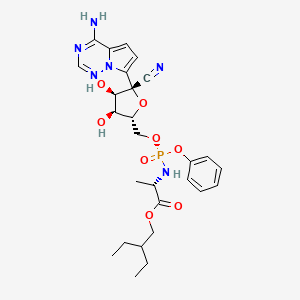
| Formula | C27H35N6O8P |
|---|---|
| Molecular weight | 602.59 g/mol |
| IUPAC name | 2-ethylbutyl (2S)-2-[[[(2R,3S,4R,5R)-5-(4-aminopyrrolo[2,1-f][1,2,4]triazin-7-yl)-5-cyano-3,4-dihydroxyoxolan-2-yl]methoxy-phenoxyphosphoryl]amino]propanoate |
| CAS | 1809249-37-3 |
| PubChem CID | 121304016 |
| InChIKey | RWWYLEGWBNMMLJ-YSOARWBDSA-N |
| logP | 2.31 (XLogP 1.9) |
| Polar surface area | 203.55 Ų |
| H-bond acceptors / donors | 13 / 4 |
| Drug-likeness (QED) | 0.16 |
| Lipinski violations | 2 |
SMILES
CCC(CC)COC(=O)[C@H](C)N[P@](=O)(OC[C@H]1O[C@@](C#N)(c2ccc3c(N)ncnn23)[C@H](O)[C@@H]1O)Oc1ccccc1Biology & Pharmacokinetics
Pharmacokinetics predicted
| Bioavailability | 70.0% |
|---|---|
| Half-life | 4.564 h |
| Volume of distribution | 0.736 L/kg |
| Protein binding | 74.3% |
| BBB penetrant | No |
Enzyme interactions
| Enzyme | Role | Detail |
|---|---|---|
| CYP2B6 | Inhibitor | — |
Transporters
BCRP (Inhibitor)BSEP (Inhibitor)BSEP (Inhibitor)MATE1 (Inhibitor)MRP1 (Inhibitor)NTCP (Inhibitor)OAT3 (Inhibitor)OATP1B1 (Inhibitor)OATP1B1 (Inhibitor)OATP1B3 (Inhibitor)OATP1B3 (Inhibitor)OCT1 (Inhibitor)P-gp (Inhibitor)MDR1 (Substrate)OATP1B1 (Substrate)P-gp (Substrate)
Drug–drug interactions (100+, DDInter)
| Interacting drug | Severity | Management |
|---|---|---|
| Chloroquine | major | |
| Hydroxychloroquine | major | |
| Abemaciclib | moderate | |
| Abiraterone | moderate | |
| Acarbose | moderate | |
| Acitretin | moderate | |
| Acyclovir | moderate | |
| Afatinib | moderate | |
| Aldesleukin | moderate | |
| Alectinib | moderate | |
| Amikacin | moderate | |
| Amikacin (liposome) | moderate | |
| Amphotericin B | moderate | |
| Amphotericin B (cholesteryl sulfate) | moderate | |
| Amphotericin B (lipid complex) | moderate | |
| Amphotericin B (liposomal) | moderate | |
| Apalutamide | moderate | |
| Asparaginase Escherichia coli | moderate | |
| Atovaquone | moderate | |
| Axitinib | moderate | |
| Bacitracin | moderate | |
| Balsalazide | moderate | |
| Belinostat | moderate | |
| Bexarotene | moderate | |
| Bicalutamide | moderate | |
| Binimetinib | moderate | |
| Blinatumomab | moderate | |
| Bortezomib | moderate | |
| Bosutinib | moderate | |
| Brentuximab vedotin | moderate | |
| Bupropion | moderate | |
| Carboplatin | moderate | |
| Carfilzomib | moderate | |
| Carmustine | moderate | |
| Celecoxib | moderate | |
| Ceritinib | moderate | |
| Chenodeoxycholic acid | moderate | |
| Cisplatin | moderate | |
| Clarithromycin | moderate | |
| Clofarabine | moderate |
Showing 40 of 100+.
Registered Products (1)
| Brand | Form / strength | Pack | Agent | Citizen (JOD) |
|---|---|---|---|---|
| Veklury | Vial 100 mg VIL | one vial | Beta Drug Store | — |