Bosentan
JFDA label: Tracleer 62.5mg
- Distribution program:
- Hepatotoxicity:
- Embryo-fetal toxicity:
Mechanism of Action
Antagonist of Endothelin receptor, ET-A/ET-B — Endothelin receptor, ET-A/ET-B antagonist
| Target | Action | Gene / class |
|---|---|---|
| Endothelin receptor, ET-A/ET-B efficacy | ANTAGONIST |
Indications
Approved
- Pulmonary arterial hypertension
Off-label
- Prevention of digital ulcers in systemic sclerosis
- Raynaud phenomenon in systemic sclerosis
Contraindications
Source: Lexicomp
- Additional contraindications (not in US labeling): Moderate to severe hepatic impairment (eg, ALT or AST >3 times ULN, particularly when total bilirubin >2 times ULN) Absolute
- Hypersensitivity to bosentan or any component of the formulation Absolute
- concurrent use of cyclosporine or glyburide Absolute
- use in women who are or may become pregnant Absolute
Adverse Reactions
Cardiac disorders (6)
Very Common Edema
Common Chest pain · flushing · hypotension · palpitations · syncope
Nervous system disorders (1)
Very Common Headache
Hepatobiliary disorders (2)
Very Common Increased serum ALT · increased serum AST
Blood and lymphatic system disorders (1)
Common Anemia
Metabolism and nutrition disorders (1)
Common Fluid retention
Musculoskeletal and connective tissue disorders (1)
Common Arthralgia
Respiratory, thoracic and mediastinal disorders (2)
Very Common Respiratory tract infection
Common Sinusitis
Dosing
Source: Lexicomp
Warnings & Precautions
Source: Lexicomp
Fluid retention/peripheral edema
Development of peripheral edema due to treatment and/or disease state (pulmonary arterial hypertension) may occur. There have also been postmarketing reports of fluid retention requiring treatment (eg, diuretics, fluid management, hospitalization) for heart failure. If clinically significant fluid retention develops (with or without weight gain), further evaluation is necessary to determine cause and appropriate treatment or discontinuation of therapy. Use with caution in patients with underlying heart failure due to potential complications from fluid retention. In a scientific statement from the American Heart Association, bosentan has been determined to be an agent that may exacerbate underlying myocardial dysfunction (magnitude: major) (AHA [Page 2016]).
Hematologic effects
Dose-related decreases in hematocrit/hemoglobin may be observed, usually within the first few weeks of therapy with subsequent stabilization of levels by 4 to 12 weeks of treatment. Monitor hemoglobin prior to treatment initiation, after 1 and 3 months, and every 3 months thereafter. Significant decreases in hemoglobin require further evaluation to determine the cause and specific management.
Hepatotoxicity
Bosentan is associated with transaminase elevations (ALT or AST ≥3 times ULN), and in a small number of cases may occur with elevations in bilirubin. Monitor transaminases at baseline then monthly thereafter. Adjust dosage if elevations in liver enzymes occur without symptoms of hepatic injury or elevated bilirubin. In the postmarketing surveillance (with close monitoring), there have been rare cases of unexplained hepatic cirrhosis after prolonged therapy (>12 months) in patients with multiple comorbidities and drug therapies. There have also been cases of hepatic failure. Treatment should be stopped in patients who develop elevated transaminases either in combination with symptoms of hepatic injury (unusual fatigue, jaundice, nausea, vomiting, abdominal pain, and/or fever) or elevated bilirubin (≥2 times ULN); safety of reintroduction is unknown. Avoid use in patients with baseline serum transaminases >3 times ULN at baseline (monitoring for hepatotoxicity may be more difficult) or moderate to severe hepatic impairment. The combination of hepatocellular injury (transaminase elevations >3 times ULN) and bilirubin increased ≥2 times ULN are a marker for potential serious hepatotoxicity. Transaminase elevations are dose dependent, generally asymptomatic, occur both early and late in therapy, progress slowly, and are usually reversible after treatment interruption or discontinuation. Transaminase elevations may also spontaneously reverse while continuing bosentan treatment. Con
Hypersensitivity
Hypersensitivity reactions, including Drug Reaction with Eosinophilia and Systemic Symptoms (DRESS), anaphylaxis, rash and angioedema have been observed.
Spermatogenesis
Decreased sperm counts have been observed in men during treatment; bosentan may have an adverse effect on spermatogenesis.
Pulmonary veno-occlusive disease
If signs of pulmonary edema occur, consider possibility of pulmonary veno-occlusive disease; may require discontinuation of bosentan. Concurrent drug therapy issues:
Drug-drug interactions
Potentially significant interactions may exist, requiring dose or frequency adjustment, additional monitoring, and/or selection of alternative therapy. Consult drug interactions database for more detailed information. Special populations:
Pregnancy
Bosentan is likely to cause major birth defects if used by pregnant women based on animal data. Therefore, pregnancy must be excluded before the start of treatment with bosentan. Throughout treatment and for 1 month after stopping bosentan, women of childbearing potential must use 2 reliable methods of contraception unless the patient has an intrauterine device (IUD) or tubal sterilization in which case no other contraception is needed. Hormonal contraceptives, including oral, injectable, transdermal, and implantable contraceptives, should not be used as the sole means of contraception because these may not be effective in patients receiving bosentan. Obtain monthly pregnancy tests. Other warnings/precautions:
REMS program
Because of the risks of hepatotoxicity and birth defects, bosentan is only available through the Tracleer REMS Program. The Tracleer REMS Program is a component of the bosentan Risk Evaluation and Mitigation Strategy (REMS). Patients, prescribers, and pharmacies must enroll with the program. Call 1-866-228-3546 or visit http://www.tracleer.com/hcp/prescribing-tracleer.asp for more information.
Pregnancy & Lactation
Pregnancy
Contraindicated
Monthly pregnancy tests and two forms of contraception required due to teratogenic potential
Lactation
It is not known if bosentan is present in breast milk. Due to the potential for serious adverse reactions in the breastfed infant, breastfeeding is not recommended by the manufacturer.
Monitoring
| Clinical pearl | Serum transaminase (AST and ALT) and bilirubin (prior to treatment initiation and monthly thereafter, or more frequently if clinically necessary [every 2 weeks following transaminase elevations and 3 days after reintroducing therapy if withheld due to transaminase elevations]). Hemoglobin and hematocrit (at baseline, at 1 month and 3 months of treatment, and every 3 months thereafter [generally stabilizes after 4 to 12 weeks of treatment]). Pregnancy test in women of childbearing potential (prior to the initiation of therapy, monthly during treatment, and one month after stopping bosentan). Monitor for clinical signs/symptoms of liver injury (eg, abdominal pain, fatigue, fever, jaundice, nausea, vomiting) and fluid retention. |
|---|
Chemistry & Properties
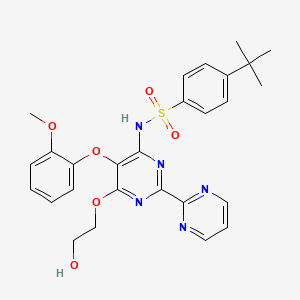
| Formula | C27H29N5O6S |
|---|---|
| Molecular weight | 551.63 g/mol |
| IUPAC name | 4-tert-butyl-N-[6-(2-hydroxyethoxy)-5-(2-methoxyphenoxy)-2-pyrimidin-2-ylpyrimidin-4-yl]benzenesulfonamide |
| CAS | 147536-97-8 |
| PubChem CID | 104865 |
| InChIKey | GJPICJJJRGTNOD-UHFFFAOYSA-N |
| logP | 4.2 (XLogP 3.8) |
| Polar surface area | 145.65 Ų |
| H-bond acceptors / donors | 10 / 2 |
| Drug-likeness (QED) | 0.29 |
| Lipinski violations | 1 |
SMILES
COc1ccccc1Oc1c(NS(=O)(=O)c2ccc(C(C)(C)C)cc2)nc(-c2ncccn2)nc1OCCOBiology & Pharmacokinetics
Pharmacokinetics
| BBB penetrant | No |
|---|
Enzyme interactions
| Enzyme | Role | Detail |
|---|---|---|
| CYP2C19 | Inhibitor | — |
| CYP2C8 | Inhibitor | — |
| CYP2C9 | Inhibitor | — |
| CYP2C9 | Substrate | — |
| CYP3A4 | Inhibitor | — |
| CYP3A4 | Substrate | — |
Receptor binding (top 1)
| Target | Action | Affinity |
|---|---|---|
| ETB receptor (EDNRB) | Antagonist | pKi 7.1 |
Transporters
BCRP (Inhibitor)BSEP (Inhibitor)BSEP (Inhibitor)MDR1 (Inhibitor)MRP1 (Inhibitor)MRP2 (Inhibitor)MRP3 (Inhibitor)MRP4 (Inhibitor)NTCP (Inhibitor)OAT (Inhibitor)OATP (Inhibitor)OATP1B1 (Inhibitor)OATP1B1 (Inhibitor)OATP1B3 (Inhibitor)OATP1B3 (Inhibitor)P-gp (Inhibitor)Transporter(unspecified) (Inhibitor)MDR1 (Substrate)OATP (Substrate)OATP1B1 (Substrate)OATP1B3 (Substrate)OATP2B1 (Substrate)P-gp (Substrate)Transporter(unspecified) (Substrate)
Drug–drug interactions (100+, DDInter)
| Interacting drug | Severity | Management |
|---|---|---|
| Axitinib | major | |
| Bosutinib | major | |
| Brigatinib | major | |
| Cobicistat | major | |
| Cobimetinib | major | |
| Cyclosporine | major | |
| Deflazacort | major | |
| Encorafenib | major | |
| Entrectinib | major | |
| Ethinylestradiol | major | |
| Fedratinib | major | |
| Glasdegib | major | |
| Glyburide | major | |
| Hydrocodone | major | |
| Leflunomide | major | |
| Lorlatinib | major | |
| Medroxyprogesterone acetate | major | |
| Neratinib | major | |
| Olaparib | major | |
| Siponimod | major | |
| Sonidegib | major | |
| Teriflunomide | major | |
| Venetoclax | major | |
| Abemaciclib | moderate | |
| Acalabrutinib | moderate | |
| Acetohexamide | moderate | |
| Albendazole | moderate | |
| Alpelisib | moderate | |
| Apalutamide | moderate | |
| Apixaban | moderate | |
| Apremilast | moderate | |
| Aprepitant | moderate | |
| Artemether | moderate | |
| Asparaginase Escherichia coli | moderate | |
| Astemizole | moderate | |
| Betamethasone | moderate | |
| Brentuximab vedotin | moderate | |
| Brimonidine (ophthalmic) | moderate | |
| Brimonidine (topical) | moderate | |
| Busulfan | moderate |
Showing 40 of 100+.
Registered Products (9)
| Brand | Form / strength | Pack | Agent | Citizen (JOD) |
|---|---|---|---|---|
| Bosentas 62.5 | Tablet 62.5 mg | 14 tab | ORIENT DRUG STORE CO | 9.830 |
| Bosentas 125 | Tablet 125 mg | 14 tab | ORIENT DRUG STORE CO | 16.120 |
| Gonista | Film-Coated Tablet 125.0 mg | 56 F.C Tab pack varies | UNITED PHARM.MFG.CO.LTD(UPM)/JORDAN | — |
| Gonista | Film-Coated Tablet 62.5 mg | 60 F.C Tab | UNITED PHARM.MFG.CO.LTD(UPM)/JORDAN | — |
| Gonista | Film-Coated Tablet 125.0 mg | 60 F.C Tab pack varies | UNITED PHARM.MFG.CO.LTD(UPM)/JORDAN | — |
| Pahex | Tablet 62.5 mg | 56 tab | Sun Set Drug Store | — |
| Pahex | Tablet 125 mg | 56 tab | Sun Set Drug Store | — |
| Tracleer | Tablet 62.5 mg | 56 tab | Shawi & Rushedat Drug Store | — |
| Tracleer | Tablet 125 mg | 56 tab | Shawi & Rushedat Drug Store | — |