Propranolol
JFDA label: Indicardin Tablets
- Cardiac ischemia after abrupt discontinuation (Inderal LA, Inderal XL, Innopran XL):
Mechanism of Action
Nonselective beta-adrenergic blocker (class II antiarrhythmic); competitively blocks response to beta1- and beta2-adrenergic stimulation which results in decreases in heart rate, myocardial contractility, blood pressure, and myocardial oxygen demand. Nonselective beta-adrenergic blockers (propranolol, nadolol) reduce portal pressure by producing splanchnic vasoconstriction (beta2 effect) thereby reducing portal blood flow.
Indications
Approved
- Chronic kidney disease (CKD) and hypertension
- Coronary artery disease (CAD) and hypertension
- Hypertension
Off-label
- Akathisia, antipsychotic-induced
- Performance anxiety
- Tetralogy of Fallot (TOF) hypercyanotic spells
- Thyroid storm
- Thyrotoxicosis
- Thyrotoxicosis/thyroid storm (pediatric patients)
- Tremor, lithium-induced
- Variceal hemorrhage (prophylaxis)
Contraindications
Source: Lexicomp · Curated
- Additional contraindications (not in US labeling): Cor pulmonale Absolute
- Hypersensitivity to propranolol, beta-blockers, or any component of the formulation Absolute
- Severe reactive airway disease (may precipitate life-threatening bronchospasm) Absolute
- Uncompensated heart failure Absolute
- allergic rhinitis during pollen season Absolute
- bronchial asthma Hemangeol (additional contraindications): Premature infants with corrected age Absolute
- hypotension (blood pressure parameters not specified in labeling) Absolute
- metabolic acidosis Absolute
- patients prone to hypoglycemia Absolute
- severe peripheral arterial circulatory disturbance Hemangiol (additional contraindications): Infants weighing Absolute
- severe sinus bradycardia, sick sinus syndrome, or heart block greater than first-degree (except in patients with a functioning artificial pacemaker) Absolute
- uncompensated congestive heart failure (unless the failure is due to tachyarrhythmias being treated with propranolol), cardiogenic shock Absolute
- vasospastic angina (also referred to as Prinzmetal angina or variant angina) Absolute
Adverse Reactions
Cardiac disorders (10)
Common Bradycardia
Not Known angina pectoris · atrioventricular conduction disturbance · bradycardia · cardiac failure · cardiogenic shock · Cold extremities · hypotension · ineffective myocardial contractions · syncope
Vascular disorders (1)
Common Cold extremities
Nervous system disorders (17)
Not Known agitation · amnesia · carpal tunnel syndrome (rare) · catatonia · cognitive dysfunction · confusion · dizziness · drowsiness · fatigue · hypersomnia · irritability · lethargy · nightmares · paresthesia · psychosis · Sleep disorder · vertigo
Hepatobiliary disorders (2)
Not Known Increased serum alkaline phosphatase · increased serum transaminases
Renal and urinary disorders (4)
Not Known Increased blood urea nitrogen · interstitial nephritis (rare) · Oliguria (rare) · proteinuria (rare)
Blood and lymphatic system disorders (2)
Not Known Immune thrombocytopenia · thrombocytopenia
Metabolism and nutrition disorders (4)
Not Known Hyperglycemia · hyperkalemia · hyperlipidemia · hypoglycemia
Gastrointestinal disorders (6)
Not Known abdominal pain · anorexia · constipation · decreased appetite · Diarrhea · stomach discomfort
Skin and subcutaneous tissue disorders (8)
Not Known Changes in nails · contact dermatitis · dermal ulcer · eczematous rash · erosive lichen planus · hyperkeratosis · pruritus · skin rash
Musculoskeletal and connective tissue disorders (3)
Not Known Arthropathy · oculomucocutaneous syndrome · polyarthritis
Psychiatric disorders (2)
Common Sleep disturbance / nightmares
Uncommon Depression
Eye disorders (3)
Not Known Conjunctival hyperemia · decreased visual acuity · mydriasis
Reproductive system and breast disorders (1)
Common Erectile dysfunction
General disorders and administration site conditions (2)
Very Common Fatigue
Not Known Ulcer
Respiratory, thoracic and mediastinal disorders (7)
Uncommon Bronchospasm
Not Known bronchiolitis (infants; associated with cough, fever, diarrhea, and vomiting) · Bronchitis · bronchospasm · dyspnea · pulmonary edema · wheezing
Dosing
Source: Lexicomp
Warnings & Precautions
Source: Lexicomp
Anaphylactic reactions
Use caution with history of severe anaphylaxis to allergens; patients taking beta-blockers may become more sensitive to repeated challenges. Treatment of anaphylaxis (eg, epinephrine) in patients taking beta-blockers may be ineffective or promote undesirable effects. Disease-related concerns:
Bronchospastic disease
In general, patients with bronchospastic disease should not receive beta-blockers; if used at all, should be used cautiously with close monitoring.
Conduction abnormality
Consider pre-existing conditions such as sick sinus syndrome before initiating.
Diabetes
Use with caution in patients with diabetes mellitus; may potentiate hypoglycemia and/or mask signs and symptoms.
Heart failure (HF)
Use with caution in patients with compensated HF and monitor for a worsening of the condition (efficacy of propranolol in HF has not been demonstrated).
Hepatic impairment
Use with caution in patients with hepatic impairment; dosage adjustment may be required.
Myasthenia gravis
Use with caution in patients with myasthenia gravis.
Peripheral vascular disease (PVD) and Raynaud's disease
Can precipitate or aggravate symptoms of arterial insufficiency in patients with PVD and Raynaud's disease. Use with caution and monitor for progression of arterial obstruction.
Pheochromocytoma (untreated)
Adequate alpha-blockade is required prior to use of any beta-blocker.
Prinzmetal variant angina
Beta-blockers without alpha1-adrenergic receptor blocking activity should be avoided in patients with Prinzmetal variant angina since unopposed alpha1-adrenergic receptors mediate coronary vasoconstriction and can worsen anginal symptoms (Mayer 1998).
Psoriasis
Beta-blocker use has been associated with induction or exacerbation of psoriasis, but cause and effect have not been firmly established.
Psychiatric disease
Use with caution in patients with a history of psychiatric illness; may cause or exacerbate CNS depression.
Renal impairment
Use with caution in patients with renal impairment; may have increased side effects.
Thyroid disease
May mask signs of hyperthyroidism (eg, tachycardia). If thyrotoxicosis is suspected, carefully manage and monitor; abrupt withdrawal may exacerbate symptoms of hyperthyroidism or precipitate thyroid storm. Alterations in thyroid function tests may be observed. Concurrent drug therapy issues:
Drug-drug interactions
Potentially significant interactions may exist, requiring dose or frequency adjustment, additional monitoring, and/or selection of alternative therapy. Consult drug interactions database for more detailed information. Special populations:
Infants and children
Considerations when treating infantile hemangioma: - Cardiovascular concerns: Bradycardia and/or hypotension may occur or be worsened; monitor heart rate and blood pressure after propranolol initiation or increase in dose; discontinue treatment if severe (- Hypoglycemia: May potentiate hypoglycemia and/or mask signs and symptoms. Withhold the dose in infants or children who are not feeding regularly or who are vomiting; discontinue therapy and seek immediate treatment if hypoglycemia occurs. - Respiratory concerns: May cause bronchospasm. Interrupt therapy in infants or children with lower respiratory tract infection associated with dyspnea or wheezing.
Elderly
Bradycardia may be observed more frequently in elderly patients (>65 years of age); dosage reductions may be necessary. Smokers: Cigarette smoking may decrease plasma levels of propranolol by increasing metabolism. Patients should be advised to avoid smoking. Other warnings/precautions:
Abrupt withdrawal
Beta-blocker therapy should not be withdrawn abruptly (particularly in patients with CAD), but gradually tapered to avoid acute tachycardia, hypertension, and/or ischemia. Severe exacerbation of angina, ventricular arrhythmias, and myocardial infarction (MI) have been reported following abrupt withdrawal of beta-blocker therapy. Temporary but prompt resumption of beta-blocker therapy may be indicated with worsening of angina or acute coronary insufficiency.
Major surgery
Chronic beta-blocker therapy should not be routinely withdrawn prior to major surgery.
Pregnancy & Lactation
Pregnancy
Caution
Labetalol preferred for hypertension. Propranolol still used for thyrotoxicosis control in T1 before carbimazole effect achieved
Lactation
Propranolol is present in breast milk. The relative infant dose (RID) of propranolol is 1% when calculated using the highest breast milk concentration located and compared to an infant therapeutic dose of 1 mg/kg/day. In general, breastfeeding is considered acceptable when the RID is 25% breastfeeding should generally be avoided (Anderson 2016; Ito 2000). Using the highest milk concentration (0.075 mcg/mL), the estimated daily infant dose via breast milk is 11.25 mcg/kg/day. This milk concentr
Monitoring
| Clinical pearl | Acute cardiac treatment: Monitor ECG, heart rate, and blood pressure with IV administration; heart rate and blood pressure with oral administration Consult individual institutional policies and procedures. Hemangeol: Monitor heart rate and blood pressure for 2 hours after initiation or dose increases. |
|---|
Chemistry & Properties
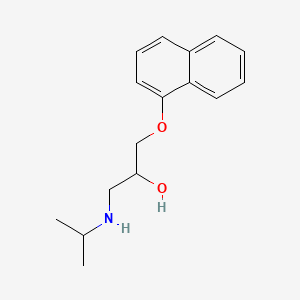
| Formula | C16H21NO2 |
|---|---|
| Molecular weight | 259.35 g/mol |
| IUPAC name | 1-naphthalen-1-yloxy-3-(propan-2-ylamino)propan-2-ol |
| CAS | 525-66-6 |
| PubChem CID | 4946 |
| InChIKey | AQHHHDLHHXJYJD-UHFFFAOYSA-N |
| logP | 2.58 (XLogP 3.0) |
| Polar surface area | 41.49 Ų |
| H-bond acceptors / donors | 3 / 2 |
| Drug-likeness (QED) | 0.84 |
| Lipinski violations | 0 |
SMILES
CC(C)NCC(O)COc1cccc2ccccc12Biology & Pharmacokinetics
Pharmacokinetics
| BBB penetrant | Yes (logBB 0.64) |
|---|
Enzyme interactions
| Enzyme | Role | Detail |
|---|---|---|
| CYP1A2 | Inhibitor | IC₅₀ 4.000000000000001 µM |
| CYP1A2 | Substrate | — |
| CYP2C19 | Substrate | — |
| CYP2D6 | Inhibitor | IC₅₀ 2.670511575118003 µM |
| CYP2D6 | Substrate | — |
| CYP3A4 | Substrate | — |
Receptor binding (top 2)
| Target | Action | Affinity |
|---|---|---|
| 5-HT1B (HTR1B) | Binding | pKi 6.3 |
| HISTAMINE H1 (HRH1) | Binding | pKi 5.2 |
Transporters
BCRP (Inhibitor)BCRP (Inhibitor)BSEP (Inhibitor)BSEP (Inhibitor)MATE1 (Inhibitor)MDR1 (Inhibitor)MRP1 (Inhibitor)MRP2 (Inhibitor)MRP3 (Inhibitor)NTCP (Inhibitor)OATP1B1 (Inhibitor)OATP1B1 (Inhibitor)OATP1B3 (Inhibitor)OATP1B3 (Inhibitor)OATP2B1 (Inhibitor)OCT1 (Inhibitor)OCT2 (Inhibitor)OCT3 (Inhibitor)OCTN2 (Inhibitor)P-gp (Inhibitor)BCRP (Substrate)MCT1 (Substrate)MDR1 (Substrate)MRP (Substrate)OATP1B3 (Substrate)OATP2B1 (Substrate)OCT1 (Substrate)OCT2 (Substrate)P-gp (Substrate)Transporter(unspecified) (Substrate)
Drug–drug interactions (100+, DDInter)
| Interacting drug | Severity | Management |
|---|---|---|
| Aminophylline | major | |
| Ceritinib | major | |
| Dolasetron | major | |
| Dyphylline | major | |
| Epinephrine | major | |
| Fingolimod | major | |
| Formoterol | major | |
| Indacaterol | major | |
| Iobenguane (I-131) | major | |
| Methacholine | major | |
| Olodaterol | major | |
| Orciprenaline | major | |
| Oxtriphylline | major | |
| Pirbuterol | major | |
| Salbutamol | major | |
| Salmeterol | major | |
| Siponimod | major | |
| Terbutaline | major | |
| Theophylline | major | |
| Vilanterol | major | |
| Abiraterone | moderate | |
| Acetohexamide | moderate | |
| Aldesleukin | moderate | |
| Alectinib | moderate | |
| Alimemazine | moderate | |
| Amifostine | moderate | |
| Anagrelide | moderate | |
| Apalutamide | moderate | |
| Atropine | moderate | |
| Betamethasone | moderate | |
| Brigatinib | moderate | |
| Brimonidine (ophthalmic) | moderate | |
| Brimonidine (topical) | moderate | |
| Budesonide | moderate | |
| Bupropion | moderate | |
| Calcium Phosphate | moderate | |
| Calcium acetate | moderate | |
| Calcium carbonate | moderate | |
| Calcium citrate | moderate | |
| Calcium glubionate anhydrous | moderate |
Showing 40 of 100+.
Registered Products (6)
| Brand | Form / strength | Pack | Agent | Citizen (JOD) |
|---|---|---|---|---|
| Indicardin Tablets | Tablet 10 mg | 50 tab pack varies | The Arab Pharmaceutical Manufacturing PSC/Salt | 0.990 |
| Indicardin Tablets | Tablet 40 mg | 5x10s pack varies | The Arab Pharmaceutical Manufacturing PSC/Salt | 1.940 |
| Indicardin Tablets | Tablet 10 mg | 1000 tab pack varies | The Arab Pharmaceutical Manufacturing PSC/Salt | 16.830 |
| Indicardin Tablets | Tablet 40 mg | 1000 tab pack varies | The Arab Pharmaceutical Manufacturing PSC/Salt | 32.260 |
| Pranol | Ampoule 1 mg/ml | 6 amp | Hikma Pharmaceuticals Co.Ltd/Jordan | — |
| Pranol | Ampoule 5 mg/5 ml | 5 amp | Hikma Pharmaceuticals Co.Ltd/Jordan | — |