Levodopa
Active form: Dopamine.
JFDA label: CREDANIL TABS
Mechanism of Action
Agonist of D(3) dopamine receptor — Dopamine D3 receptor agonist
| Target | Action | Gene / class |
|---|---|---|
| D(3) dopamine receptor efficacy | AGONIST | DRD3 |
Indications
Approved
- Parkinson disease
Contraindications
Source: Lexicomp
- Hypersensitivity to benserazide, levodopa, or any component of the formulation Absolute
- angle-closure glaucoma Absolute
- clinical or laboratory evidence of decompensated cardiovascular, endocrine, renal, hepatic, hematologic, or pulmonary disease Absolute
- psychiatric diseases with a psychotic component Absolute
- use with or within 14 days of MAO inhibitors Absolute
- when administration of a sympathomimetic amine (eg, epinephrine, norepinephrine, isoproterenol) is contraindicated Absolute
Adverse Reactions
Cardiac disorders (9)
Not Known Arrhythmias · chest pain · ECG changes (nonspecific) · edema · flushing · hypertension · orthostatic hypotension · pallor · phlebitis
Nervous system disorders (32)
Not Known Agitation · anxiety · ataxia · bruxism · confusion · delusions · dementia · depression · dopamine dysregulation syndrome · euphoria · faintness · fatigue · fever · gait abnormalities · hallucinations (mostly visual) · headache · impulse control symptoms (including pathological gambling) · insomnia · lethargy · malaise · neuroleptic malignant-like syndrome · nightmares · oculogyric crisis · on-off phenomena · paranoid ideation · psychotic episodes · sedation · seizures · somnolence · suicidal tendencies/behavior · temporal disorientation · trismus
Hepatobiliary disorders (4)
Not Known Alkaline phosphatase increased · bilirubin increased · LDH increased · transaminases increased
Renal and urinary disorders (6)
Not Known BUN increased · Discoloration of urine · hematuria · nocturia · urinary frequency · urinary retention or incontinence
Blood and lymphatic system disorders (5)
Not Known Agranulocytosis · hemolytic anemia (rare) · leukopenia (transient) · Positive Coombs' test · thrombocytopenia
Metabolism and nutrition disorders (3)
Not Known Libido increased · protein-bound iodine increased · uric acid increased
Gastrointestinal disorders (17)
Not Known Abdominal distress or pain · anorexia · burning sensation on tongue · constipation · diarrhea · duodenal ulcer · dysphagia · epigastric pain · eructation · flatulence · GI bleeding · nausea · sialorrhea · taste alterations · vomiting · weight gain/loss · xerostomia
Skin and subcutaneous tissue disorders (3)
Not Known Alopecia · pruritus · rash
Musculoskeletal and connective tissue disorders (11)
Not Known Akinesia paradoxica · choreiform and involuntary movements · dystonia · end-of-dose akinesia · hand tremor · low back pain · muscle spasm and twitching · musculoskeletal pain · numbness · torticollis · weakness
Eye disorders (5)
Not Known Activation of latent Horner's syndrome · blepharospasm · blurred vision · diluted pupils · diplopia
General disorders and administration site conditions (5)
Not Known Diaphoresis · discoloration of sweat · hiccups · hypersensitivity reactions · lip/mouth/tongue tightness
Respiratory, thoracic and mediastinal disorders (4)
Not Known Bizarre breathing pattern · cough · hoarseness · postnasal drip
Dosing
Source: Lexicomp
Warnings & Precautions
Source: Lexicomp
CNS effects
[Canadian Boxed Warning]: Patients have reported falling asleep while engaging in activities of daily living including the driving of a car; in some cases, these events have occurred without significant warning signs. Monitor for daytime somnolence or preexisting sleep disorder; discontinue if significant daytime sleepiness or episodes of falling asleep occur. Patients must be cautioned about performing tasks which require mental alertness (eg, operating machinery or driving). Use with caution in patients receiving other CNS depressants or psychoactive agents. Effects with other sedative drugs or ethanol may be potentiated.
Hypersensitivity
Hypersensitivity reactions may occur in susceptible patients.
Impulse control disorders
Dopamine agonists used for Parkinson disease or restless legs syndrome have been associated with compulsive behaviors and/or loss of impulse control, which has manifested as pathological gambling, libido increases (hypersexuality), and/or binge eating. Causality has not been established, and controversy exists as to whether this phenomenon is related to the underlying disease, prior behaviors/addictions and/or drug therapy. Dose reduction or discontinuation of therapy has been reported to reverse these behaviors in some, but not all cases.
Increased growth hormone levels
May increase human growth hormone levels.
Melanoma
Risk for melanoma development is increased in Parkinson disease patients; drug causation or factors contributing to risk have not been established. Patients should be monitored closely and periodic skin examinations should be performed. Disease-related concerns:
Cardiovascular disease
Use with caution in patients with cardiovascular disease (MI, atrial, nodal, or ventricular arrhythmias); initiate in a monitored setting. Use is contraindicated in decompensated cardiovascular disease.
Diabetes
Use with caution in patients with diabetes mellitus; monitor blood glucose frequently. Antidiabetic agents may require dose adjustment.
Glaucoma
Use with caution in patients with chronic wide-angle glaucoma; monitor IOP carefully. Use is contraindicated in patients with angle-closure glaucoma.
Hepatic impairment
Use with caution in patients with hepatic impairment. Use is contraindicated in decompensated hepatic disease.
Peptic ulcer disease
Use with caution in patients with peptic ulcer disease.
Psychotic disorders
Use with extreme caution in patients with a history of psychotic disorders; observe patients closely for development of depression with concomitant suicidal tendencies. May also cause hallucinations and confusion.
Renal impairment
Use with caution in patients with renal impairment. Use is contraindicated in decompensated renal disease.
Seizure disorder
Use with caution in patients with a history of seizure disorder. Concurrent drug therapy issues:
Drug-drug interactions
Potentially significant interactions may exist, requiring dose or frequency adjustment, additional monitoring, and/or selection of alternative therapy. Consult drug interactions database for more detailed information. Special populations:
Elderly
Use with caution in the elderly; may be more sensitive to CNS effects of levodopa.
Perioperative patients
Continue therapy as close to surgical procedures as possible in patients requiring general anesthesia (excluding halothane-risk of blood pressure fluctuations and/or arrhythmias; discontinue benserazide/levodopa 12 to 48 hours before procedure); resume therapy postoperatively with a gradual increase in dose up to that established preoperatively.
Young adults
Use is contraindicated in patients Other warnings/precautions:
Abuse
May induce dopaminergic dysregulation syndrome resulting in excessive use of levodopa/benserazide beyond prescribed doses, particularly in males with early onset Parkinson disease (Giovannoni 2000); may lead to cognitive and behavioral disturbances. Monitor for excessive use if cognitive/behavioral disturbances develop.
Appropriate use
Not indicated in management of intention tremor, Huntington's chorea, or drug-induced extrapyramidal symptoms. Administer in careful increments and observe closely for development of abnormal involuntary movements.
Discontinuation of therapy
Avoid abrupt withdrawal of therapy; dopaminergic agents have been associated with a syndrome resembling neuroleptic malignant syndrome (NMS) on abrupt withdrawal or significant dosage reduction after long-term use. Withdraw therapy gradually and monitor closely; symptomatic patients should be treated appropriately and if necessary resumption of benserazide/levodopa therapy may be considered.
Pregnancy & Lactation
Pregnancy
Use is contraindicated during pregnancy and in women of childbearing potential without proper contraception. Adverse events have been observed with levodopa in animal reproduction studies. Levodopa crosses the placenta and can be metabolized by the fetus and detected in fetal tissue (Merchant 1995). The incidence of Parkinson disease in pregnancy is relatively rare and information related to the use of benserazide/levodopa in pregnant women is limited (Hagell 1998; von Graevenitz 1996). The manufacturer recommends that women who become pregnant during therapy gradually taper off therapy; avoid abrupt withdrawal.
Lactation
Levodopa is excreted into breast milk (based on a study using carbidopa/levodopa) (Thulin, 1998); excretion of benserazide is not known. Breast-feeding is not recommended by the manufacturer.
Monitoring
| Clinical pearl | Regular assessment of cardiovascular, hepatic, hematopoietic, and renal function with initiation and during dose stabilization then periodically with extended therapy; blood glucose frequently in patients with diabetes; symptoms of psychosis and dystonia |
|---|
Chemistry & Properties
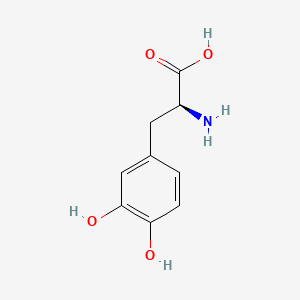
| Formula | C9H11NO4 |
|---|---|
| Molecular weight | 197.19 g/mol |
| IUPAC name | (2S)-2-amino-3-(3,4-dihydroxyphenyl)propanoic acid |
| CAS | 59-92-7 |
| PubChem CID | 6047 |
| InChIKey | WTDRDQBEARUVNC-LURJTMIESA-N |
| logP | 0.05 (XLogP -2.7) |
| Polar surface area | 103.78 Ų |
| H-bond acceptors / donors | 4 / 4 |
| Drug-likeness (QED) | 0.51 |
| Lipinski violations | 0 |
SMILES
N[C@@H](Cc1ccc(O)c(O)c1)C(=O)OBiology & Pharmacokinetics
Pharmacokinetics
| BBB penetrant | Yes (logBB -0.8) |
|---|
Enzyme interactions
| Enzyme | Role | Detail |
|---|---|---|
| CYP2C9 | Substrate | — |
| CYP2D6 | Substrate | — |
Transporters
BCRP (Inhibitor)BCRP (Inhibitor)BSEP (Inhibitor)BSEP (Inhibitor)MDR1 (Inhibitor)MRP1 (Inhibitor)MRP2 (Inhibitor)MRP4 (Inhibitor)OATP1B1 (Inhibitor)OATP1B1 (Inhibitor)OATP1B3 (Inhibitor)OATP1B3 (Inhibitor)OCT1 (Inhibitor)P-gp (Inhibitor)PEPT1 (Inhibitor)P-gp (Substrate)
Drug–drug interactions (100+, DDInter)
| Interacting drug | Severity | Management |
|---|---|---|
| Methylene blue | major | |
| Ozanimod | major | |
| Procarbazine | major | |
| Adalimumab | moderate | |
| Alimemazine | moderate | |
| Atropine | moderate | |
| Benznidazole | moderate | |
| Bortezomib | moderate | |
| Brentuximab vedotin | moderate | |
| Brimonidine (ophthalmic) | moderate | |
| Brimonidine (topical) | moderate | |
| Bupropion | moderate | |
| Cabazitaxel | moderate | |
| Carboplatin | moderate | |
| Carfilzomib | moderate | |
| Certolizumab pegol | moderate | |
| Chloramphenicol | moderate | |
| Chloroquine | moderate | |
| Cisplatin | moderate | |
| Clidinium | moderate | |
| Crizotinib | moderate | |
| Dapsone | moderate | |
| Diazoxide | moderate | |
| Dicyclomine | moderate | |
| Dinutuximab | moderate | |
| Diphenhydramine | moderate | |
| Disulfiram | moderate | |
| Docetaxel | moderate | |
| Elotuzumab | moderate | |
| Ephedrine | moderate | |
| Epinephrine | moderate | |
| Eribulin | moderate | |
| Etanercept | moderate | |
| Ethanol | moderate | |
| Etoposide | moderate | |
| Ferrous fumarate | moderate | |
| Ferrous gluconate | moderate | |
| Fludarabine | moderate | |
| Glycopyrronium | moderate | |
| Golimumab | moderate |
Showing 40 of 100+.
Registered Products (11)
| Brand | Form / strength | Pack | Agent | Citizen (JOD) |
|---|---|---|---|---|
| Sinemet | Tablet 250 mg, 25 mg | 20 tab | Adatco Drug Store | 5.000 |
| CREDANIL TABS | Tablet 250 mg, 25 mg | 50 tab | JAWEDA INT. DRUD STORE | 7.630 |
| Dopalevo 50,12.5,200 Film Tablet | Tablet Levodopa 50.000 mg, Carbidopa 12.5 mg, Entacapone 200.000 mg | 30 tab pack varies | Sun Set Drug Store | 13.710 |
| Stalevo 200/50/200 | Tablet 200 mg, 200 mg, 50 mg | 30 tab | Awtar Pharmaceutical Co | 14.770 |
| Stalevo Tab | Tablet 200 mg, 50 mg, 12.5 mg | 30 tab | Awtar Pharmaceutical Co | 14.770 |
| Stalevo Tab | Tablet 200 mg, 150 mg, 37.5 mg | 30 tab | Awtar Pharmaceutical Co | 14.770 |
| Stalevo Tab | Tablet 200 mg, 100 mg, 25 mg | 30 tab | Awtar Pharmaceutical Co | 14.770 |
| Cavida | Tablet 200 mg, 200 mg, 50 mg | 30 tab | UNITED PHARM.MFG.CO.LTD(UPM)/JORDAN | 19.590 |
| Cavida | Tablet 200 mg, 150 mg, 37.5 mg | 30 tab | UNITED PHARM.MFG.CO.LTD(UPM)/JORDAN | 19.590 |
| Cavida | Tablet 200 mg, 100 mg, 25 mg | 30 tab | UNITED PHARM.MFG.CO.LTD(UPM)/JORDAN | 19.590 |
| Dopalevo 50,12.5,200 Film Tablet | Tablet Levodopa 50.000 mg, Carbidopa 12.5 mg, Entacapone 200.000 mg | 100 tab pack varies | Sun Set Drug Store | 42.960 |